


“Increased on- and off-terminal capacity gives customers more options for moving refrigerated commodities to and from international markets,” said GPA Executive Director Curtis Foltz. “This additional infrastructure will strengthen Savannah’s position as the premier East Coast facility for refrigerated exports.”
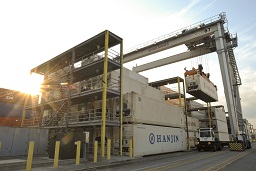
By adding 20 more racks, GPA will increase its refrigerated container rack slots by 480, for a total of 2,496 – a 28% increase in refrigerated container rack capacity. Counting 600 chassis plug-ins, Savannah’s total capacity will grow to 3,096 refrigerated boxes.
The Port of Savannah handles nearly 40 percent of the nation’s containerized poultry exports, and much of that cargo is supplied by Georgia growers. Supporting agribusiness is an important part of GPA’s mission. Farming accounts for more than $75 billion in total economic impact and employs more than 375,000 in Georgia. The Port of Savannah links our poultry, pecans, peanuts and blueberries to global buyers.
Refrigerated container racks have greatly increased the efficiency of frozen cargo handling at the Port of Savannah, making the operation much cleaner for the environment. Previously, diesel generators were used to power refrigerated containers in tandem with wheeled parking spots with electrical hookups. Today, for every 10 racks placed into service, the GPA avoids the use of about 540,000 gallons of diesel fuel annually, which would have been used to power diesel generators.
The additional racks approved by the GPA board will also allow the Port of Savannah to make room for the anticipated 4.5% growth rate for refrigerated cargo.
“We continue to experience high demand from existing customers wanting to move their distribution closer to the port,” said Ross Maple, Director of Business Strategy for Nordic Cold Storage. “Savannah’s additional racks will allow us to meet customer demands, as increases in exports are expected as poultry consumption worldwide continues to grow, while an increase in frozen imports is anticipated with the expansion of the Panama Canal.”