

Friday, December 12, 2025
spot_img
Home Blog Page 101

New inauguration of the Port of Kapellskär – five modern quay-berths and a larger port area

0

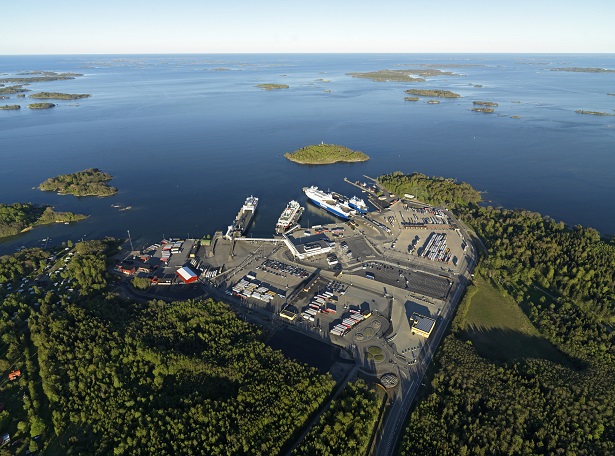
After more than 55 years as one of Sweden’s most significant freight ports, the Port of Kapellskär needed to be modernised and made more efficient. A three year port refurbishment and expansion project has now been completed, on time and within budget. The Port of Kapellskär is now ready to receive the vessel sizes and larger volumes of the future.

“The Port of Kapellskär is extremely important for trade along the East-West axis and for sustainable transport in the rapidly growing Stockholm region. Measured in length, more than three million meters-worth of goods are transported through the port annually. In addition, almost one million passengers pass through the port each year. Now finally the prerequisites are in place for traffic to grow even more,” says Stefan Hansson, Chair of the Board at Port of Stockholm.

The reconstructed port consists of 200 000 square metres of logistics area, an entirely new pier with two quay-berths, a newly renovated pier with two quay-berths and a reconstructed quay-berth. Following the reconstruction work the Port of Kapellskär now has five modern quay-berths. There is also a new pilot harbour adjacent to the south end of the port.

“This has been long-awaited. Both the traffic through the port and the vessel service traffic has expanded enormously at the Port of Kapellskär and there has been a great demand to expand capacity. Now we have modern facilities that can efficiently handle vessels, cargo and passengers,” says Peter Lundman, Technical Operations Manager at the Port of Kapellskär.

“The fact that we now have a modern, large capacity port for the upcoming 100 years is also very important for the development of the Municipality of Norrtälje. Sustainable transport is extremely important for the growing Stockholm region and shipping is an important piece of the jigsaw,” explains Ulrika Falk, Chair of the Municipal Board, Municipality of Norrtälje.

The electricity, water and waste management utilities at the Port of Kapellskär have also been modernised. It is important to be able to offer sustainable services and this is one path to achieving Ports of Stockholm’s sustainability targets.

The Port of Kapellskär is part of the Ports of Stockholm Group, which has ports in Stockholm, Nynäshamn and Kapellskär. The Port of Kapellskär is located around ninety kilometres north of Stockholm, close to the shipping fairways of the outer archipelago.

Shipping industry unites to propose amibitous CO2 reduction objectives

0

The IMO Marine Environment Protection Committee will meet in London this July to begin the development of a strategy for the reduction of the sector’s CO2 emissions aligning the international shipping sector response to the 2015 Paris Agreement’s call for ambitious contributions to combat climate change.

In a detailed submission, the industry bodies have proposed that IMO Member States should immediately adopt two Aspirational Objectives on behalf of the international shipping sector:
• To maintain international shipping’s annual total CO2 emissions below 2008 levels; and

• To reduce CO2 emissions per tonne of cargo transported one kilometre, as an average across international shipping, by at least 50% by 2050, compared to 2008.

In addition, the industry associations have suggested that IMO should give consideration to another possible objective of reducing international shipping’s total annual CO2 emissions, by an agreed percentage by 2050 compared to 2008, as a point on a continuing trajectory of further CO2 emissions reduction.
The industry associations assert that it is important for IMO to send a clear, unambiguous signal to the global community that shipping’s regulators have agreed to some ambitious objectives for reducing the sector’s CO2 emissions, in the same way that land-based activity is now covered by government commitments under the Paris Agreement.

The shipping industry wants IMO to remain in control of additional measures to address CO2 reduction by international shipping and to develop a global solution, rather than risk the danger of market-distorting measures at the national or regional level.

Importantly, acknowledging concerns of developing nations about the possible impacts of CO2 reduction for trade and sustainable development, the industry submission emphasises that any objectives adopted by IMO must not imply any commitment to place a binding cap on the sector’s total CO2 emissions or on the CO2 emissions of individual ships.

The industry associations also highlight that dramatic in-sector CO2 reductions alongside increasing trade would require substantial and sustained research into the development of alternative fossil-free fuels and new technologies – something which they say needs to be identified by the IMO strategy.

New Kent radar for Port of London Authority

0

The PLA is investing £1 million in replacing the existing Northfleet radar, located on Tarmac’s riverside office building, with a new 50-metre tall tower that will house the latest, energy efficient system. Tarmac’s Northfleet site is ideally located, offering excellent line of sight along two busy reaches of the Thames; they import more than half a million tonnes of cement through their berths every year.

PLA chief executive, Robin Mortimer, said: “A radar at this location is essential as it gives our port control team at Gravesend an eagle’s eye view of a complex, busy part of the river with a blind bend and very strong tidal flows. This part of the Thames is the heart of the commercial port, so our investment is keeping ships safe for cargo handling operations which generate over 40,000 jobs and economic value added of £4 billion a year.”

The Thames is home to 70 independently operated terminals, supplying the bulk of south-east’s vehicle and airport fuel, the country’s largest grain and forestry products terminals, and facilitating the shipping of food, household goods, steel, cars, waste, and construction aggregates.

Peter Steen, PLA director of marine operations added: “It is essential that we provide continuous oversight of the busy river that we look after. The new radar is an important part of this and will improve the overall resilience of our network of equipment including radar, CCTV, weather monitoring, pilotage sector lights and our microwave communications system.”

Breheny Civil Engineering has been contracted to install the tower installed over the next six months; PLA radar and communications equipment commissioning will follow.

Port of Kiel invests in a cleaner Baltic

0

The new facility, which cost well over EUR 1.8 million, serves as a model and increases current waste-water reception capability tenfold to as much as 300m³ an hour. Dr Dirk Claus, Managing Director of the Port of Kiel (Seehafen Kiel GmbH & Co. KG) said: “We are investing in a cleaner Baltic. This capacity increase is Kiel’s contribution to marine protection and meets regulatory demands which are not even due to take effect until 2021.” The first ships to take advantage of the new waste-water reception facility were “Mein Schiff 3” and “Mein Schiff 6″which called this morning. All the countries on the Baltic have agreed that from the year 2021 all cruise ships – indeed new ships from as early as 2019 – must dispose of all their waste-water in port and can only do so on board ship when regulatory standards are adhered to.

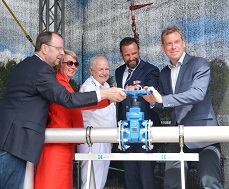
Kiel’s new waste-water reception facility has been built at the Ostseekai Cruise Terminal in the space of just six months. Several hundred metres of pressure resistant pipes of 225 mm diameter, as well as eight junction points, have been laid parallel to the ship berths. The pipes flow into storage containers, located north of the terminal, which have capacities of up to 75 m³ and are fitted with waste-water analytical and treatment technology. By using compressed air and adding ozone the water is aerated in fine stoneware pipes. If required the pH value of the water can be regulated by feeding in sodium hydroxide solution. “We carried out intensive tests last year with the firm of Unitechnics to determine the best processing method”, said Dirk Claus, “and we have as a result created new standards”. The compressed air connections are fully sealed while filters and adsorbers eliminate hydrogen sulphides in the facility itself. Cleaned exhaust air is discharged through a chimney. The treated ship waste-water is finally pumped into compressed air pipes newly laid below the Prinzengarten and Jensendamm and leading to the municipal delivery point. From there it is fed to the city sewage works in Bülk and cleaned.

The ships of owners AIDA Cruises, Phoenix Seereisen and TUI Cruises already regularly offload their waste-water on shore: last year it totalled well over 10,500m³. At the Ostseekai Terminal, the volume requirements of the cruise shipping companies for the handling of up to 200m³ an hour are now being totally complied with. “With the new facility we are taking on a pioneering role”, said Dirk Claus. “There is hardly any other port that can as yet handle such large volumes of waste-water from ships”, he added. The PORT OF KIEL expects that nearly all the cruise ships that berth at the Ostseekai Terminal will in future discharge their waste-water there.