

Planning and execution of this shipment were an extremely testing and complex challenge.
The rotary boiler, 24m in length, with a diameter of 4.40m and weighing tons, will be used in the food industry for processing grains and oilseeds. It was transferred by HHLA’s Hamburg-based floating cranes III and IV directly into an inland waterway craft that is taking the vulnerable cargo along the Elbe to Melnik. From there it will cover at least 300km by road to its final destination in Olomouc, Czechia.
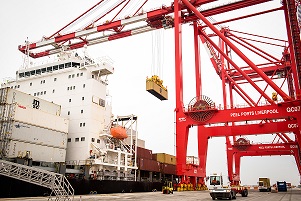
The special challenge here was that on account of its centre of gravity, the two HHLA floating cranes had to operate in tandem to lift the rotary boiler from the hold, where it was secured on a total of eleven 40-ft flatracks. For that, they first had to secure themselves together on the towering side of the 366-metre-long containership. The cargo was then lifted out and lowered on to the waiting inland waterway craft.
Thomas Lütje, Sales Director for Hamburger Hafen und Logistik AG, commented: “This transhipment underlines the flexibility and capacity of HHLA container terminals. Our facilities are not only supremely efficient specialists in handling containers, but also offer impressive solutions for transhipping heavy-lifts.”
The COSCO shipping company, with its European headquarters in Hamburg, has been a player in the general cargo business for around ten years. Its special traffic/projects department looks exclusively after breakbulk cargoes. This year alone, this dedicated COSCO department has handled 80 especially heavy and/or out-of-gauge shipments via ports in the North Range, 70 of these in Hamburg. Yet this is never a routine matter. “Despite all our experience, handling this rotary boiler was something special,” confirms Dennis von Gogh of COSCO’s special traffic team in Hamburg. “We had just six weeks to prepare for this load, but its weight and dimensions meant that it was by no means an everyday job.”
In planning, COSCO’s project cargo specialists conducted full calculations on a great diversity of routes and handling options. Von Gogh: “Hamburg’s handling facilities and excellent hinterland link with Czechia via the Elbe made it the best solution.”
As a universal port, the Port of Hamburg offers the maximum variety of handling opportunities for cargoes of all types. Four highly specialized multi-purpose terminals are available for the conventional general cargo segment. Using special equipment, plant and project cargo with unit weights of up to 400 tons are loaded and discharged there. Other state-of-the-art container terminals handle general cargoes, using shore-based container gantry cranes or with the aid of floating cranes.