Thursday, December 11, 2025
spot_img
Home Blog Page 106

Charleston Harbor Deepening project receives construction funding

0

Charleston also received USD 16.1 million in operations and maintenance dollars, which provide for the routine maintenance dredging of the harbor necessary for construction begin. Collectively the funds allocated in the Work Plan allow Charleston to continue moving forward and preparing for construction.

“This is monumental news for the Charleston Harbor Deepening Project, and we are appreciative to Governor McMaster and the entire South Carolina congressional delegation for their efforts to ensure the project was included in the Corps Work Plan,” said Pamela Lackey, SCPA Board Chair. “Their unanimous support and tireless efforts continue to move our project forward without delay.”

The largest contract for the project will be let this fall, utilizing federal dollars in combination with the USD 300 million in state funding already set aside for the project.

“The significance of this funding for the timeline of our deepening project cannot be overstated – it is tremendous news for Charleston,” said Jim Newsome, SCPA president and CEO. “By the end of the decade, we will achieve 52 feet of depth and be the deepest harbor on the East Coast, a depth advantage that will add significant capability in the Southeast, the fastest growing port region in the country. We are grateful for the leadership of our congressional and state delegations and look forward to a continued, productive partnership with the USACE as the project progresses.”

The project has moved rapidly through the USACE SMART Planning process. Only six years ago, in May 2011, the project reached its first milestone with a USD 150,000 allocation in the USACE Work Plan to study the need and justification for the Charleston Harbor to be deepened beyond its current depth of -45 feet.

The Water Infrastructure Improvement for the Nation Act (WIIN), passed by Congress in December, authorized the Army Corps of Engineers Chief’s Report for the construction phase of the Charleston Harbor Deepening Project. By achieving 52 feet of depth, SCPA will be able to accommodate fully-loaded new-Panamax container ships without tidal restriction.

The project has received strong support by all levels of government. In 2012 the S.C. General Assembly set aside USD 300 million for the project, and it was expedited by the Obama Administration as a “We Can’t Wait” initiative.

Port NOLA Joins USDA's Southeast U.S. Cold Treatment Pilot Program

0

Participation in the Animal and Plant Health Inspection Services (APHIS) pilot program means select time-sensitive products can be treated to meet customs compliance in-transit rather than after it arrives to the U.S. – resulting in shorter transit times and increased efficiency for shippers.

“Participating in this pilot is a significant gain and highlights Port NOLA’s ongoing commitment to developing new business,” said Brandy D. Christian, Port of New Orleans President and CEO. “This program gives current and future port shippers additional options to transport refrigerated cargo, while reducing transit time from origin to the consumer.”

Prior to this program, refrigerated cargo had to flow through specialized treatment facilities in the Northeast U.S. to be cleared for distribution. With more than 900 refrigerated plugs available at Port NOLA’s facilities, the Port is equipped to handle additional perishable cargo.

Cold treatment is a process whereby perishable fruits are brought to a certain temperature for a period of time as dictated by authorities to fulfill APHIS quarantine requirements targeting pests such as fruit flies.

The following commodities are included in this pilot:
• Blueberries, citrus, and grapes from Peru
• Blueberries and grapes from Uruguay, and
• Blueberries, apples, and pears from Argentina.

“NOCS is excited to work with the Port of New Orleans and potential customers to take advantage of this opportunity to bring new products through the US Gulf,” said Jim Henderson, Vice President Sales and Marketing New Orleans Cold Storage. “With all the global container routes coming into this port from many producing areas around the world, combined with the unique cold chain infrastructure and growing distribution market in the region, the Port of New Orleans is a natural fit. We look forward to working with the industry and community to further develop this trade.”

New Orleans is well-positioned to grow in the refrigerated import sector with additional leverage coming from efficient rail connections to inland markets.

“It is an exciting development for the Port of New Orleans to be approved by APHIS as a pilot port in the Southeast for cold-treatment in-transit of certain tree fruit and stone fruit from South America,” said John Hyatt, Vice President of the Irwin Brown Company, a New Orleans freight forwarder. “Historically, fruit subject to infestation by med-fly could not be imported south of the Mason Dixon Line, a geographical designation. With this test program, more niche cargoes of this type, can be considered as candidates for on-shore/on-dock cold treatment.

Port NOLA is the most recent Southeast U.S. port to be included in this pilot.

“Congratulations to the Port of New Orleans for becoming an official participant in the Southeast U.S. In-transit Cold Treatment Pilot,” said Dr. Laura Jeffers, APHIS National Operations Manager. “Approving the Port of New Orleans in this pilot will help promote the health of U.S. agriculture in the international trade arena.”

Port NOLA will partner with APHIS and the U.S. Custom and Border Protection Agency to implement this pilot.

Good first quarter for Hamburg's seaborne cargo throughput as a universal port

0

Contributing to the Hamburg total, bulk cargo throughput was 6.7 percent higher at 12.2 million tons, and general cargo handling at 23.1 million tons, just 0.7 percent lower. In the former segment, the 12-million-ton mark was exceeded for the first time, and the best quarterly figure achieved since records began. On the export side, general cargo throughput at 11.9 million tons represented growth of 3.4 percent. At 11.2 million tons, general cargo imports were somewhat lower, being down by 4.7 percent. First-quarter container throughput at 2.2 million TEU was 0.7 percent lower than in the comparable period of the previous year.

At 1.9 million TEU, Hamburg’s total seaborne loaded-container throughput for the first quarter of 2017 gratifyingly rose by 0.04 percent. Throughput of empty containers dropped by 4.9 percent to 307,000 TEU. “Despite the persisting non-implementation of the dredging of the fairway of the Lower and Outer Elbe, cargo still finds its way via Hamburg. We find that while the number of loaded containers has risen slightly, handling of empty containers has declined. By contrast with the globally coordinated transport chains for boxes stuffed with import or export cargoes, empty containers are less linked to specific ports and routing is therefore more volatile,” explained Ingo Egloff, Joint CEO of Port of Hamburg Marketing. On the main trade routes, Hamburg’s container traffic with Europe was up by 0.6 percent at 663,000 TEU, with the Americas by 6.4 percent at 311,000 TEU and with Australia/Pacific by 19.9 percent at 13,000 TEU. With totals 5.5 and 3.0 percent lower at 70,000 TEU and at 1.2 million TEU, respectively, the Africa and Asia trade routes did not match the previous year’s results. A total of 637,000 TEU, down by 2.0 percent, was handled in container traffic with China, Hamburg’s most significant trading partner. However, gratifying single- and double-digit growth in container traffic with top-ten trading partners – Russia, up 15.6 percent at 120,000 TEU the USA, up 5.5 percent at 89,000 TEU, Malaysia, 0.4 percent to 76,000 TEU, the United Kingdom, up 2.8 percent at 66,000 and Sweden, up 4.0 percent at 66,000 TEU – did not suffice to offset this in the total. “Among our Top Three trading partners, China, Russia and the USA, only the first reported a slight downturn on the previous year. In the first quarter of 2017 we saw a continuation of the stabilization already commencing in the final quarter of last year. We are also assuming that with foreign trade still growing, container traffic with China may develop positively in the course of this year,” said Egloff. Along with Russia, still subject to restrictions on its foreign trade under the existing sanctions, the Baltic countries also take a significant proportion of goods from China, or export them there, via Hamburg. At 76,000 TEU, they achieved a 28.2 percent advance. “Twofold handling, from the seagoing ship to the feeder and vice versa, means that a resumption of growth in transhipment services with the Baltic region produces rapid increases in volume for Hamburg,” explained Egloff.

In container shipping, the first quarter was notable for consolidation, preparations by shipping companies for the new alliances and hopes of a recovery in the market. With over 100 liner services, the Port of Hamburg remains well positioned. In container traffic, it will also be called by ten Asia services of the new THE and OCEAN alliances, along with two run by 2M. High freight volumes mean that on the Asia services, shipping companies are increasingly deploying mega-ships. In the first quarter of 2017 there was a renewed increase in the number of calls by these. The total of 74 containerships with slot capacities of more than 14,000 TEU berthing in Hamburg was up by 61.0 percent. To simplify passing of mega-ships and traffic flow on the Elbe, the dredging of the Elbe to a great extent approved by the Federal Administrative Court on 9 February 2017, will be of the greatest importance for the port. In the opinion of the court and the planning institutions responsible, the planning deficiencies it had established in documenting increased salt water content affecting the Schierlings water fennel, documentation of compensatory measures in Lower Saxony, and the rejection of one compensatory measure in Hamburg territory, can all be remedied.

Conventional general cargo handling was sluggish in the first quarter, with the total 22.0 percent lower at 324,000 tons. Ingo Egloff surmises that this was caused by the withdrawal of the Buss Hansa Terminal handling facility and a downturn in RoRo traffic with Africa caused by lower demand.

Record figure on bulk cargo handling
One outstanding feature of the first quarter of 2017 was the record figure for bulk cargo throughput. ‘Hamburg does not just do containers. At 12.2 million tons, throughput of suction, grab and liquid cargoes achieved 6.7 percent growth. That made Hamburg the only North Range port to report growth in this segment, underling its position as a universal port for cargoes of all types,” said Egloff. The main elements in the grand total were suction cargoes up 0.4 percent at 2.3 million tons, grab cargoes 18.0 percent ahead at 6.4 million tons, and liquid cargoes down 5.9 percent at 3.5 million tons. Increased handling of coal, coke and ores, as imports, and grain and oil products, as exports, also made a positive impact on the excellent trend in the first quarter.

Renewed growth in rail freight transported on Port of Hamburg’s hinterland services
Around 11 percent of total German rail freight transport starts or ends in the Port of Hamburg. Offering 2000 container block train services per week, Hamburg is Europe’s Rail Port No. 1. In the first quarter of 2017 there was again a positive trend in volume transported on the Port of Hamburg Railway, 0.4 percent higher at 11.6 million. Railborne container transport was also up by 0.4 percent at 587,000 TEU. On 23 March 2017 the starting signal was given for the ‘Hamburg-NRWplus’ cooperation project, aimed at boosting rail’s share of freight transport. Primarily through Port of Hamburg Marketing’s contacts on the market, the two states will promote greater use of rail for freight transport. The offer of new container block trains like the link between Warstein and Hamburg launched by Warsteiner Brewery at the beginning of the year, ensures greater transport capacity by rail and simplifies the switch of transport from truck to rail. Port of Hamburg Railway and handling terminals in the Port of Hamburg are excellently prepared for further growth in container and bulk goods services by rail.


Kalmar celebrates ground breaking of its new facility in Ljungby, Sweden

0

The centre will create new business and job opportunities in Southern Sweden especially in the area of digitalisation.

Dan Pettersson, Senior Vice President, Mobile Equipment, Kalmar, said, “This is a very important day and the starting point of a new era for Kalmar. This long-term investment will help us utilise the vast possibilities provided by digitalisation in developing our offering further. We will gather our extensive competence at one facility and strengthen our way of working in digital business development, zero emission machines and automation in order to keep our pole position also in the future.”
Kalmar celebrates ground breaking of its new facility in Ljungby, Sweden

Kalmar, part of Cargotec, officially broke ground on a new facility in Ljungby, Sweden, on 24 May 2017. The new Business, Innovation and Technology Centre in Ljungby will focus on strengthening Kalmar’s expertise in digital business development, research and development, prototype production and testing of mobile equipment and related services. The centre will create new business and job opportunities in Southern Sweden especially in the area of digitalisation.

Dan Pettersson, Senior Vice President, Mobile Equipment, Kalmar, said, “This is a very important day and the starting point of a new era for Kalmar. This long-term investment will help us utilise the vast possibilities provided by digitalisation in developing our offering further. We will gather our extensive competence at one facility and strengthen our way of working in digital business development, zero emission machines and automation in order to keep our pole position also in the future.”

Kalmar has already launched a digital business development program in collaboration with Centre for Information Logistics and Linneaus University in Southern Sweden.
“We believe that through open innovation and co-creation Kalmar, as well as the industry as a whole, will be exposed to new ideas and thinking that can help the entire value chain on their road to digitalisation and increased efficiency. Once this site is ready, we want to use it as our showroom and bring our customers here to showcase the latest and most innovative solutions available on the market,” said Antti Kaunonen, President, Kalmar, during the ground breaking ceremony.

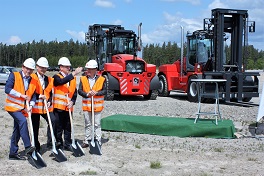
In the picture from the left: Dan Pettersson, SVP Kalmar Mobile Equipment, Antti Kaunonen, President Kalmar, Stefan Johansson, Program Director, Kalmar Mobile Equipment and Claes Bodén Lagans Byggnads AB (the contractor).

Kalmar has already launched a digital business development program in collaboration with Centre for Information Logistics and Linneaus University in Southern Sweden.
“We believe that through open innovation and co-creation Kalmar, as well as the industry as a whole, will be exposed to new ideas and thinking that can help the entire value chain on their road to digitalisation and increased efficiency. Once this site is ready, we want to use it as our showroom and bring our customers here to showcase the latest and most innovative solutions available on the market,” said Antti Kaunonen, President, Kalmar, during the ground breaking ceremony.

In the picture from the left: Dan Pettersson, SVP Kalmar Mobile Equipment, Antti Kaunonen, President Kalmar, Stefan Johansson, Program Director, Kalmar Mobile Equipment and Claes Bodén Lagans Byggnads AB (the contractor).