
Thursday, December 11, 2025
spot_img
Home Blog Page 111

The baptism of two LHM 800's

0

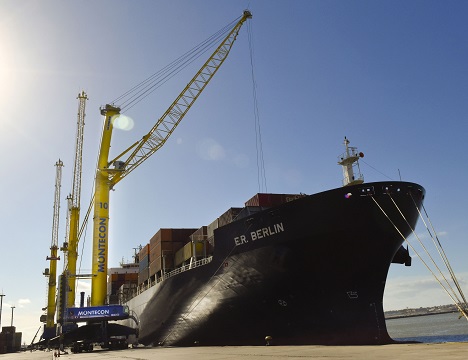
Members of Montecon’s owner families – the family Schandy and the family von Appen – welcomed Liebherr for the official inauguration. Montecon invests in improving the competitiveness of the port of Montevideo.

Four years after Montecon charged Liebherr Maritime Cranes with designing and creating two new mobile harbour cranes, able to reach up to 22 rows of containers – a feat of dockside logistics never seen before – the project has been completed.

The Port of Montevideo is one of the major ports in South America and plays an essential role in the economy of Uruguay. Looking back in history of Uruguay the port is closely linked to the origins of the city Montevideo and the country Uruguay. Having in mind that strategic decisions for this port can have far-reaching effects it makes Liebherr Maritime Cranes even more proud to be a part of Montecon’s new success story – the investment in two Liebherr LHM 800 mobile harbour cranes.

The growth of Liebherr’s mobile harbour crane range is linked to Montecon. Liebherr Maritime Cranes developed the LHM 800 at Montecon’s request because there were no mobile harbour cranes big enough to meet the needs of the largest ships. According to Olascoaga, General Manager of Montecon, the investment took place “because it’s our business, a point we wish to emphasise. But also because we take it as a basic strategic aim that the port of Montevideo is the only deep-water port in the whole of Uruguay and of this region, with a future full of possibilities.”

Mr Berthold, Managing Director Sales of Liebherr-MCCtec Rostock GmbH, comments: “The decisive link between the biggest mobile harbour crane in the world and a successfully running port business is the close and trustful cooperation of two leading family businesses. The LHM 800 represents a before and after, a new area for both family-owned companies, Montecon and Liebherr.” The presence of members of the owner families furthermore underlines the strong importance of the business partnership between Liebherr and Montecon.
The Port of Virginia welcomes the COSCO Development

0

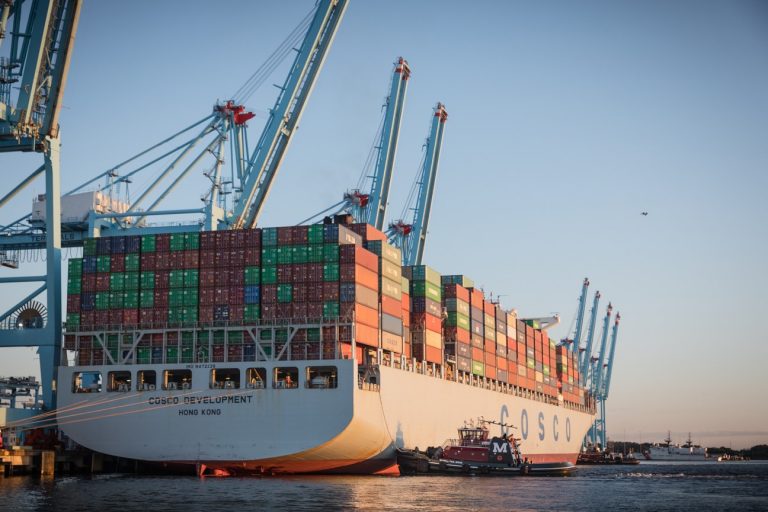
The vessel can carry 13,092 twenty-foot equivalent units, or TEUs. The previous record was held by the MOL Benefactor when it sailed to Norfolk International Terminals (NIT) last summer. By comparison, Monday’s arrival of the COSCO Development breaks the previous record by 3,000 TEUs.

“We’ve seen nothing like her here,” said John. F. Reinhart, CEO and executive director of the Virginia Port Authority. “For years, we have been talking about the ‘next generation’ of vessels and the ‘big-ship era’. This is what we have been preparing for: the talk is over, the big ships are here.”

In Monday’s early morning, tugboats eased the COSCO Development alongside at Virginia International Gateway (VIG). Soon after, crews descended on the berth, climbed into the ship-to-shore cranes and shuttle trucks and began the process of loading and unloading. During the course of her 30-plus hour stay in Virginia, multiple labor shifts will load and unload nearly 2,000 containers. On average, most vessels are here for 12-14 hours.

“What’s truly significant is that Virginia is this vessel’s first East Coast stop,” Reinhart said. “This vessel is taking full advantage of our 50-foot channels and an expanded Panama Canal. As the ships get bigger there are corresponding cargo loads. So our ability to quickly push these slugs of cargo inland by barge to Richmond Marine Terminal and double-stack rail to Virginia Inland Port and then into our markets in the nation’s heartland becomes even more important.
“Our partnership with labor, our modern terminals, our efficiency, our deep water — all these assets that we have been discussing and investing in are now coming into focus. From this day forward, we’ll be seeing vessels of this size with regularity. The big ship era at The Port of Virginia is truly underway.”

COSCO Shipping is part of the OCEAN Alliance, which is an alliance of ocean carriers composed of CMACGM, Evergreen Line and OOCL. In an alliance, the members agree to contribute ships and share space on those vessels. The vessel is in the alliance’s South Atlantic Express service and it came to The Port of Virginia via the Panama Canal.

In this weekly Asia-to-U.S. East Coast service there are 11 vessels ranging in size from 11,000 to 13,000 TEUs. The port rotation includes Hong Kong, Yantian, Ningbo, Shanghai, Panama, Virginia, Georgia and South Carolina and then back to China.
Reinhart said the growing vessels sizes and accompanying cargo volumes are behind the port’s $670 million investment to increase overall annual throughput capacity by 40 percent – 1 million containers – by 2020. Presently, heavy construction is underway at VIG and the civil engineering work is nearing its start at NIT.

“We are adding capacity now so we can handle the cargo that will be coming to us on these vessels,” Reinhart said. “The big ships are here — more are on the way – and they are carrying significant amounts of containers. In order to be sustainable and competitive for decades to come, we must be ready to accommodate that volume at our inland and water-side facilities.

“The continued investment in people, technology and those capacity projects being undertaken here during the next three-to-four years are positioning this port to become the East Coast’s premiere port: a true gateway to world trade and a catalyst for commerce in Virginia.”

Port of Long Beach sees April boost

0

For the calendar year so far, cargo volume at the Port is up 5.1 percent from 2016.

“We continue to be on pace for a strong year,” said Harbor Commission President Lori Ann Guzmán. “In April, we were pleased to welcome back Hyundai Merchant Marine as well as a new customer, SM Line. As shipping lines around the world settle into new alliance routes, our many business partners can depend on Long Beach to provide a safe harbor for their goods with our signature efficient and sustainable services.”

A total of 558,014 twenty-foot equivalent units (TEUs) moved through Long Beach in April. Inbound boxes numbered 288,207, an increase of 16.5 percent. Long Beach handled 116,260 loaded outbound TEUs during the month, up 3.1 percent. Empty containers returning overseas to be filled with goods jumped to 153,547 TEUs, 29.3 percent higher.

The Port of Long Beach is one of the world’s premier seaports, a gateway for trans¬-Pacific trade and a trailblazer in goods movement and environmental stewardship. With 175 shipping lines connecting Long Beach to 217 seaports, the Port handles $180 billion in trade annually, supporting hundreds of thousands of Southern California jobs.

Port efficiency to attract more shipping lines, port users to Subic

0

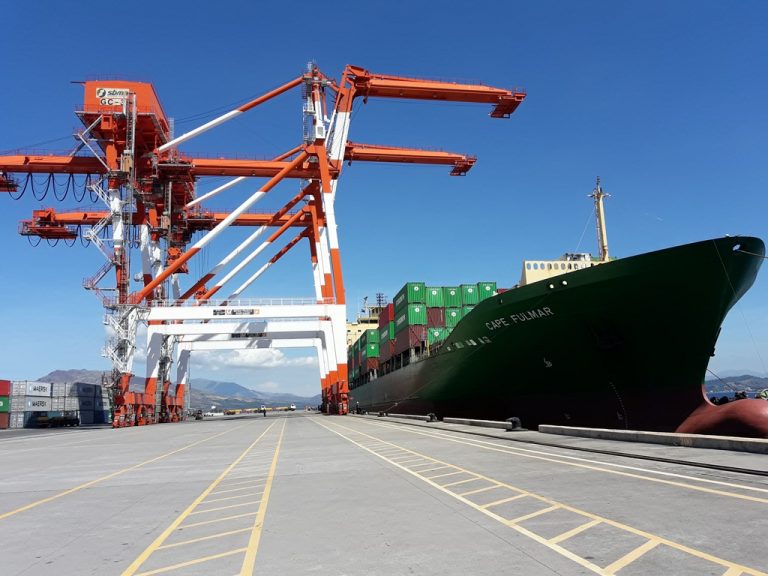
Two Panamax quay cranes at the New Container Terminal (NCT) 1 recently handled close to 400 twenty foot equivalent units (TEU) with each crane averaging 40 and 33 moves per hour, respectively. The productivity levels were achieved during the inaugural call of Evergreen Marine Corp.’s 1,440-TEU boxship Cape Fulmar.

The call signaled the start of Evergreen’s South Korea-Taiwan-Philippines (KTP) service, a new route to facilitate improving regional trade between the three economies. The service plies the ports of Incheon and Kwang Yang, South Korea; Kaohsiung, Taiwan; and Batangas, Manila and Subic Bay, Philippines. Aside from Cape Fulmar, 1,440-TEU boxship Cape Faro is also chartered to the weekly service.

“It was a great effort and a big win for ICTSI’s Subic operations. This goes to show that Subic is at par with the productivity levels in MICT. We are continuously working on improving our services to attract more shipping lines, and for northern and central Luzon businesses to use the container terminals in Subic,” says Roberto Locsin, Subic Bay International Terminal Corp. (SBITC) President.
He adds: “As a national port operator, ICTSI ensures that each Philippine marine terminal under its helm remains competitive. Subic, in particular, was developed not only for the industrial locators of the Freeport but for the local markets in Luzon north of Metro Manila.”

MICT, ICTSI’s flagship terminal, primarily serves the Metro Manila market and its adjacent markets, where most of the economic activities of the country happen being the country’s capital. “Metro Manila as a market will continue to grow,” says Mr. Locsin.

“But, as the northern and central Luzon countryside develops driven by industrial centers like Subic, Clark, Bataan and Tarlac also continuing to grow, the Subic Bay Freeport is that gateway ready to link its products to global markets. We have the equipment and facilities. We carry ICTSI’s brand of service and efficiency,” he adds.

ICTSI has positioned itself in Subic in anticipation of growing local markets north of Metro Manila. In 2007, under the Subic Port Development Plan, the Subic Bay Metropolitan Authority awarded SBITC the concession for NCT 1. In 2011, under the plan’s second phase, another ICTSI subsidiary, ICTSI Subic, Inc., was awarded the concession to operate NCT 2.

Increasing volumes in Subic enabled ICTSI to streamline and interface the operations of NCT 1 and 2. The merged operation has been serving the growing markets of the region, alongside the continued support to facilitate the box market of Metro Manila.