

Monday, December 8, 2025
spot_img
Home Blog Page 114

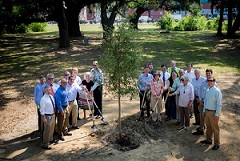
GPA holds tree-planting ceremony

0

“As we improve our operations and upgrade facilities, we take every step we can to preserve Georgia’s historic, majestic trees,” said GPA Executive Director Griff Lynch. “The 10-year-old live oak sapling we’re planting today is a small example of how the GPA provides for our natural resources today and into the future.”

On the 1,200-acre Garden City Terminal, the GPA protects and preserves habitats from wetlands to old growth oak trees, as part of its commitment to conduct port operations in an environmentally responsible manner.

The sapling planted Friday joins a grove of about a dozen trees that are more than 200 years old adjacent to Highway 25. The oldest oaks at the port facility date to the mid-1600s.
Local arborist Shannon Baughman applauded the GPA’s sustainability effort protecting trees.

“Maintaining these old-growth trees at a working port shows that it is possible for industry and the natural environment to coexist,” Baughman said. “The shade these trees provide, the oxygen they produce and the carbon sequestered in their massive trunks provide long-term benefits to the area. It’s exciting that the Georgia Ports Authority recognizes their value.”

The GPA has a long track record of sustainable practices.

The Authority currently preserves 300 acres of natural wetlands in Brunswick, and has established 14 acres of wetlands at the Port of Savannah for its natural filtering capability, in order to protect the Savannah River. Additionally, GPA is a longtime supporter of the Caretta Research Project, which protects sea turtle hatchlings.

The GPA has transitioned its ship-to-shore cranes from diesel to electric power to reduce its carbon footprint, and in 2016, received the EPA Clean Air Excellence Award for its electric rubber-tired gantry crane program.

The eRTG program will transfer GPA’s rubber-tired gantry crane fleet – used to handle containers on terminal – to electric power. This will virtually eliminate diesel fuel usage for these machines and reduce the terminal’s diesel emissions.

High-tech lighting controls and container yard light fixtures reduce light pollution and cut energy consumption by 60 percent.

“Operating Georgia’s deepwater ports sustainably is an integral part of our mission,” said Lynch. “In every business decision, the Authority balances continued economic growth with being good stewards of precious natural resources.”

New Liebherr equipment will strengthen Saqr Ports top position in the Middle East bulk market

0

Saqr Port Authority is about to establish new berths in order to further strengthen their position in the in the Middle East bulk market.
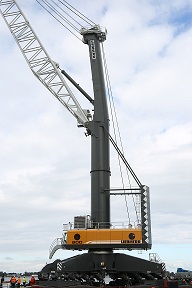
Saqr Port Authority recently signed a contract for two new units LHM 800 in bulk handling configuration. These two machines will be the biggest mobile harbour cranes for bulk operation in the Middle East.
Saqr Port is located at the foot of the Hajar Mountains in the north of the United Arab Emirates. The port is mainly handling limestones and aggregates, which serves the majority of the construction projects within the Middle East and is central to its economic success.
Liebherr sold the first mobile harbour crane to Saqr Port more than 25 years ago. The partnership between both companies has grown successfully since then. Saqr Port operates eight Liebherr mobile harbour cranes of various types. Now they have opted for the biggest type available in Liebherrs extensive MHC product range – the LHM 800.

Maersk Line deploys its first 2nd generation Triple-E

0

Madrid Maersk is the first in a series of eleven (11) 2nd generation Triple-E vessels. It is also the first of the 27 vessels Maersk Line ordered in 2015 to enter service. Maersk Line will take delivery of the vessels until end of 2018 and they will replace older and less efficient tonnage.

Maersk Line has not taken delivery of own new-buildings since July 2015.

Maersk Line’s remaining order book consists of ten (10) 2nd generation Triple-E vessels, nine (9) 15,226 TEU and seven (7) 3,596 TEU container vessels. The order book corresponds to 11% of Maersk Line’s current fleet – a relatively small order book when compared to the industry’s order book of around 15%.

To stay competitive and achieve lowest cost, Maersk Line will continue to manage fleet capacity tightly. For example, Maersk Line has a relatively high number of vessels on short term charters. This gives Maersk Line the flexibility to adjust fleet capacity when new vessels come on-stream. Maersk Line is also recycling old and more inefficient vessels. In the first quarter of 2017, Maersk Line recycled seven Panamax vessels.

10th World FIBC Congress & Exhibition 2017

0

Congress & Exhibition
1 – 2 May 2017

Amsterdam, the Netherlands

The conference programme will examine the latest technology and developments across the Flexible Intermediate Bulk Container (FIBC) industry covering key issues such as machinery, the global market, FIBC components, new technology and electrostatics – highlighting topics that are not only key to manufacturers and suppliers, but most importantly, the end-user.

For further information visit www.mcimedia.com