Wednesday, December 10, 2025
spot_img
Home Blog Page 134

OMC's real-time DUKC plays major role in record iron ore tonnage from Port Hedland

0

“Under DUKC advice a record 270,006 tonnes of iron ore left Port Hedland – the world’s largest bulk export port – on the Fortescue Metals Group loaded ship HL TUBARAO on Wednesday morning March 1,” he said.

“Our technology, which has been operating at Port Hedland for more than 20 years, safely allowed an increased draft of 0.70m over the traditionally conservative static rule, which meant an extra 12,000 tonnes of iron ore could be loaded.”

DUKC technology, which is supported 24/7 from OMC’s Melbourne headquarters, has also assisted in enabling PPA to ship record iron ore shipments from Port Hedland in previous years. Last week’s largest ever single shipment of 270,006 tonnes of iron ore exceeds the previous record set by the ship CSB Years in April 2015 which loaded a total cargo of 264,858 tonnes under DUKC advice. It also beats the previous maximum sailing draft of 19.67 metres set by the ship Abigail N in February 2015.

“OMC is proud of this very productive working relationship with PPA and our joint efforts to find innovative working solutions to safely deliver economic and efficiency benefits when favourable conditions allow deeper drafts and/or extended tidal windows at Port Hedland,” Dr O’Brien said.

More space for big ships in the Port of Hamburg

0

The widened Vorhafen basin access benefits both con-tainer shipping and cruise shipping. For one, the tidal (time) windows avail-able to inbound and outbound ships are longer now and the manoeuvring space for big ships in the Tollerort area has increased. For two, it is now possible for cruise ships with a beam of 40 metres (formerly 32.3 metres) to berth at the Cruise Center Altona. Moreover, additional waiting berths for feeders can later be provided, which will help reduce vessel movements in this highly frequented section of the port.

The Vorhafen harbour basin is the approach to the cargo terminals in Stein-werder. Its location along the main current of the Norderelbe combined with the former river bank geometries had created river current conditions that only allowed ships with a maximum width of 370 metres to enter and leave the basin. The now completed widening project permits the passage of ves-sels with a beam of up to 400 metres.

“The widened Vorhafen basin entrance has made vessel traffic manage-ment more efficient, easier to plan and safer,” says Jens Meier, Chairman of the Management Board of the HPA, and adds, “With the now optimised waterside access we have added another important piece to the port’s in-frastructure that will further increase the competitive edge of the Port of Hamburg and benefit both container shipping and cruise shipping.”

Frank Horch, Hamburg Minister for Economic Affairs, Transport and Inno-vation explains, “We are developing the port with an eye on the future, and the infrastructure must be upgraded and expanded accordingly. This pro-ject is another milestone in the development of the port. Shipping compa-nies and terminal operators will benefit in particular.”

The project comprised three major construction phases:
1. The soil of a four-hectare large site at the Tollerort tip was removed to create more water surface area. Part of the excavated material was used to backfill what was left of the Kohlenschiffhafen harbour basin, thus creating additional areas for the Containerterminal Tol-lerort (CTT) and the Köhlbrandhöft sewage plant. The remaining soil was temporarily stored at the adjacent Kuhwerder Terminal for use in future port development and other infrastructure projects.

2. On the northern Tollerort River banks new foreshore structures were built. An about 250-metre-long quay wall starts at the north-eastern corner of the Tollerort tip and turns into a roughly 350-metre-long em-bankment line in the western section. The already existing quay wall at the northern end of the Europakai was reinforced by an about 90-metre-long foreshore quay wall.

3. To reinforce the existing all-round quay wall at Lotsenhöft, a roughly 160-metre-long quay wall structure was built in front of it.

Due to the above measures ships can now manoeuvre in a space with a diameter of 450 metres, berth assignment has become more flexible and the safety of navigation in the Tollerort area has improved.

MoorMaster berth unveiled at Port of Helsinki

0

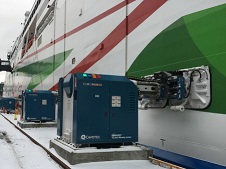
“The new auto-mooring system will significantly speed up the mooring and unmooring of ships. For local residents, the system also has the benefit of reducing noise and emissions,” according to a statement on the Port of Helsinki website.

The MoorMaster MM400E15 machines at the LJF berth will moor the new-build, 212m Tallink Megastar and the Tallink Star passenger ferries three times a day each. Mooring of these vessels takes a matter of seconds compared to conventional mooring that would take substantially longer. The introduction of the technology also removes hazardous mooring lines from the mooring process.

The development of West Terminal 2 included the construction of a new berths and a terminal building, passenger bridges and access roads; and is the largest single investment project undertaken by the Port in the past 10 years.

The opening ceremony was attended by a large number of guests, and a number of speakers, including Finland’s Minster for Foreign Trade and Development, Kai Mykkänen; the CEO of the Port of Helsinki, Kimmo Mäki; the CEO of Eckerö Line, Taru Keronen; and the CEO of Tallink Silja, Margus Schults.

MoorMasterâ„¢ is a vacuum-based automated mooring technology that eliminates the need for conventional mooring lines. Remote-controlled vacuum pads recessed in, or mounted on the quayside or pontoons, moor and release vessels in seconds. MoorMasterâ„¢ units have completed an estimated 260,000 mooring operations at ferry, bulk and container handling, and lock applications worldwide.

SC Ports breaks ground on inland port Dillon

0

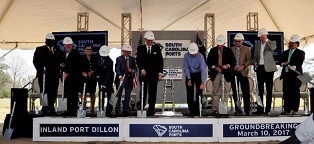
“Inland Port Dillon will diversify SCPA’s footprint and enable port users to gain logistics efficiencies through rail transportation of their cargo,” said Jim Newsome, SCPA president and CEO. “Inland ports provide infrastructure in the interior of the state that supports the movement of freight to and from our marine terminals. Our facilities in Dillon and Greer are important to SCPA’s overall volume growth and the significant amount of cargo that moves today by rail.”

International intermodal rail lifts have increased 170 percent since 2011, with 23 percent of the Port of Charleston’s containerized import and export volume moving by rail. Growth in the intermodal sector has driven tremendous success of Inland Port Greer, which handled a record 103,639 rail lifts last year.

“This is a significant project for SCPA and our entire state,” said SCPA Board Chairman Pat McKinney. “Inland Port Dillon complements the Port’s infrastructure investments in Charleston and will no doubt spur economic development activity both in the Pee Dee area and the surrounding region. Port-related jobs pay 40 percent higher than the state’s average wage, and it is an exciting day to bring such opportunities to Dillon County.”

“Our ports are a tremendously important part of South Carolina’s growing economic engine, and Inland Port Dillon will play a crucial role in helping our companies move goods more efficiently than ever before,” said South Carolina Governor Henry McMaster. “This new facility will mean even more jobs and industry, and help take our state straight to the top.”

Located within the Carolinas I-95 Mega Site, Inland Port Dillon has close proximity to I-95, a critical transportation artery in the Southeast. The area is central to a significant base of existing Port users that represent base cargo opportunities for the facility. The initial phase is expected to handle at least 45,000 containers annually, offering overnight access to and from Charleston via an existing CSX mainline.

“We congratulate Inland Port Dillon on this groundbreaking, which is the beginning stage of building a competitive advantage for area businesses by lowering transportation costs and providing greater access to domestic and international markets,” said Dean Piacente, CSX Vice President, Intermodal. “This new facility will build on the state of South Carolina’s already strong freight rail network, supporting continued business growth and job creation.”

SCPA first announced consideration of a constructing an inland port in Dillon in April of 2016. To date, SCPA has completed the initial design phase, permitting and equipment requisition process for the facility and will soon award contracts to begin construction of the terminal.

“The fruition of the Inland Port in Dillon County culminates a long process from a dedicated team and partnership in which Marlboro Electric Cooperative remains ecstatic to be a part of,” said Bo McInnis, MEC Chairman. “The Port’s leadership team is already providing tremendous value today, and the future for our entire region just got a lot brighter.”

Comments from South Carolina leaders:
“I’ve worked very hard at the federal level and with the South Carolina Ports Authority to advance the Dillon Inland Port project. This facility will bring industrial diversity and high-paying jobs to Marion, Dillon, and Marlboro counties, resulting in a huge economic impact to a much-needed area.” –
Congressman Tom Rice

“The groundbreaking is another step forward in ensuring the Port of Charleston is the preferred port on the East Coast. The positive ripple effects on businesses as a result of an inland port in Dillon will drive economic growth around the region. I look forward to seeing the facility, in conjunction with the inland port in Greer, strengthen our Port’s competitiveness and improve logistics for South Carolina companies.” – South Carolina Senator Hugh K. Leatherman, Sr., President Pro Tempore and Executive Committee, North Eastern Strategic Alliance (NESA)

“The opportunity for job creation and economic growth driven by this facility in our region cannot be overstated. This is an extremely significant day for residents of Dillon and surrounding areas, and I applaud the Ports Authority and its many partners for making this a reality.” – South Carolina Senator Kent Williams

“Today’s Inland Port Dillon groundbreaking is an important development for our region and the state. Providing increased inland infrastructure will create industry growth and provide job opportunities that will benefit our area and the entire state.” – South Carolina Representative Jackie E. “Coach” Hayes