
Thursday, December 11, 2025
spot_img
Home Blog Page 135

Leading German fruit terminal opts for additional Konecranes Gottwald mobile harbour crane

0

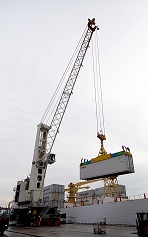
At the end of 2016, HHLA Frucht- und Kühl-Zentrum, a company of Hamburger Hafen und Logistik AG (HHLA) and the terminal operator SEA-invest, put a diesel-electric Konecranes Gottwald Model 4 Mobile Harbor Crane into operation at their multi-purpose terminal in Hamburg.

The crane’s main job at the O’Swaldkai multi-purpose terminal in Hamburg is to serve reefer vessels that transport bananas. The G HMK 4406 unloads the delicate fruit on pallets from the ship’s hold and unloads reefer containers that arrive as deck cargo. With a maximum lifting capacity of 100 t and an outreach of up to 46 m, it can also handle heavy cargo and project cargo.
Axel Hoeckrich, Managing Director of HHLA Frucht- und Kühl-Zentrum GmbH, said: “With this new mobile harbor crane, we can efficiently unload the growing number of containers that are now being transported aboard fruit vessels. It has replaced an old ship-to-shore crane. Furthermore, it can also unload fruit pallets, and its versatility increases our ability to develop new business activities. With this state-of-the-art crane, we are strengthening the fruit port of Hamburg, which is already the most important site for fruit handling and trade in Germany.”
HHLA has trusted mobile harbor crane technology from Konecranes for fruit handling since 2003. At that time, two small HMK 90 E cranes of Generation 4 went to Hamburg where they are still in operation. Like them, the new crane can be moved quickly on the quayside. “All of the cranes also have high working speeds, giving high productivity and, particularly when handling fruit pallets, help us to keep the cold chain intact,” explains Hans-Juergen Schneider, Regional Sales Manager, Konecranes, Port Solutions. The G HMK 4406’s maximum lifting speed is 90 m/min.
The benefits of Konecranes Gottwald Mobile Harbor Cranes and the resulting competitive advantages have recently impressed several other operators of fruit terminals. As a result, two additional machines started work in a fruit terminal in the UK in October 2016. These machines are Model 2 cranes in the G HMK 2204 two-rope variant, predominantly intended for unloading fruit pallets arriving at two berths.
PSA and Singapore Institute of Technology in collaboration

0

SIT, through its continuing education unit, SITLEARN, will develop and deliver a 16-month part-time Systems Engineering training programme to equip PSA engineers and ICT professionals with the competencies to design, develop and maintain complex integrated systems which are vital for PSA’s new generation of ultra-modern and intelligent container terminals.

As part of the MOU, students and faculty from SIT will also be exposed to PSA’s inner workings, with specialists from PSA delivering guest lectures on port technology and operations. To enable synergies between academic and industrial research, PSA and SIT will also collaborate on applied research projects to explore solutions to business problems.

Alongside these, PSA will be offering scholarships to promising students and also provide Integrated Work Study Programme (IWSP) positions in selected Engineering and ICT Bachelor’s programmes. The IWSP will expose students to the dynamic and exciting port industry. Students will also have the opportunity to embark on capstone projects which will allow them to delve deeper into and offer solutions to various port business and technology problems.

Mr Ong Kim Pong, Regional CEO Southeast Asia, PSA International, and witness to the signing ceremony, said, “As PSA continues its development of advanced port technologies for our present and future terminals, it is timely that we commit to this collaboration with SIT. By equipping PSA staff and SIT students with the knowledge and skill sets to handle and work with smart systems, we can ensure that they are ready for future challenges and help propel the Singapore port to the next level of excellence and productivity.”

“The MOU marks our commitment in developing talents for the maritime industry and has further cemented the symbiotic relationship we have with PSA. Through the various collaborative platforms, SIT students will benefit from learning opportunities in PSA and develop skills of adaptability and innovation that will allow them to navigate in the fast-changing economy,” said Professor Loh Han Tong, Deputy President (Academic) & Provost, SIT.

Cavotec MoorMaster berth unveiled at Port of Helsinki

0

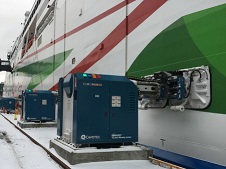
“The new auto-mooring system will significantly speed up the mooring and unmooring of ships. For local residents, the system also has the benefit of reducing noise and emissions,” according to a statement on the Port of Helsinki website. Read more about the system on the port’s own website here.
The MoorMasterâ„¢ MM400E15 machines at the LJF berth will moor the new-build, 212m Tallink Megastar and the Tallink Star passenger ferries three times a day each. Mooring of these vessels takes a matter of seconds compared to conventional mooring that would take substantially longer. The introduction of the technology also removes hazardous mooring lines from the mooring process.
The development of West Terminal 2 included the construction of a new berths and a terminal building, passenger bridges and access roads; and is the largest single investment project undertaken by the Port in the past 10 years.
The opening ceremony was attended by a large number of guests, and a number of speakers, including Finland’s Minster for Foreign Trade and Development, Kai Mykkänen; the CEO of the Port of Helsinki, Kimmo Mäki; the CEO of Eckerö Line, Taru Keronen; and the CEO of Tallink Silja, Margus Schults.
MoorMasterâ„¢ is a vacuum-based automated mooring technology that eliminates the need for conventional mooring lines. Remote-controlled vacuum pads recessed in, or mounted on the quayside or pontoons, moor and release vessels in seconds. MoorMasterâ„¢ units have completed an estimated 260,000 mooring operations at ferry, bulk and container handling, and lock applications worldwide.

Port of Liverpool welcomes largest containership to date

0

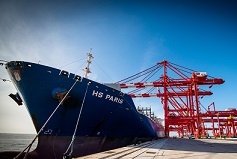
Previously, the Port of Liverpool’s existing container terminal could only accommodate vessels up to 4500TEU. The HS Paris is the first post-Panamax vessel to call at Liverpool following the phase 1 opening of Liverpool2 in November 2016.

Mark Whitworth, Chief Executive of Peel Ports Group, said: “This is a huge milestone for Peel Ports and the Port of Liverpool. The whole team is delighted to welcome HS Paris to the city for the first time. While we have the capacity to handle vessels up to 20,000 TEU, smaller post-Panamax ships are still very much part of our overall strategy and it’s essential that can accommodate those too. We can now do that thanks to our £400m investment at Liverpool2, providing a shorter route to market for UK importers and exporters, which reduces their costs, congestion and carbon emissions.”

Peel Ports recently announced that it had secured 150 advocates for its Cargo200 initiative. The campaign calls on importers and exporters whose goods begin or end their journey in the north of the UK to switch delivery of ocean freight from south-east ports to the centrally-located Port of Liverpool. It’s estimated that the initiative could save UK plc up to £200 million by 2020. It also aims to cut freight mileage by 200 million miles by 2020.