
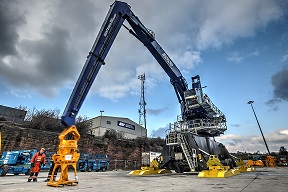
The decision to add a Mantsinen 200M crane to its equipment fleet reinforces ABP’s commitment to invest in the port, which is now able to handle any vessel that can pass through the on-site lock.
The Port of Garston crane is one of five new equipment contracts, with a total value of £6million, signed by ABP and Cooper Specialised Handling, the UK’s largest independent provider of port equipment and cargo handling solutions. This investment is part of ABP’s wider £1billion improvement programme, which aims to support customers with innovative logistics solutions.
Weighing in at more than 280 tonnes, the Mantsinen 200M is the world’s largest hydraulic crane. The Garston machine was built to meet the port’s specific requirements and is the first to operate in the UK.
Carl Bevan, ABP’s Divisional Port Manager at Garston, said: “We are expanding our operation at the Port of Garston and the new crane will play a key part in our development strategy, enabling us to derive key operating efficiencies while simultaneously opening up opportunities in new sectors. Ultimately, our aim is to offer greater flexibility to customers across the North West.”
Around 500,000 tonnes of cargo pass through the 65-acre Garston facility each year, including metals, forest products and agribulks. Along with two steel coil stores totalling 2,500 sq m, one of which is adjacent to a deep-water discharge berth, the port has a bulk scrap metal export facility for short-sea and deep-sea shipments. The site also features 7,000 sq m of conventional covered storage and a dedicated import terminal for cement. For dry bulks the Port of Garston offers 10,000 sq m of common-user flat-stores and 6,000 sq m of segregated storage with HM Revenue & Customs duty-free approval.
Cooper’s Managing Director, Tony Rooney, said: “In terms of throughput, which will vary depending on the commodity, we are targeting 1,500 tonnes per hour of steel coils and a rate of 800-1,200 tonnes per hour for cereals, aggregates, fertiliser and sand.
“With a capacity of 50 tonnes, the Mantsinen 200M can lift in excess of 10 cubic metres of agribulks at a time, but since the Garston machine will be feeding trailers directly, the priority is accuracy rather than out and out productivity.”
Cooper Specialised Handling has also supplied ABP’s Port of Garston with a series of Mantsinen designed and manufactured attachments along with the ‘quick-hitch’ MC720 rotator, which facilitates the easy interchanging of tools. Crane operators will be able to switch between clamshell buckets, coil clamps and anchor hooks in approximately two minutes.
Caption: The world’s largest hydraulic crane, a Mantsinen 200M, is now in operation at ABP’s Port of Garston.
New crane to boost productivity at ABP's Port of Garston
Port of Long Beach awarded zero-emissions equipment grant
The California Energy Commission has announced a Notice of Proposed Award for a $9.7 million grant to the Port that would involve the design and creation of 25 new or converted electric cargo handling vehicles to be demonstrated for 12 months in the Port of Long Beach at terminals operated by SSA Marine, International Transportation Service (ITS), Long Beach Container Terminal (LBCT), and logistics company Total Transportation Services Inc. (TTSI).
The grant, which still requires final Energy Commission approval, would pay for most of the $13.7 million project.
Harbor Commission President Lori Ann Guzmán said the Port is grateful for the Energy Commission’s desire to invest in the project.
“We are the Green Port and other ports look to us to set the example,” Guzmán said. “This award is an important step in the Port of Long Beach’s goal of becoming a zero-emissions port. It will go a long way in significantly reducing the amount of emissions generated from operations at the port and make our air cleaner for the communities surrounding it.”
The project is anticipated to reduce greenhouse gases by more than 1,323 tons and smog-causing nitrogen oxides by 27 tons. Also, the switch to zero-emissions equipment is expected to save more than 270,000 gallons of diesel fuel.
The project will include the conversion of nine diesel-electric rubber tire gantry cranes into fully electric equipment for SSA Marine terminal, the purchase of 12 battery-electric yard tractors for ITS and LBCT, and the conversion of TTSI’s four underpowered Class 8, liquefied natural gas trucks into plug-in hybrid-electric trucks. These trucks will also be outfitted with a software system that enables them to be programmed to operate only in zero-emissions mode near Port communities.
The Port of Long Beach is one of the world’s premier seaports, a gateway for trans¬-Pacific trade and a trailblazer in goods movement and environmental stewardship. With 175 shipping lines connecting Long Beach to 217 seaports, the Port handles $180 billion in trade annually, supporting hundreds of thousands of Southern California jobs.
ICTSI Manila to order mega vessel handling equipment
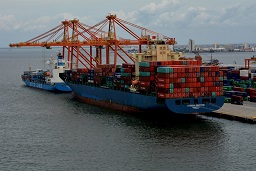
The massive order for the Manila International Container Terminal (MICT) includes five post-Panamax quay cranes capable of servicing up to 13,000-TEU boxships, the largest in the intra-Asia trade. Also on order are 20 rubber tired gantry cranes.
The purchase, along with the construction of another berth, is part of ICTSI’s USD80 million capital equipment program for the MICT.
With a maximum reach of 20 containers across and twin lift rated load capability, the post-Panamax quay cranes are capable of servicing single-ocean box ships, too large to pass through the Panama Canal. The capital equipment program would enable the MICT to service new generation vessels with capacities of up to 13,000 TEUs, setting a new standard for container terminal operation in the country.
“Hitting the two-million mark last year is a clear indication that we need to further expand our operation in response to the direction of the market. We also have to address the growing consolidation trend happening with major carriers that have them deploying larger capacity vessels,” says Christian R. Gonzalez, ICTSI Senior Vice President and Regional Head of Asia Pacific and MICT.
The 2 millionth TEU milestone triggered a multi-billion peso capacity improvement commitment with the Philippine Ports Authority (PPA). The program is in line with the projected increase in container movement as a result of an improving Philippine economy despite the global downturn in the container shipping industry.
“We have always been steps ahead of the game in terms of planning. By the way things are looking, there is a legitimate need to invest in equipment and construct an additional berth in the near future. We need to ensure expansion is ahead of the curve in terms of being prepared for an increase in vessel sizes,” continues Gonzalez.
The MICT currently has six berths. Two of the new quay cranes will be deployed at Berth 5. Another pair will be deployed at Berths 6 and 7, respectively, while the last crane will be deployed at Berth 3. The first three cranes are scheduled for delivery by 2018, with the remaining two at 2019.
In 2015, ICTSI deployed new-generation reach stackers at the MICT to improve operational efficiency as volume continued to grow. Earlier in 2014, the MICT completed the construction of Yard 7, which added four hectares of yard space to the terminal or roughly 500,000 TEUs, and further extended the terminal’s berth to 1,700 meters. With the recent expansion, MICT’s annual capacity increased to 2.75 million TEUs.
ICTSI has several other projects in the pipeline for its Philippine operation that should pave the way for it to become a complete logistics provider. These include the revival of the rail link between MICT and the recently opened Laguna Gateway Inland Container Terminal in Calamba. It has also recently submitted a proposal to build a roll on-roll off barge terminal in Cavite, south of Metro Manila.
Kalmar and Rainbow-Cargotec Industries celebrate the opening of new jetty in China

The new jetty will support Kalmar’s business growth in the Asia-Pacific region by enabling the deliveries of fully erect Kalmar yard cranes from RCI. The jetty can berth vessels of up to 50,000 DWT capacities. It is 361 metres long and the water depth is 12 metres.
RCI is a joint venture established in Taicang, Jiangsu Province, China, in 2012 between Cargotec Corporation and Jiangsu Rainbow Heavy Industries. RCI is responsible for the production of Kalmar rubber-tyred gantry cranes (RTG), automatic stacking cranes (ASC), rail-mounted gantry cranes (RMG) and ship-to-shore cranes (STS) for the global markets. The first RTG deliveries by the joint venture took place in 2013, and all deliveries have been completed on time and in budget.
Speaking at the event, Timo Alho, Vice President Intelligent Crane Solutions at Kalmar says: “Our RTG development is driven by safety, productivity and green values, which are very high on the industry agenda. To improve productivity, we have developed different driver assisting features that make it possible to squeeze seconds out from each container cycle. Automation is growing the demand for intelligent safety solutions, and we at Kalmar are developing automated RTGs that meet the demand.”
He continues: “Nowadays, operators are very conscious about their carbon footprint. We provide RTGs with energy efficient hybrid power units and zero emission fully electric cranes, which are becoming more and more popular especially in Asia.”
The opening ceremony attendees include members of the Board of Cargotec Corporation together with representatives of Jiangsu Rainbow Heavy Industries, RCI, Kalmar, Taicang Runhe Port, guests of Taicang government as well as international and local media.