Monday, December 22, 2025
spot_img
Home Blog Page 154

Kalmar delivers two super-heavy forklift trucks to Finnish steel mill

0

The delivery will take place during quarter one, 2017.

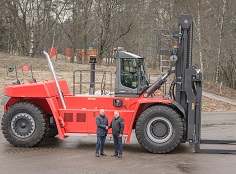
With a lifting capacity of 62 tonnes, the two new super-heavy forklifts will be the highest-capacity forklifts that Kalmar has delivered since one of its machines broke the world record by lifting 90 tonnes in 1991. They will be used to handle steel coils weighing anything from five to 30 tonnes, and will be capable of single and double coil lifting.

Kalmar’s super-heavy forklift trucks are designed specifically for the heaviest and most challenging lifting applications, making them ideal for the extreme demands of steel handling, where safety and efficiency are paramount. Kalmar DCG620-15 forklift will also feature the ergonomic EGO cabin, which provides maximum visibility and comfort for operators.

Thomas Malmborg, Vice President, Forklift Trucks at Kalmar: “We’re very happy that Kalmar forklift trucks have been chosen to ensure the safe and efficient handling of steel products at the Raahe steel mill. These forklifts, which will handle extreme weights, are the result of hard work by our dedicated teams. This prestigious order demonstrates our outstanding capabilities in developing reliable and flexible customer solutions that are able to meet the heavy-lifting demands of customers around the world.”

Kijlstra produces custom-made precast components for MoD project

0

Precast was chosen for the jetty primarily for speed of construction – the jetty needs to be ready to receive HMS Queen Elizabeth which is currently being fitted-out at Rosyth Dockyard.

Main contractor Volker Stevin has demolished the old 1920s jetty – comprising 1m thick concrete supported on a complex lattice frame. Part of the existing structure, dating from the 1970s, has been strengthened.

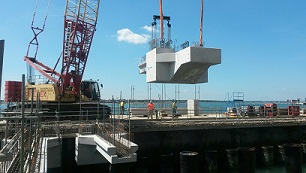
The new precast jetty is being constructed on reinforced tubular piles driven into the bed of the dock basin. It comprises a number of custom-designed precast components, all of which have been manufactured at Henlade using moulds made for the purpose by specialist suppliers in The Netherlands.

“The main supports are 31 cruciform beams measuring 10m in length, 2m high and up to 3.6m wide,” says Kijlstra’s production manager Rupert Treadaway.

These giant T-shaped beams are adjoined by some of the 44 transverse beams ranging in length from 9m to 13m. Each one of the transverse beams is unique and some have splayed ends while others have straight ends and include cast in fittings for temporary works.

Both types of beams have insitu reinforcement placed inside them at the precast yard to save vital time on site. These will then be filled with insitu concrete on site.

The cruciform and transverse beams support the 205 reinforced concrete planks which complete the upper surface of the jetty. There are also 24 precast concrete pile-caps, some of which, says Rupert, are among the most complex components he’s ever had to produce.

“There are 16 fender pile-caps comprising two types. The smaller ones weigh 32 tonnes; the larger ones weigh 50.2 tonnes.

“They are being cast in a very large and complicated mould measuring 2.5m x 2.5m x 5m long. The pile caps are all hollow, so the mould incorporates a collapsible steel core which has a hydraulic mechanism for removing it from the mould after the concrete has cured,” explains Rupert.

There are also eight ‘raker’ pile caps which are slightly smaller than the fender pile-caps.

The fender pile-caps are designed to withstand the lateral forces imposed by the 65,000 tonne Queen Elizabeth-class vessels as they come in to dock. They are complemented by fender infill panels which have special stainless steel plates cast into them to add strength and absorb the high friction forces acting on the jetty.

“This is undoubtedly one of the biggest contracts Kijlstra has secured in the UK and it’s one of the most prestigious,” says Rupert. “It has been a challenging project due to the geological constraints on site which has meant design and manufacture has had to be adapted to accommodate.”

And so far, it is also a satisfied client, with all the components delivered on schedule to keep the project on track. Manufacture began at Henlade in March 2016 and the first batch was delivered to site in May. Kijlstra delivered the last consignment in October 2016.


EU-funded S/F SamueLNG Project led by Dragages Ports starts in Gijon

0

S/F SamueLNG Project, lead by French Dragages Ports (DP), is the first phase of the Global Project ‘Towards a Blue Atlantic Arch by 2025’. The overall project aims to improve the sustainability of marine traffic through the use of marine Liquefied Natural Gas (LNG) as an environmentally-friendly, and cost-effective, alternative to conventional ship fuels for small vessels.
According to the ‘Third IMO Greenhouse Gas Study 2014’, maritime transport emits around 1000 million tonnes of CO2 annually and is responsible for about 2.5% of global greenhouse gas emissions. Shipping emissions are predicted to increase by between 50% and 250% by 2050 – depending on future economic and energy developments – and something clearly needs to be done. Such increases are not compatible with the internationally agreed goal of keeping the global temperature increase below 2°C, compared to pre-industrial levels. The current goals require worldwide emissions to be at least halved, from 1990 levels, by 2050.

Subsequently, the IMO’s Marine Environment Protection Committee (MEPC) has agreed that implementation of a 0.5% global sulphur cap on marine fuel will be brought forward to 2020, from the originally proposed date of 2025. The S/F SamueLNG Project will contribute to this by helping to achieve the objectives of two key EU Directives: Directive 2014/94/EU on the sustainability of the European maritime transport and Directive 2012/33/EU on reduction in the sulphur content of marine fuels.

Key activities
Over the next three years, the S/F SamueLNG Project will cover the following key activities:
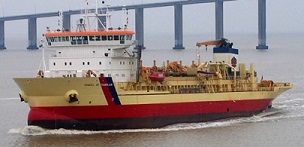
LNG retrofit of DP’s Samuel de Champlain – an 8,500m3 Trailing Suction Hopper Dredger – from Marine Gas Oil to a dual-source fuel engine system
LNG bunkering studies including: a risk assessment in the port of Nantes Saint-Nazaire, a mobile bunkering unit in the Port of Gijon, and a floating device in the Port of Vigo (in conjunction with each of the port’s partners)
Environmental Impact Assessment studies in the Ports of Rouen, Le Havre and Nantes Saint-Nazaire
The training of staff involved in LNG operations in the Ports of Nantes Saint-Nazaire and Rouen
Dissemination of the results to the maritime community by CEDA

The Consortium
The SamueLNG Project is coordinated by DP and supported by a solid consortium of 12 partners, from along the Atlantic Arch, representing France, Spain and the Netherlands. The partners working alongside DP are:
5 public port authorities: Nantes Saint-Nazaire (GPMNSN), Le Havre (GPMH), Rouen (GPMR), Port Authority of Gijon (APG), Port Authority of Vigo (APV)
2 ship engineering and design companies: Inova, Ghenova
2 energy supply companies: Energias de Portugal (EDP), Gas Natural Fenosa (GNF)
A short sea shipping company: Suardiaz (VN)
An international dredging association: CEDA

The S/F SamueLNG Project started work in earnest, at the meeting in Gijon, Spain, to agree schedules which will be disseminated to all interested parties in due course. The EU tendering process, to choose the shipyard that will carry out the LNG conversion, will begin soon.

Photo low res version supplied (a high resolution image is available on request):
Caption: Samuel de Champlain dredger operating in front of Saint Nazaire bridge in the Loire Estuary
Credit: Dragages Port

Official liquidation for Hanjin

0

This basically means that any method of rehabilitation for the shipping company is over and will transfer into liquidation of the company.

According to analysts liquidation of Hanjin would bring in an estimated USD1.56 billion rather than continuing the rehabilitation scheme which would be costly.

Since its’ collapse in August 2016, parts of the company has been sold off bit-by-bit, with vessels, assets and even staff being transferred. The most recent action was the eventual wrap-up of Hanjin’s stake in terminal operator TTI, who own terminals at the Port of Long Beach and the Port of Seattle.

The announcement for bankruptcy will be made by the Seoul Central District Court on 17 February.

Hanjin, which was formed in 1977, was South Korea’s number one shipper and one of the largest shipping lines in the world before its’ collapse with debts of more than USD5 billion.