

Monday, December 22, 2025
spot_img
Home Blog Page 155

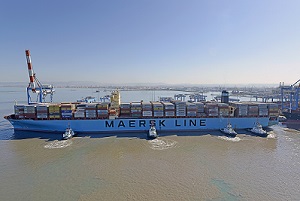
Haifa Port – the first in Israel to enter the era of 14,000 TEU ships, with today's call of the Maersk Elba

0

The Maersk Elba is the largest ship ever to dock in Israel, and its visit formally inducted Israel’s leading port into the exclusive club of ports that handle high-capacity 14,000 TEU Mega ships. This ship, part of the weekly service line operated by the 2M Alliance of Maersk and MSC, links the ports of South Korea, China and Singapore to Haifa Port, and from there continues to the Adriatic ports. It entered the Carmel Terminal, where it was operated on by 4 STS cranes with an average productivity of 136 containers per ship hour.

All who familiar with the shipping industry understand that preparing Haifa Port to welcome this new generation of ships was a lengthy process that has only now come to fruition. Today, Haifa Port stands as the only Israeli port that has the necessary cranes, depth of water, tugs, and – as many would attest – the professionalism and experience, to provide these massive ships with the excellent service they expect.

In order to prepare for the arrival of the Maersk Elba and similar subsequent vessels, five new cranes were built at the Carmel Terminal, including two STS cranes from KOCKS CRANES with arms suitable for transporting 20 + 1 lines of containers across the ship. These were constructed on the dock and are now fully operational, joining six other STS cranes. Furthermore, three new KoneCranes RMG’s cranes have been added at the storage area of the terminal, where they complement an existing 15-crane array.

Israeli Transport Minister Israel Katz officially unveiled the new cranes a few weeks ago, just in time for wide beam ships to begin calling at the port. Last month, the Israel Ports Company also deepened the water by the Carmel Terminal so that such ships can reach their maximum draft, or very close to it.

In the last two years, Haifa Port has also acquired two new tugs, both of which can achieve bollard pull of 70 tons. The second of these, the Elad, arrived a few months ago.

These measures, in addition to adopting the advanced Navis TOS system, completed Haifa Port’s preparations. It is now the only Israeli port suitable for 14,000 TEU ships and is likely to remain so in the near future. It should be noted that the next generation of ships, in the order of 18,000 TEU and above, will not be able to call in Israel during the next few years. Therefore, Haifa’s 14,000 TEU can be termed “Isra-max”, in the parlance of “Panamax” ships.

Mendi Zaltzman, Haifa Port CEO, commented: “We are entering a new era, as Haifa Port is promoted to the premier league of terminals worldwide. This advancement comes with its own obligations. It is important to remember that these massive ships are being serviced at a dock that was originally built to accommodate ships of up to only 6,000 TEU, yet now we are fully prepared to receive ships of 14,000 TEU. The ships in question, such as the Maersk Elba and those that will follow, are very selective about the few ports they call at, and they will not settle for anything less than excellent, rapid service. We are prepared to provide precisely this outstanding level of service to these ships and all others that opt to enjoy Haifa Port’s services.”
Barcelona sets new record in FY2016

0

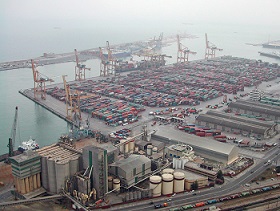
“These three most strategic segments of activity at the Port of Barcelona registered significant year-on-year increases,” declared the organisation’s President Sixte Cambra during the press conference held yesterday. “The positive performance of traffic segments shows that we are well-positioned to achieve the goals we set in the Port of Barcelona Third Strategic Plan”.

Regarding total containers, which are a reliable indicator of progress in the surrounding economy, the Port moved more than 2.2 million TEU (20-foot container equivalent units). This record represents an increase of 14.5%, the highest in the last decade. All sections of this traffic behaved very positively: foreign trade containers (import and export), cabotage with the Balearics and Canary Islands and transshipment (where containers are unloaded at the port to be shipped on to their final destination).

During 2016, foreign trade containers continued to increase, reflecting the efforts of the hinterland producers to open up to international markets and showing a clear recovery in domestic consumption. So it was that export container numbers grew by 3.8% (to reach 683,527 TEU) while import containers advanced at a rate of 8.7% (totalling 518,480 TEU). Meanwhile, containerised cargo in cabotage to the Spanish islands surged 10% (up to 124,455 TEU) and containers in transhipment increased by 47% (431,750 TEU). This latter figure indicates a trend towards a recovery in traffic that was severely affected during the crisis.

As far as the geographical distribution of the containers handled by the Port is concerned, Asia stands out as the origin of 77% of the imports and the recipient of 43% of exports leaving the precinct. By country, China remains the largest trading partner, since it is the origin or destination of 23% of the containers passing through the Port. The Americas account for 25% of exports and 9% of imports. United States (+7%), Mexico (+9%) and Brazil (+17%) are the fastest-growing countries in the Americas in terms of their exchanges with the Port of Barcelona.

Vehicle movements at the Port grew 4% in 2016 to reach a record 916,834 units. Most of these (778,109 cars) are foreign trade: exports continue to grow (+3%, with more than 465,000 units), while imports are progressing at a rate of 20%, although they account for fewer units in absolute terms (206,000).

Passenger movements also registered record highs, with nearly 4 million passengers (3,958,960 in total, up 6.7%), a figure that includes both ferries and cruisers. Ferry passengers (1.27 million) travelling to the Balearic Islands, Italy or North Africa increased by 9%. Meanwhile, cruise passengers
numbered 2.68 million (+5.6%). Particular mention should be made of the fact that passengers in turnaround (starting and ending their cruise in Barcelona, who therefore make a greater contribution to the local economy) represented 58% of all the Port’s cruise passengers, increasing by 14% in 2016. However, the number of passengers merely stopping over to visit the city for a few hours decreased by 4%.

The Port of Barcelona handled more than 370,500 ITUs of ro-ro traffic (cargo loaded onto a ship on a truck, platform or trailer), up 2.9% year on year. This business segment includes exchanges of ro ro cargo with the islands (235,400 ITUs, or intermodal transport units, up 7.4%) and traffic on the motorways of the sea or Short Sea Shipping (SSS), which channelled more than 135,000 ITUs with several destinations in Italy and North Africa. This figure means that more than 135,000 lorries were diverted from the road to the maritime mode, which is more economical and environmentally efficient because it reduces emissions.

During the period, the Port of Barcelona transported 11.4 million tons of liquid bulk, 5% less than the previous year. However, shipments of diesel/gas oil (the main hydrocarbon passing through our facility) grew by 16.4% to 2.7 million tonnes.

Meanwhile, the volume of dry bulk remained practically stable compared to the previous year, with 4.4 million tonnes handled. The top products in this section were cement and clinker, up 9%, and cereals and meal, which also increased by 9%.

Financial results

Regarding the Port of Barcelona’s financial results during 2016, we should underline the organisation’s considerable capacity to generate resources, with a cash flow totalling €86.2 million, a year-on-year increase of 17%.

Net turnover remained stable compared to the previous year, with € 155.3 million despite the significant cuts to Port fees applied to concessions, which are the result of new land valuation. Provisional figures for the close of the financial year indicate that the Port of Barcelona obtained profits of € 33.2 million (-16%). This decrease is due mainly to the fact that extraordinary profits were obtained in 2015 from the sale of various financial assets.

In 2016 the Port of Barcelona managed to reduce significantly the long-term debt contracted with the European Investment Bank (EIB). After the early cancellation of € 20.8 million, added to the forecast amortisation timetable, the facility reduced its debt by 13% to a current level of € 303.9 million.

During the period investments were made to the tune of € 25.9 million, the most significant of which include several works projects related to rail access, the actions on Prat wharf, extending the rail terminal on the South Dock, the new road and rail access to Alvarez de la Campa wharf and the new ice factory at the fishing facilities, among others.

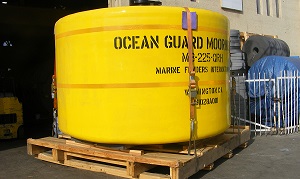
Remote island St. Helena equipped with SFT Buoys

0

The buoys will be installed at the new Rupert’s Bay Wharf which is a new access point to the island. In 2011 a South African consortium was awarded the contract to build a new airport which as well involved the new construction of marine facilities.

Our buoys with dimensions of OD 3,700 x H 2,250 mm are equipped with quick release mooring hooks, non- slip deck, solar amber LED light (GPS synchronized) and internal counter weight. Prior to shipment the buoys were inspected by Intertek, an independent third party and found in line with the specification. A comprehensive quality documentation, reviewed by 3rd party Intertek, was handed over to the client recently.

Right now, our buoys are on their way in a 40′ flatrack to Cape Town from where the onward transport is organized to the new wharf on the island of St. Helena.

The Port of Kapellskär has expanded from three to five quay-berths

0

The Port of Kapellskär in Sweden has been expanded and now has two piers and a total of five modern quay-berths. The new 245 metre-long pier has been in operation since summer 2016. The original pier has been extensively renovated and is now ready for traffic.

“An important milestone has been reached now that we have all of our five modern quay-berths in operation,” says Peter Lundman, Technical Operations Manager at the Port of Kapellskär. The dredging work has been completed, the concrete has been repaired and the pier has been equipped with erosion protection, fenders, bollards, safety barriers and new lighting. New water supply and drain connections have been installed and the pier is prepared for the capability to allow vessels to connect to shore electricity.

The shipping company DFDS has moved all of its services to the renovated pier, with the first vessel calling on Saturday 28 January 2017. With this move DFDS will now operate from the northern esplanade and use its new freight forwarding building. Tallink Silja and Finnlines will continue to operate services from the new pier that was completed in summer 2016.

Viking Line will continue as usual to call at the port’s central quay-berth. When the ferry Rosella is back in service on 3 February, after having been in the dockyard, the new Viking Line check-in will be used for the first time.

After three years of reconstruction Kapellskär is a state-of-the-art port with the capacity to welcome the largest combined cargo and passenger-carrying vessels. The port esplanade area is almost twice as large and the logistics and safety solutions have been significantly updated. The official opening of the new Port of Kapellskär will take place in early summer 2017.