

Thursday, December 18, 2025
spot_img
Home Blog Page 16

Port of Hamburg wins award for best seaport in Europe

0

Asia Cargo News honours logistics service providers in 50 categories. For the fourth time in a row, the Port of Hamburg has succeeded in being named the best port in Europe.

At the gala of the trade magazine Asia Cargo News in Singapore, Alan Yip of Kerry Logistics presented the Asian Freight, Logistics and Supply Chain Award (AFLAS) in the category “Best Seaport – Europe” to HHM representative Anne Thiesen.   


In the final vote among the four nominated ports in Europe, the Port of Hamburg was able to leave the ports of Rotterdam, Antwerp-Bruges and HAROPA behind. “We are very pleased that the readers of Asia Cargo News have placed their trust in us for the sixth time,” says Thiesen. With this year’s “Best Seaport – Europe” honour, the Port of Hamburg holds six awards in this category. It went to the Port of Hamburg in 2015, 2016, 2020, 2021, 2022 and 2023. In addition, the Port of Hamburg won the award in the category “Best Global Seaport” in 2018 and 2019. 

Axel Mattern, Executive Director of Hafen Hamburg Marketing, is also proud of winning the award again: “The prize shows that our achievements are recognised worldwide despite external challenges. At the same time, it is an incentive for the port industry to continue providing outstanding service.”


The awards are hosted annually by Asia Cargo News. The 15,000 readers of Asia Cargo News and subscribers to E-News vote for the winners. The awards are designed to recognise leading service providers such as airlines, shipping lines, airports and seaports, as well as logistics and 3PL companies and other industry professionals, according to Asia Cargo News.

The nomination criteria are set annually by the organiser. After an initial evaluation, the top eight nominees in each category will face a final vote. The top four in each category then make up the final shortlist. Asia Cargo News is considered an important source of information for freight, logistics and supply chain companies based in or operating in Asia.
Port of Kapellskär has Sweden’s first suction mooring

0

Port of Kapellskär has welcomed the new Finnlines vessel with brand new technology. The port now offers automooring using vacuum pads, as well as next generation onshore power connections. This makes mooring more efficient and improves the sustainability.

Mid-September was the premier of Sweden’s first automooring of a vessel using vacuum technology. The brand new Finnlines vessel, M/S Finnsirius, which operates on the Kapellskär – Långnäs – Naantali route, now docks using vacuum pads. The pads can dock and undock the vessel in less than 30 and 15 seconds, respectively.


“Together with Finnlines, we have planned and updated Port of Kapellskär with brand new technology before the brand new Finnlines vessel arrived. Automooring using vacuum technology improves sustainability by providing a safer working environment and reduced environmental impact,” says Johan Wallén, Chief Commercial Officer at Ports of Stockholm.


Automooring with vacuum technology eliminates the risk of injury, as it is work handling conventional mooring lines, that carries the greatest injury risk during a vessel call. Operative efficiency is also improved as the mooring time is reduced. The vessels engines can be stopped earlier, which leads to a significant fuel saving and reduced NOx and CO2emissions, especially when combined with connection to onshore power.


M/S Finnsirius also connects to onshore power at Port of Kapellskär using a next generation crane, a PowerReach NxG. A lot of power can be transferred using this system. The voltage capacity is 11,000 volts, or 11kV, which delivers power of up to 4 MVA. This is the combined electricity consumption equivalent of 1,000 households.


Connecting to onshore power enables a significant fuel saving, as the vessel’s auxiliary engines do not need to be used at the quayside. This reduces NOx and CO2emissions. The work environment is also improved, as the noise levels and vibrations from the vessel are reduced. The lower noise levels also have a positive impact on the surrounding environment.


Ports of Stockholm began to provide onshore power connections for vessels in the 1980s and all of its ports are now equipped with onshore power connection facilities.


The facilities for onshore power connection and automated mooring at Port of Kapellskär is partly financed by the EU, within the framework of the EU project “Upgrade of the Baltic sea bridge Kapellskär–Naantali (MoS Finnlink).” The onshore power connection project also has funding from the Swedish national Climate Leap investment project.

Victoria International Container Terminal gets new automated STS cranes

0

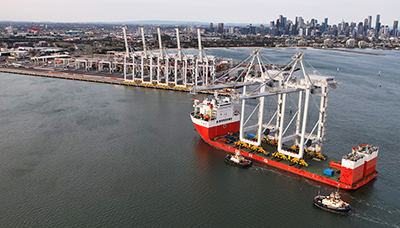
Victoria International Container Terminal (VICT), Australia’s first fully automated container terminal and one of world’s most advanced port facilities, will soon be handling the largest boxships to arrive in Australia after the recent delivery of two new ship-to-shore (STS) cranes.

“We are now ready to receive the largest vessels that will come to Australia as part of the upsizing strategy undertaken by the all the major shipping lines in the world. This trend will lead to an increasing number of supersized vessels sailing into Phillips Bay and mooring at VICT – the only terminal in Melbourne capable of receiving them,” said Bruno Porchietto, VICT chief executive officer.

VICT’s new automated cranes are the largest in Australia, with a lift height of 49 meters or 10 meters higher than the terminal’s five existing STS cranes. The 60-meter boom outreach enables the new cranes to operate 22 containers across on a vessel. The existing cranes, on the other hand, are capable of handling 19 containers across with their 50-meter boom outreach. The new cranes also offer better productivity with their lashing platforms mounted 15 meters high compared to the cranes that only allow pinning to be completed at the quay level.

VICT’s acquisition of the new cranes form part of the AUD235 million expansion project that will increase the terminal’s capacity to 1.25 million TEUs.

Victoria International Container Terminal is a subsidiary of International Container Terminal Services, Inc. (ICTSI), the world’s largest independent terminal operator.

Rio Brasil Terminal welcomes COSCO’s ESE2 service

0

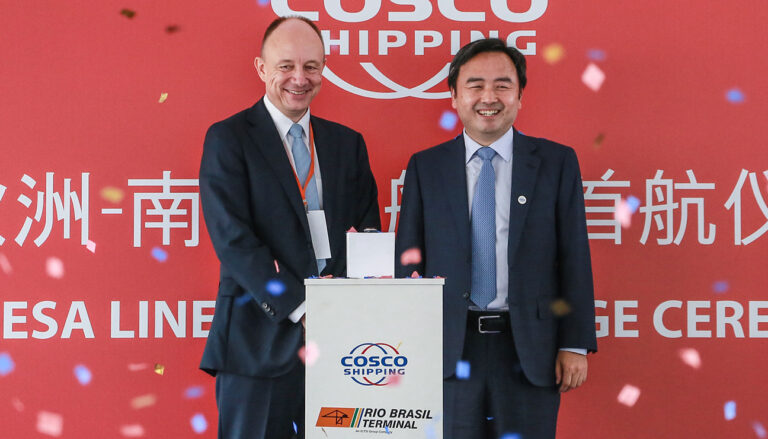
Rio Brasil Terminal (RBT), International Container Terminal Services, Inc.’s (ICTSI) operation at the Port of Rio de Janeiro, recently handled the inaugural call of COSCO Shipping Lines’ Europe – East Coast of South America (ESE2) service.

On 15 September, vessel Xin Nan Tong inaugurated the ESE2 service at RBT. The new service connects the Brazilian states of Rio de Janeiro and Minas Gerais to Europe, offering customers a stable weekly connection with very competitive transit times from the East Coast of South America to Europe. The ESE2 service is aimed at targeting refrigerated cargoes out of South America, and the consuming markets of Europe such as UK, Netherlands and Belgium.

The ESE2 service covers the following port rotation: Rotterdam (Netherlands) – London Gateway (UK) – Hamburg (Germany) – Antwerp (Belgium) – Lisbon (Portugal) – Algeciras (Spain) – Santos (Brazil) – Paranagua (Brazil) – Montevideo (Uruguay) – Buenos Aires (Argentina) – Itapoa (Brazil) – Paranagua – Santos – Rio De Janeiro (Brazil) – Algeciras – Rotterdam, with an expected total duration of 9 weeks. The initial fleet will have 4,000-5,000 TEU ships.

Anders Kjeldsen, ICTSI senior vice president and regional head for Latin America, witnessed the inauguration of the service together with Heyue Ge, COSCO Shipping Lines deputy general manager. They were joined by RBT’s business partners, local government officers and stakeholder representatives from across the supply chain. 

On the same occasion, RBT and COSCO signed a preliminary contract for the operation of CLIA Pouso Alegre – a logistics corridor in Minas Gerais covering empty container yards and bonded warehouses.