Sunday, December 21, 2025
spot_img
Home Blog Page 164

British Ports Association responds to Prime Minister's BREXIT speech

0

“With the Prime Minister indicating that the UK will be leaving the Single Market, the issues and implications of this for UK ports are centre around increased Government border activities which could lead to disruption on goods and logistics flows at ports. We will be discussing with government how the re-introduction of customs and VAT declaration requirements on intra EU routes can be best managed at the border.

“There are different Brexit related challenges and opportunities for ports across the UK. Many ports with intra EU trade will welcome the indication from Mrs May that the UK would look to negotiate a deal that would allow a future free trade agreement with the EU.”

Growing number of vessels receive environmental discount at the Port of Gothenburg

0

Heading the discount list are Donsö-based shipping companies Tärntank Ship Management AB and Furetank AB, whose vessels are powered by liquefied natural gas.
The Port of Gothenburg rewards vessels that are environmental high performers. One in three vessels that called at the largest port in Scandinavia last year were classified as green according to the industry environmental indexes.
In total, 75 vessels received a discount of 10 per cent on the port charges compared to 41 in 2015.
Edvard Molitor, Environmental Manager at Gothenburg Port Authority, said: “The growing number of vessels classified as green is highly encouraging. They are also vessels that call at the port on a regular basis.”
The discount is based on two separate environmental indexes, Environmental Ship Index and Clean Shipping Index (see fact file below). Vessels that have a score of at least 30 according to ESI, or which are classified as green according to CSI, receive a 10 per cent discount on the port charges.
Gothenburg shipping companies operate using liquefied natural gas
An additional discount is available for vessels that run on liquefied natural gas (LNG). By using LNG as a marine fuel, emissions of sulphur and particles are reduced to almost zero and nitrogen oxide emissions by 85-90 per cent. There is also a substantial reduction in carbon dioxide emissions.
In total, these vessels receive a 30 per cent discount each time they call. In 2016, two vessels received the maximum discount. These were Ternsund and Fure West, owned by Donsö-based shipping companies Tärntank Ship Management AB and Furetank AB.
“Swedish shipping companies are very much at the forefront when it comes to LNG, methanol, hybrid electric ships and other eco-smart solutions,” said Edvard Molitor.
Port rewards green initiatives
The current environmental discount was first introduced on January 1, 2015. Another similar environmental reward system was in place prior to that. The aim is for shipping companies to be encouraged to mitigate their environmental impact in a way that goes beyond laws and regulations.
“We want to reward the shipping companies for their green initiatives. For the average freight vessel, the environmental discount could result in savings of tens of thousands of kronor,” explained Edvard Molitor.
Now it is even simpler for shipping companies to secure a discount. Previously, companies were required to register their vessels with Port Control at the Port of Gothenburg. With effect from January 1, 2017, registration takes place automatically when vessels call at the port. Vessels running on LNG will still need to report to the Gothenburg Port Authority to secure the discount.

Shipping companies that receive an environmental discount:
Atlantic Container Line, APL, Amyntas, Baltic Front Shipping, Broström, Carl Buttner GmbH & Co, DFDS, Dong A Tanker, Euro Marine Carrier, Furetank, Glovis, Hapag Lloyd, Handytankers, Hyundai Merchant Marine, Maersk Line, Maersk Tanker, Mitsui OSK-Lines, Mediterranean Shipping Company, Norient Product Pool, Stena Line, SCF Management Services, Sirius Shipping, TUI Cruises, Tärntank Ship Management, TMS Tankers, Thun Tanker, Wallenius Lines, Wallenius Wilhemsen Logistics, Wilson Euro Carriers and Älvtank.

Port of Hamilton releases results of 2016 shipping season

0

The agri-food sector continues to shine within the Port of Hamilton’s cargo mix. In 2016, agricultural cargoes surpassed 20.7% of the port’s total cargo, the highest proportion ever. Commodities such as Ontario-grown corn, wheat and soybeans, and crop inputs such as fertilizer and potash made up the 2016 total agricultural tonnage of 1,916,535 MT.
The port’s contribution to Ontario’s agri-food sector is poised to expand in 2017, as two major infrastructure developments come into operation: a new 50,000 MT capacity grain export terminal, under construction by G3 Canada Ltd., and a new flour mill under construction by Parrish & Heimbecker.
“We’ve seen terrific momentum in the past several years, as new terminal investments have increased our capacity to get crops from Ontario farms to global markets efficiently. With these new developments on the horizon, we expect the growth trend to continue,” said Ian Hamilton, President & CEO, Hamilton Port Authority.
Steel industry sector tonnage is a complex picture, with the ongoing decline in tonnage at Hamilton’s Stelco facility being balanced by positive performance among other steel players, such as ArcelorMittal Dofasco and Federal Marine Terminals. Overall, steel sector commodities such as iron ore and coal were 5,961,715 MT of the port’s total cargo (not including finished steel), representing a modest decline of 1.9%. Imports of finished steel reached their highest volume in the past five years, with more than half a million tons (509,087 MT) transiting the port in 2016.
Liquid bulk commodities make up approximately 4.2% of the port’s total tonnage. These products, such as gasoline for southern Ontario consumer gas stations, jet fuel for the airport, and asphalt for area roads, totaled 394,000 MT in 2016, with volumes increasing by 17.1% over 2015.
The Port of Hamilton also serves as a strategic location for the import and export of machinery and components for Ontario’s manufacturing and energy sectors. Measured in cubic metres, these are heavy-lift items such as windmill blades and heavy equipment. More than 52,000 m3 transited the port in 2016, exceeding the five-year average by 6.7%.
The Port of Hamilton is more than a marine facility; it is one of Ontario’s key multimodal hubs, and rail service is an increasingly important aspect. More than 6,200 rail cars transited the port in 2016, 15.2% more than 2015, following a steady growth trend over the past five years. “We’re focused on delivering modal choice, efficiency and competitiveness to port users, helping Ontario industries thrive and our community prosper,” said Ian Hamilton.
The Port of Hamilton is Ontario’s largest port, managing 630 acres of transportation-intensive industrial land on Hamilton’s working waterfront. More than 2,100 people work at the 130 companies located on port lands. The port’s employment complement has grown by 30% since 2009.

IMO Maritime Day theme launched at the Port of Felixstowe

0

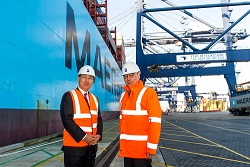
“Connecting Ships, Ports and People” has as key objectives improving cooperation between ports and ships and developing a closer partnership between the two sectors. It will seek to raise global standards for the safety, security and efficiency of ports, and for port and coastal state authorities, as well as standardising port procedures by identifying and developing best practice guidance and training materials.

Clemence Cheng, Chief Executive Officer of the Port of Felixstowe and Managing Director of Hutchison Ports Europe, said: “We are delighted to welcome Mr Lim and to support the IMO in the important work it does to maintain and improve standards across the international shipping industries. Hutchison Ports is committed to the highest principles of both operational efficiency and environmental stewardship and, in that regard, our philosophy is closely aligned with that of the Secretary General.”

Mr Lim said: “The maritime sector, which includes shipping, ports and the people that operate them, can and should play a significant role helping Member States to create conditions for increased employment, prosperity and stability ashore through promoting trade by sea; enhancing the port and maritime sector as wealth creators both on land and, through developing a sustainable blue economy, at sea.

“Ultimately, more efficient shipping, working in partnership with a port sector supported by governments, will be a major driver towards global stability and sustainable development for the good of all people.”

The aim of the latest World Maritime Day is to build on the theme for 2016, “Shipping: indispensable to the world”, by focussing on helping Member States to develop and implement maritime strategies to invest in a joined-up, interagency approach that addresses the whole range of issues, including the facilitation of maritime transport and increasing efficiency, navigational safety, protection of the marine environment, and maritime security.