Sunday, December 21, 2025
spot_img
Home Blog Page 166

Ports of Stockholm sets new container record 2016

0

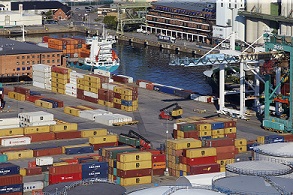
At the beginning of December 2016 Ports of Stockholm exceeded the previous record set at Frihamnen of just over 51 000 containers*. The total number of containers handled in 2016 was
53 945.

“It’s extremely positive that the shipping companies are happy with the efficiency and collaboration at Frihamnen, and that this has resulted in increased volumes in container handling. We are simultaneously building a new freight port that in the future will account for a major portion of the supply of goods to the rapidly growing Stockholm region,” says Henrik WiderstÃ¥hl, Deputy Managing Director and Head of Marketing at Ports of Stockholm.

The Container Terminal at Frihamnen is an efficient terminal that is located at the heart of Sweden’s largest consumer market, containing one third of Sweden’s population. The world’s second largest container shipping company, MSC, operates services to and from the terminal. Other shipping companies that operate into and out of the terminal are Team Lines, TransAtlantic Container and Unifeeder.

Ports of Stockholm is building a new port to the south of Stockholm, the Stockholm Norvik Port, which is anticipated to open in 2020 and will have a draught of 16.5 m (the maximum for the Baltic Sea).
The Stockholm Norvik Port will make it possible to transport goods by sea as close to the country’s largest consumer area as possible. This results in major environmental benefits and simultaneously reduces the pressure on Sweden’s already congested road and railway networks.

TT Club once more urges care with coiled cargoes

0

In general, investigations into incidents along the international supply chain – whether on roads, rail, inland waterway or at sea – can often be attributed to poor practices in the packing of cargo transport units (CTUs) and coiled materials are a particular hazard.

As a leading insurer of international container transport TT Club has dealt with many incidents where coils, mostly of steel, have been improperly packed and insufficiently secured in the container, leading to the cargo shifting inside the unit and usually breaking out, resulting in injuries or damage to property. The packing process is critical given the forces exerted on the freight during a typical journey, such as braking or turning of a road vehicle, variable handling techniques at port terminals and significant, sometimes violent motions of a ship at sea. The consequences of these types of forces on poorly packed cargo will, of course, vary from over-turned trucks, to train derailment and damaged cranes to containers lost overboard and damage to the ship. Coils have even been known to break through the floor of a carrying unit and escaped into traffic. In short, improperly secured coil materials can have significant and fatal consequences.

“Such experiences led us to collaborate with the CINS Organisation – a significant safety-based initiative set up by major container shipping lines,” explains TT Club’s Peregrine Storrs-Fox, “In order to update and expand our earlier ‘Stop Loss’ briefing guide, which addressed carriage of metal coils.”

The freely available revised guidelines, ‘Transport of Coiled Materials in Containers'[1], focus attention on how a container packer can understand the risks involved through the supply chain in order to ensure that the coils are packed and secured successfully. Equally, while recognising that there are a number of proprietary solutions available, these guidelines specifically support less sophisticated operations reliant primarily on timber for load distribution and bracing, where the greatest risk exposure has been seen.

Port of Kiel posts record cargo and passenger handling

0

Ferry services to Scandinavia and the Baltic region showed above-average growth, while trade with Russia continued to decline. Dr Dirk Claus, Managing Director of the Port of Kiel (Seehafen Kiel GmbH & Co. KG) comments: “Kiel has achieved a record result. Increases of as much as 7.6 % were posted at the public terminal facilities operated by the Port of Kiel.” The port was able to win two important new customers in the past year – SCA and Iggesund Paperboard – and to open a new forest products terminal in the Ostuferhafen. “Investment in the paper business means we will continue to grow and can now set our sights on a seven million ton handling figure”, says Dirk Claus. “It is also of decisive importance that we have been able to expand the port’s logistics competence”, he added.

Almost 2.1 million travellers were recorded on passenger services – an increase of 3.4 % over the previous year. All the ferry operators reported growth with Color Line posting the highest number of passengers. In the cruise shipping sector Kiel can look back on its most successful cruise shipping season ever with record results in the numbers of ship calls, passenger totals and overall tonnage.

Maydon Wharf infrastructure upgrades in the Port of Durban reach a milestone

0

Transnet Group Capital (TGC) – which is executing this major project on behalf of TNPA – completed work on Berth 13 and 14 within the project’s timeframe.

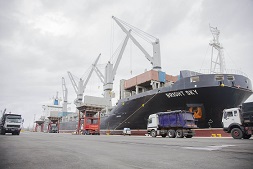
On Friday 13 January the Port of Durban serviced Bright Sky, the first vessel to use the common-user berth 14 after reconstruction of both the berths and a handover to port’s operations. Both berth 13 and 14 are now fully operational.
Port of Durban Manager Moshe Motlohi said: “The handing over of these two berths marks a great milestone for one of the oldest ports in the country. It talks to safety improvements and revamping of infrastructure which will further enhance the attractiveness and competitiveness of our ports.”

The R1.5 billion project for reconstruction and deepening of six Maydon Wharf Berths 1-4, 13 and 14 was awarded to Stefanutti Stocks AXSYS Joint Venture in 2014.

It forms an integral part of Transnet’s Market Demand Strategy which aims to enable the effective, efficient and economic function of an integrated port system to promote economic growth.

Once completed the berths will have a draught of 14.5m enabling them to handle vessels with draughts up to 13 m, making these berths the deepest berths in the Port of Durban. However, the Maydon Wharf access channel will still need to be deepening thereafter to enable deeper-draught vessel to sail in fully laden.

Constructed more than 90 years ago, the Maydon Wharf Precinct is one of the oldest cargo terminals and is the largest breakbulk and dry bulk handling precinct in the Port of Durban covering 120 ha of port land.
The precinct’s youngest berth is about 42 years old while its oldest berth is 92 years old.

The quay walls in the precinct were originally designed to handle vessels of approximately 20 000 DWT versus the 55 000 DWT vessels now calling the port.

Port of Durban Engineer, Malefetsane Setaka said: “The quay walls of the old berths had reached their lifespan and were becoming unsafe for the vessels to operate. This project has given new life and a safe environment for larger ships to berth.”
The project scope involved demolition of paving, rail track work and services, construction of new steel sheet piled quay walls, demolition of existing piled crane beams, extraction of timber, concrete piles and limited number of steel sheet piles and removal of the existing quay walls and capping beams.

Despite the reconstruction being identified as a brownfield project, the team had a challenge in obtaining initial engineering drawings for the berths.

“One of the biggest challenges was to understand and retrieve the initial engineering recording of these berths. This meant that the team had to spend more time in designing and reconstruction of the quay walls,” added Setaka.

The newly constructed quay walls will now have a lifespan of about 50 years.

The completion of Berths 13 and 14 comes a few months after the handover of Berth 1 and 2 to port operations in July 2016. This brings to four the number of completed berths out of the six berths included in the project scope.
“Our customers are the key beneficiaries of this project. They will now operate in safer and much deeper berths. We are also pleased that the project timelines committed to were adhered to by the project team,” added Motlohi.

The completion of the four berths, 1, 2, 13 and 14 within schedule has generated positive feedback from TNPA customers who have been kept abreast of all the progress throughout the project. TNPA customers were kept informed via a weekly communique.
The project has created a total of 127 jobs including general workers, semi-skilled workers, safety officers, and storeman as well as project managers. On skills development programme, 206 people were trained and attained various skills in lifting and rigging, construction, project management as well as safety officers.

Its supplier development programme was 7% above target and to the total value of R273 million of the overall cost of the project. About R116 million of the R273 million was spent on national and regional suppliers who provided concrete, foam work, dredging and scouring services. An amount of R83 million was spent on Small Business Development with service ranging from travel, steel suppliers, reinforcing, electrical work and earthworks and plant hire.
The project to reconstruct and repair all six berths is expected to be completed by 2018.