
Sunday, December 21, 2025
spot_img
Home Blog Page 167

Smart Freight Center and FEPORT sign MoU

0

Freight transport forms the backbone of today’s global economy; materials and products manufactured in one region are transported to another region along increasingly lengthy and complex transport chains, often involving more than one mode of transport as the product travels to its destination, stopping at warehouses, ports and terminals along the way.

However, the use of different approaches in different locations and for different activities along the supply chain leads to fragmentation in calculating and reporting emissions.

In an effort to bring more consistency in the calculation and reporting of emissions, Smart Freight Centre (SFC) has formed in 2014 the Global Logistics Emissions Council (GLEC), a voluntary partnership of companies, associations and programs committed to the consistent calculation and reporting of emissions from logistics operations, with a view to using this information as the basis for targeted emissions reduction from the logistics sector.

Since 2012, the major container terminal operators in the European Union have created a voluntary methodology (the EEEG[1] Guidelines) which allows container terminals to calculate their CO2 emissions on a periodical basis.

“Sustainable port and logistics operations and the reduction of carbon emissions are among the top priorities for private port operators. For many years our members have taken voluntary concrete steps to reduce their emissions. We believe that industry actors remain best placed to take initiatives aiming at the necessary steps to continue to reducing emissions and we are doing it” continues FEPORT Secretary General.

“The Smart Freight Center’s Framework for Logistics Emissions Methodologies (GLEC) is now recognized as the logistics sector guidance by the Greenhouse Gas Protocol Corporate Standard, the most widely-accepted GHG accounting practice. This is why FEPORT has decided to engage into an active cooperation with the Smart Freight Center” comments Ms. Lamia Kerdjoudj-Belkaid, FEPORT Secretary General.

Mr. Alan Lewis, GLEC Director at Smart Freight Centre observes: “Real life practical application is the next key step for the GLEC Framework to demonstrate its benefit across the transport chain. We are really looking forward to working with FEPORT and its members in their carbon calculation, reporting and improvement actions and integrating this with the rest of the GLEC Framework”.

“We are looking forward to transforming the Memorandum of Understanding signed with SFC into concrete and useful results” concludes Ms. Lamia Kerdjoudj-Belkaid.
DP World signs MoU with Government of Kazakhstan

0

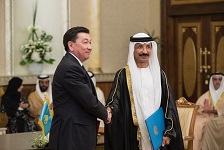
The MoU was signed by DP World Group Chairman and CEO, Sultan Ahmed Bin Sulayem and Governor of Mangistau, Akim Alik Aidarbayev in the presence of First Deputy Prime Minister, Askar Mamin. It builds on DP World’s present management advisory services contract with the Port of Aktau, Kazakhstan’s main cargo and bulk terminal on the Caspian Sea. DP World also provides similar services under a separate contract with Kazakhstan Temir Zholy (KTZ), Kazakhstan’s national railway company for the development of the Khorgos Special Economic Zone (SEZ) and Inland Container Depot (ICD).

Both parties will be exploring opportunities to work together on the Aktau SEZ development project while adding shipping capacity on the Caspian Sea. The projects are part of Kazakhstan President Nazarbayev’s five-year economic policy, ‘Nurly Zhol’, focused on the development of transport and logistics, energy and industrial infrastructure, as well as of small and medium-sized businesses.

The partnership also includes the development of a range of existing and new projects to support the Government of Kazakhstan’s efforts to attract private investment for its transport infrastructure, including the Port of Aktau.

DP World Group Chairman and CEO, Sultan Ahmed Bin Sulayem, said: “Kazakhstan is an important location along the New Silk Way – a trade corridor that will benefit economies of the world. New and efficient infrastructure is needed to realise seamless cargo movement with multi-modal transport links essential for profitable growth. To attract investors there is a need to find innovative ways of working together with a focus on infrastructure provision, developing financial markets, mitigating risks and eliminating red tape.”

“The development of Special Economic Zone in Aktau will stimulate economic growth of the country, and more importantly – it will make Kazakhstan the largest transport and logistics hub in Central Asia. We are delighted to have the opportunity to continue sharing our ports and logistics expertise with the government to develop the country’s modern logistics hubs as engines for economic development and to enable trade across the region.”

ICTSI Manila hits 2M TEU milestone

0

Nominated among the world’s top container terminals for several years, the MICT has an annual capacity of 2.75 million twenty-foot equivalent units (TEU).

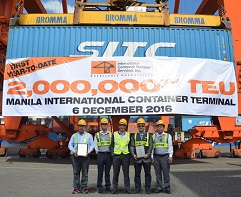
The two millionth TEU container was offloaded from SITC Osaka, which is operated by Chinese megaliner SITC Container Lines. The container vessel originated from Ningbo in China. SITC is one of MICT’s longtime clients with regular vessel calls to the Port of Manila. MICT reached its first one million-TEU move back in December 2002.

A ceremony held to commemorate the milestone was led by Christian R. Gonzalez, ICTSI Senior Vice President and Regional Head of Asia-Pacific and MICT, and Qing Quan, SITC Container Lines Philippines, Inc. General Manager.

“Today represents a significant achievement for MICT as we continue with our mandate to provide the highest level of service to our clients and stakeholders, most especially to the Filipino people. As the gateway to the Philippine market, MICT consistently seeks to improve our operational efficiency to ensure fast and uninterrupted flow of trade in and out of the port,” said Mr. Gonzalez.
Terminal utilization at the MICT has significantly improved since the completion of Yard 7 late in November 2015. Yard 7, which is part of MICT’s PHP5 billion expansion project, increased the terminal’s capacity by 18 percent from 2.5 million to 2.75 million TEUs.

The two million milestone also triggers a multi-billion peso capacity improvement commitment with the Philippine Ports Authority that requires ICTSI to commission five additional post-Panamax quay cranes along with corresponding yard equipment, and build at least another berth by 2019.

Also, key to achieving the two million TEU milestone was the rollout the Terminal Appointment Booking System (TABS), an online container booking platform, in October 2015, which significantly improved and optimized the flow of trucks in and out of the terminal.

Mr. Gonzalez explains: “The construction of Yard 7 and the implementation of TABS last year gave us the flexibility and efficiency we need to perform optimally. We have more projects in the pipeline like the revival of the rail line which will link MICT with Laguna Gateway Inland Container Terminal.”

Aside from establishing an intermodal link between its Manila and Laguna terminals, ICTSI also submitted a proposal to the Philippine Department of Transportation to build the Cavite Gateway Terminal (CGT), a USD30 million common-user barge and roll on–roll off terminal in Tanza, Cavite. The 115,000-TEU facility, which will be built in a six-hectare property, will also be directly linked with MICT. The transshipping of cargo from MICT to CGT and vice-versa will serve the dynamic economic activity of Cavite, and lessen the number of truck trips in Manila by approximately 140,000 annually.

“All of these projects are aimed at maximizing the efficiency of our operation and ensuring uninterrupted movement in the supply chain regardless of the season or fluctuation in demand. We continue to work with our stakeholders and partners in the government in formulating and implementing strategies for the benefit of the industry and the national economy,” according to Mr. Gonzalez.

TMEIC to supply solutions for world's largest automated stacking cranes project

0

This is the largest ASC order TMEIC has received to date and the largest single ASC order ever placed by a port.

“TMEIC has been a longtime, proven partner with Konecranes and The Port of Virginia, including the construction of VIG and the original ASC implementation there in 2007,” TMEIC President & CEO Dale Guidry said. “Although TMEIC provides automation and drives solutions to industries around the world, it is particularly exciting to supply a project of this magnitude in the Commonwealth, only hours from our U.S. headquarters.”

In the announcement from the Virginia Port Authority, John F. Reinhart, CEO and Executive Director of the Virginia Port Authority called the decision to team up with Konecranes and Roanoke, Virginia based TMEIC a logical choice, while Virginia Governor Terry McAuliffe commented on the benefit to the Commonwealth saying, “This project will create jobs and economic spin-off. One of the first beneficiaries of that will be TMEIC, which is a growing company that, with Konecranes, has a global demand for its services: it will be good for TMEIC and it will be good for Virginia.”

In addition to supplying 860 TMEIC-manufactured TMdrive®-10e2 industrial drives, the automation package for the project will incorporate TMEIC’s state of the art laser-based Maxview® and Maxspeed® control systems, providing fully automated solutions for high speed movement and placement of both 20 and 40 foot containers. Maxspeed® crane control systems constantly adjust speed and direction of the crane motors driving the gantry, trolley, cable reels and hoist, providing incredibly fast reaction time to operator joystick, precise control and ultimately higher crane production rates. In conjunction with TMEIC’s Maxview® crane laser-based vision systems, The Port of Virginia expansion will experience labor savings, increased yard productivity, reduced equipment maintenance and improved safety.

Procurement will proceed on two contracts of 60 and 26 ASCs for NIT and VIG, respectively. Equipment delivery will commence in 2018 and is scheduled to be completed in 2020. Upon completion, the port will have expanded the container handling capacity at VIG by 600,000 units and the capacity at NIT by 400,000 units. The combined cost of the projects is $670 million.