
Monday, December 22, 2025
spot_img
Home Blog Page 168

New President of the IADC Board of Directors

0

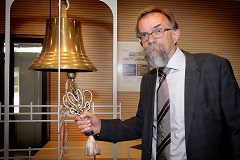
Verhoeven was part of the Royal Boskalis Westminster group of companies for 40 years. After graduating with a degree in civil engineering from the Technical University of Delft (TU Delft) in 1976, he joined Royal Boskalis as a research specialist. Over the next 25 years, he held several technical management functions before becoming General Manager for Boskalis Netherlands, a position he held from 2000 to 2005. In 2005 he became a member of the management team of Royal Boskalis and was responsible for the company’s activities in Europe and several staff departments such as tender departments and SHE-Q. When Boskalis broadened its activities to the offshore industry, acquiring Smit International and later Dockwise, Verhoeven became responsible for the company’s offshore activities and from 2010 to 2012 was chairman of Smit’s Management Team.

In 2012 he became a member of the Board of Management of Royal Boskalis, a position he fulfilled until his retirement in 2016. Mr. Verhoeven is currently a member of various supervisory boards including that of Deltares, an independent institute for applied research in the field of water and soil.

In accepting his appointment as president, Verhoeven thanked retiring president Peter de Ridder for his contributions to the success of the IADC. De Ridder held the position for 4 years since September 2012. The IADC and its member companies look forward to working with Verhoeven as he assumes the association’s presidency and joins other board members, who come from the top companies in the dredging industry.

The International Association of Dredging Companies is the global umbrella organisation for contractors in the private dredging industry, dedicated to promoting the skills, integrity and reliability of its members, as well as the economic, social and environmental influence of the dredging industry in general. The IADC has over one hundred main and associated members.
British Ports Association looking to challenges and opportunities in 2017

0

These include ensuring UK port interests feature in the Brexit negotiations and encouraging increased Government investment in port road and rail connections. The BPA has also recently launched a lobbying campaign on ‘port zones’ which encourages policy makers to ensure port activity and development are not negatively impacted by marine protection designations. Also for 2017 the BPA aims to develop a network of port communication managers to look at opportunities for collective promotion of the sector.

Following the retirements of the BPA’s longstanding figures David Whitehead and Monica Williams towards the end of 2016 the BPA has a new team to drive the agenda forward in the coming year.

Richard Ballantyne said: “This is an exciting time for the BPA and this energetic and ambitious new team comprised of Sara Walsh, Mark Simmonds and Stuart Wealands will help drive and enhance the BPA’s work with government. We enjoy an excellent working relationship with Ministers and officials in the various parts of government around the UK and we will continue to provide a key interface and focal point for the ports sector. In 2017 the BPA will be working to support our members in a number of ways and build on the excellent platform and network that we have. From Brexit to regional and national devolution there are a number of opportunities for the ports sector in the coming year.”

BPA Chairman Rodney Lunn echoed Richard’s comments and said: “We are delighted that Richard Ballantyne is leading the new BPA team into 2017. There are a variety of challenges we face and this will be a key year for the association. We are an independent sector, which uses its own resources to invest, develop and grow but we rely on government to provide a stable and competitive policy environment. The ports industry depends on the right national policies being passed and we are confident that the BPA’s new team is in a strong position to promote these to the various tiers of government around the UK. Ports are at the heart of the economy and we are continually looking for ways in which the BPA can work with government to help improve the growth opportunities for the industry. We are also very much looking forward to this year’s Annual BPA Conference, which will be hosted by the Port of Poole on 18th & 19th October, and provides a focal point where the industry can come together.”

Ports host joint clean air plan workshop

0

The community workshop will be held from 6-8 p.m. Tuesday, Jan. 24, at Banning’s Landing Community Center, 100 E. Water St. in Wilmington. The workshop is open to the public.

The CAAP was adopted in 2006 and has dramatically reduced pollution from maritime-related sources that operate in and around the ports. Programs implemented under the CAAP have reduced diesel particulate matter up to 84 percent, cut nitrogen oxides in half, eliminated 97 percent of sulfur oxides and lowered greenhouse gases an average of 12 percent, all while container volume has increased by 7 percent. The plan was last updated in 2010.

In November, Harbor Commissioners from both ports met to unveil the draft CAAP 2017 Discussion Document, which details proposed new strategies to further clean the air and reduce greenhouse gases. Strategies include aggressively deploying zero and near-zero emission trucks and cargo-handling equipment and expanding programs that reduce ship emissions.

Port trade dips  in 2016

0

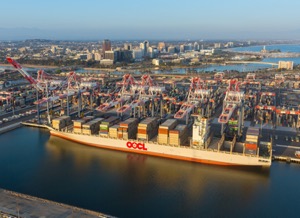
Overall cargo declined 5.8 percent in 2016 compared to 2015, as the Port was impacted by new ocean carrier alliances and the August bankruptcy of Hanjin Shipping, a South Korean company and former majority stakeholder at the 381-acre Pier T container terminal — Long Beach’s largest.

By year’s end, the Harbor Commission had approved an agreement for a subsidiary of Mediterranean Shipping Co., one of the world’s largest container ship operators, to take sole control of the long-term lease at Pier T.

“As the new year starts, we’re grateful to be able to put the Hanjin bankruptcy behind us,” said Port of Long Beach Interim Chief Executive Duane Kenagy. “At the same time, MSC’s quick interest in Pier T once it became available shows the facility’s value to the industry. We’re looking forward to a mutually beneficial partnership with MSC and the 2M Alliance.”

“Last year was turbulent, with numerous ocean carrier mergers and other changes,” said Harbor Commission President Lori Ann Guzmán. “Now we have one of the largest ocean carriers in the world as a major partner and we’re well positioned to rebound in 2017. While the industry strives for equilibrium, Long Beach will continue be a reliable port of entry and continue to provide the fastest, most efficient services for trade from the Far East.”

Cargo was 8 percent lower in December compared to the same month in 2015. Imports decreased 8.2 percent to 271,599 twenty-foot equivalent units, or TEUs. Exports fell 2.5 percent to 122,933 TEUs, while empties declined 11.4 percent to 154,397 TEUs.

A total of 6,775,171 TEUs moved through docks in 2016. Imports totaled 3,442,575 TEUs, down 5 percent, and exports were up 0.3 percent to 1,529,497. Empty containers were down 11.7 percent to 1,803,098.

The year started on a high note in Long Beach, with shipments rising in early 2016 compared to the same period in 2015. Later in 2016, shifting service routes under the new alliances and the Hanjin bankruptcy contributed to a slide in cargo figures.