
Sunday, December 21, 2025
spot_img
Home Blog Page 169

Port of Virginia sets new record in 2016

0

In 2016, import and export volumes were up 6 percent and 2.6 percent, respectively, over the prior year. The port saw increases in TEUs, rail volume and total volume at Virginia Inland Port, the port’s growing intermodal ramp located in Front Royal. Further, Richmond Marine Terminal (RMT) had its most productive year since The Port of Virginia began leasing the facility in 2010.

“In 2016, we moved 106,000 more TEUs than we did in 2015, which until now, was our highest volume year on record,” said John F. Reinhart, CEO and executive director of the Virginia Port Authority. “The growth is significant – 8,800 TEUs a month, on average – and we have responded with improved throughput in all facets of the operation, especially rail, where volume was 551,496 containers, an increase of 14 percent when compared with 2015. This record rail result placed The Port of Virginia as the highest rail-volume port on the East Coast, truly solidifying our position as the Mid-Atlantic’s global gateway.”

“Throughout the year we built a significant amount of momentum that is carrying us forward in 2017. Our focus now is getting underway with our capacity projects Norfolk International Terminals (NIT) and Virginia International Gateway (VIG), completing and opening the new gate at NIT in June and expanding our rail reach into our market by making use of the National Gateway, CSX’s double-stack route into the Midwest.”

The fourth quarter of 2016 was the best in the port’s history: there were double-digit increases in volume and the port increased its market share of East Coast cargo volume from 12.9 percent to 14.5 percent. The port was an influencing force in the announcement of 41 economic development announcements throughout the Commonwealth. Additionally, the National Retail Federation’s November figures show that Virginia’s import volume is growing faster than any US port.

“The work we did last year is a real tribute to our team and our port partners,” Reinhart said. “We must remain cognizant of the fact that we can always improve and continue to do those things that make us a sustainable business and grow The Port of Virginia.”

December is the half-way mark in fiscal year 2017 and thus far TEU volumes are 1,377,625 TEUs, which is an increase of 6 percent when compared with the same period last fiscal year; gate volumes were 80,569 moves, up 15.6 percent; and imports and exports are up 11 percent and nearly 3 percent, respectively.

The calendar year was completed with December’s TEU volumes of 229,624 TEUs, making it the eleventh consecutive month of TEU volumes exceeding 210,000 units. Also in December, rail volume was up 15 percent; total barge volume up 32 percent; RMT volume up 55 percent; and motor-carrier volume up nearly 16 percent.
Van Oord awarded a land reclamation contract in Angola

0

The contract has been signed with the Angolan government (Gabinete Técnico de Gestão da Requalificação e Desenvolvimento Urbano do Perímetro Costeiro da Cidade de Luanda, Futungo de Belas e Mussulo). It contains a financing agreement arranged by ING Bank NV and a credit insurance provided by Atradius Dutch State Business NV (the Export Credit Agency of the Netherlands) for Van Oord’s share in the project of approximately USD 400 million.

Angola’s economy relies heavily on the oil & gas sector and has been growing in a rapid pace in recent years with big infrastructure investments as a result. The current economic turmoil and lower oil prices have slowed down growth and development, however the Angolan government remains determined to invest in infrastructure and keep improving Angola’s private sector in agriculture, fishery, tourism and logistics. The growing number of inhabitants and vehicles requires the city of Luanda to expand and provide solutions to alleviate the current congestion issues.

Therefor an area of 400 hectares will be reclaimed along the coast of Luanda and will be protected by various rock revetments and breakwaters. The new area will serve the purpose for the construction of the Marginal da Corimba highway, future fishery port, marina and real estate development. The rock required for the project will be procured from local quarries. Van Oord will deploy various dredging equipment on this project which is expected to be completed mid-2019.

The Marginal da Corimba project aims to revitalize the area of Samba, Corimba and Futungo de Belas, with the purpose of improving the quality of life of the population. It will contribute to an improved accessibility of the city of Luanda as well as to help solving the capital city’s urbanization challenges in a sustainable manner.

Singapore to start truck platooning trials

0

With this, Singapore moves another step closer towards autonomous freight transport. These agreements follow from a Request for Proposals (RFP) exercise, suite to a Memorandum of Understanding (MoU) inked between MOT and PSA in October 2015 to collaborate and co-fund truck platooning projects.

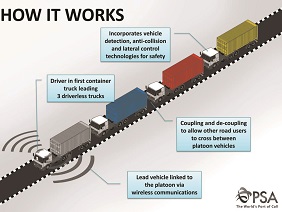
Truck platooning involves a human-driven lead truck leading a convoy of driverless trucks. In the Singapore trials, the trucks will transport containers from one port terminal to another. Efficient freight movement is critical to the competitiveness of our port. Truck platooning will also alleviate our shortage of manpower, and allow more freight movement to be conducted at night to ease traffic congestion.

Said Mr Pang Kin Keong, Permanent Secretary for Transport and Chairman of the Committee on Autonomous Road Transport in Singapore (CARTS), “Trucking as we know it today is a highly labour-intensive industry. We face a shortage of truck drivers. In this regard, truck platooning technology presents us with an opportunity to boost productivity in both the port sector and the trucking industry. It will also open up opportunities for truck drivers to take on higher-skilled roles as fleet operators and managers.”

Mr Ong Kim Pong, Regional CEO Southeast Asia, PSA International added, “As PSA prepares for our future terminals at Tuas, it is timely that we move on to the next steps in developing autonomous truck platooning technology. I am excited by the progress being made, as it underlines our joint commitment to being future-ready, while also helping us continue to serve our customers better through fast and efficient inter-terminal container movement.”

Scania and Toyota were shortlisted based on the quality of their proposals and strong track records in both truck manufacturing and the development of self-driving technology. Both companies will be working to develop technologies to enable heavy vehicles to move in leader-follower formation, as well as to fully automate the processes for precise docking and undocking of cargo.

The truck platooning trials will take place in two phases over a three-year period from January 2017 to December 2019. The first phase, lasting about a year, will focus on designing, testing and refining the truck platooning technology to adapt to local conditions. The trials will be conducted by Scania and Toyota in their respective research centres in Sweden and Japan, to leverage their existing development work. Depending on the outcomes of the phase 1 trials, MOT and PSA Corporation will then select one of the companies for phase 2, which will consist of local trials and some development of the technology in Singapore.

A 10-km long test route along West Coast Highway has been designated for the phase 2 trials. The trials will initially involve inter-terminal haulage between Brani Terminal and Pasir Panjang Terminals, and may eventually be scaled up for haulage within the port area, as well as between Pasir Panjang Terminals and Tuas Port.

BIMCO launches first report on global dry bulk terminal performance

0

Since 2015 BIMCO has been collecting feedback on the performance of port terminals in order to be able to report the results to members and, ultimately, to give further guidance to ships. BIMCO has received over 400 feedback reports from bulk carriers on the performance of dry bulk terminals around the world. The data has been collected, evaluated and presented in this first annual report.

This report gives overall ratings and analysis to show a picture of the current standards at a large number of terminals around the world. BIMCO members will also be able to access performance information on terminals in the relevant port section on the BIMCO website.

Aron F. Sørensen, Head of Maritime Technology and Regulation at BIMCO explains: “The dry bulk vetting scheme makes it possible for companies to compare terminal performances by using actual experiences provided by the crew of the bulk carrier. In general the performances of terminals have been rated positively in this first report and shows a high degree of care and good service shown to ships”.

The BIMCO dry bulk terminal data was collected in the period from 19 January 2015 to 1 December 2016 and 94 ships provided 443 reports from 231 different terminals around the world.

Mr Sørensen adds: “It is very important that more ships participate in the BIMCO dry bulk vetting scheme and continuously report their experiences after each terminal call. The information will be invaluable for our members to help guide the planning of future calls at terminals around the world. We need more reports from a lot more ships to improve the service and to have more robust analysis for next year’s report”.

In December 2016, BIMCO improved the questionnaire by adding new questions aimed at the port level and included:
• whether the ship experienced any restrictions regarding crew change and crew shore leave
• whether there were any restrictions regarding discharge of cargo residues contained in the wash water when at berth
• whether the authorities carried out a port state control inspection and if this caused any remarks.