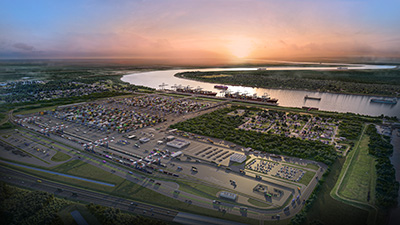
St. Louis regional ports and the St. Louis Regional Freightway are jointly supporting the Port of New Orleans’ (Port NOLA) efforts to strengthen the flow of inland river cargo with the development of the Louisiana International Terminal (LIT). The LIT is a new container terminal project on the Gulf Coast that will benefit not only residents and businesses in south Louisiana, but also advanced manufacturing operations, agribusinesses and farmers, as well as other port operations throughout the Southeast and Midwest regions. Port NOLA’s new $1.8 billion state-of-the art container terminal will eliminate air-draft restrictions that limit the size of vessels that can currently call on the Port NOLA, allowing it to serve vessels of all sizes and dramatically increasing Louisiana’s import and export capacity while fostering strategic inland growth.
The St. Louis region signed a Memorandum of Understanding (MOU) with Port NOLA in 2017 aimed at growing trade with a commitment to building existing and new business relationships between the two region’s critical ports of call. The establishment of the MOU led to increased traffic flow of cargo between the middle of America and Port NOLA, which is strongly rooted in container-on-barge service. The container-on-barge service moves an average of 30,000 TEUs per year between New Orleans, the Port of Greater Baton Rouge, Memphis and now St. Louis.
To further these efforts, the St. Louis Regional Freightway is supporting the Port of New Orleans in their development process to seek federal infrastructure funding for LIT.
The St. Louis region’s ports include America’s Central Port in Granite City, Illinois; Port Authority of St. Louis in the City of St. Louis in Missouri; Kaskaskia Regional Port Authority in southwestern Illinois; and the Jefferson County Port Authority in Missouri, south of St. Louis.
Intermodal river transportation has become an increasingly viable option for shipping containerized freight via traditional barge or new liner vessels. Maximizing one of the nation’s most important and underutilized trade routes and growing the volume of containerized freight moving on the inland waterways are two ways the St. Louis region and Port NOLA are working together and helping to solve global supply chain disruptions.
“The Port of New Orleans is proud to be a global gateway to the middle of the United States and into Canada through the St. Louis corridor of the Mississippi River system,” said Port of New Orleans President & CEO Brandy D. Christian. “Port NOLA’s continued collaboration with the St. Louis Regional Freightway plays an important role in the continued success of our container-on-barge service which expands shipping options to inland markets while honoring our commitment to sustainability.”
Dennis Wilmsmeyer, Executive Director of America’s Central Port, considers working with the Port of New Orleans on its new container terminal to be imperative. “We need to be moving more containers via the Mississippi River in order to take advantage of barge transportation as the most cost-effective and environmentally friendly mode of transportation,” said Wilmsmeyer. “As the Port of New Orleans grows, so, too, does our hope that the container-on-barge service at our Madison Harbor in the St. Louis area can ramp up and achieve its full potential.”
Derrick Good, Chairman of the Jefferson County Port Authority, also sees the potential benefits. “We are excited about the changes coming to freight movement on the Mississippi River and what that means for Midwest businesses and farmers,” said Good.
The St. Louis region is the nexus of six Class I railroads, four interstates located within 500 miles of one third of the U.S. population, and the most strategic location on the inland waterway system – ice-free and lock-free to and from the Gulf of Mexico.
“Leveraging these competitive advantages with Port NOLA’s supply chains is key to strengthening the nation’s global competitiveness,” said Mary Lamie, Executive Vice President of Multi Modal Enterprises for Bi-State Development and head of its St. Louis Regional Freightway enterprise. “Projects like the Louisiana International Terminal project will further benefit freight volume efficiency for agricultural commodities for regions like St. Louis and other inland ports.”
The St. Louis region has been branded the “Ag (Agriculture) Coast of America” as home to a 15-mile stretch of the Mississippi River that has the highest level of grain and fertilizer barge handling anywhere along the inland waterway system, efficiently moving those commodities between barge and truck and barge and rail. Fifty percent of the U.S. crops and livestock are produced within a 500-mile radius of the St. Louis region, including approximately 80% of corn and soybean acreage. With the world population expected to grow by 25% and exceed 10 billion over the next 30 years, the Midwest will play a key role in feeding the world, and being able to efficiently move ag products out of America’s heartland will be increasingly important.
The Louisiana International Terminal builds on past federal investments in dredging the Mississippi River to 50 feet and locates the new terminal within the protection of the $14 billion Hurricane and Storm Risk Reduction System, which was constructed in the New Orleans region following Hurricane Katrina. The new terminal will allow the container-on-barge service to expand with a dedicated berth space designed for use. Container-on-barge volumes nationwide are expected to grow above 200,000 TEUs by 2050. This necessary, efficient transportation access allows U.S. shippers to compete in global markets and offers expanding trade opportunities for urban and rural communities.
“Infrastructure investment like the Port of NOLA’s container terminal project will help integrate all modes of transportation and maximizes one of the nation’s most cost-effective and environmentally sustainable modes of transportation- – the inland waterway system,” Lamie said.
New Jersey-based Ports America, one of North America’s largest marine terminal operators, and Geneva, Switzerland-based Mediterranean Shipping Company, through its terminal development and investment arm Terminal Investment Limited (TiL), have committed $800 million toward the project. In addition to the partners’ investment, the construction of the terminal will be supported by a substantial commitment from Port NOLA, as well as state and federal funding sources. The project is currently in the design and permitting phase of the U.S. Army Corps of Engineers’ environmental review process. Construction is slated to begin in 2025 and the first berth to open in 2028.