Saturday, December 20, 2025
spot_img
Home Blog Page 178

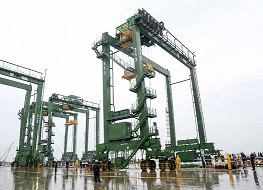
Doosan Vina ships eight "Made in Vietnam" RTGs to Saudi Arabia

0

The shipment was one month ahead of schedule.

The project for eight RTGs for SGP was signed between Doosan Vina and SGP on 4th March 2016. Each of the cranes weigh 1,240 tonnes, 29m high, 27.6m long, 5.6m wide and are used to load the 40 tonnes cargo containers onto trucks for transit to a customer or to move containers around the port. These eight cranes bring the total of “Made in Vietnam” cargo container cranes to 65.

The cranes are expected to arrive in Dammam City, in the Kingdom of Saudi Arabia after three weeks of transit. Dammam City is a key gateway on the Arabian Gulf, a major economic and commercial hub of the Saudi Global Port system.

Europe should pile up pressure on the IMO to deliver on CO2 cap

0

Shipping being a global industry and climate change being a global challenge, ESPO strongly believes that IMO is by far the right level to address the issue and to find a solution. In that respect, ESPO believes that the roadmap agreed on at the IMO MEPC meeting last October is a starting point. The IMO needs to rump up its efforts and submit an initial reduction target to the stock-take process of the Paris Agreement in 2018. This should be accompanied by short-term measures. By 2023, IMO should set an emissions reduction target and have the necessary measures to realise this target spelled out.

ESPO believes that a 6-year period gives to IMO enough time to put forward an emissions reduction target and measures to implement it. 2023 must therefore be seen as a milestone. In case this deadline is not met, EU measures will have to be introduced. It should however be clear that in case of an international agreement by 2023, the EU measures are to be repealed.

“The Paris Agreement has sent a strong signal that international cooperation can deliver tremendous results. The IMO is the right place to address shipping emissions. There is already a coalition of the willing in IMO and Europe should increase the pressure on the IMO to step up its efforts and make progress. It is becoming clear that if the IMO will not deliver an emissions reduction target and measures to implement it by 2023, an EU approach seems unavoidable. We therefore hope that the IMO will demonstrate the same level of ambition when addressing climate change as it did on the global air pollution cap agreed last October”, says ESPO’s Secretary General, Isabelle Ryckbost.

The EU and national climate measures that are currently being developed to implement the Paris Agreement, will oblige ports to reduce the carbon footprint of their land-based activities. These efforts should be accompanied by measures covering emissions generated at sea. The environmental image of the maritime and port sector is at stake. Besides, ports in Europe are literally on the first row when it comes to facing the consequences of Climate Change.
Last October, IMO MEPC 70 agreed on a roadmap towards the development of a comprehensive strategy on the reduction of GHG emissions from ships. 2018 has been set as a milestone for defining an initial IMO strategy. This initial strategy will allow international shipping to take part in the first stock-taking meeting under the Paris Agreement in 2018 where all national reduction targets will be tested whether they are fit for purpose. This initial strategy would subsequently be adjusted based on the analysis of available data, and a revised strategy envisaged for spring 2023 will be finally adopted.

The roadmap does not however make any commitment to setting an initial emissions reduction target as part of the strategy.

Contargo uses EDI for data transfer

0

Here, container logistics service provider Contargo has a dual strategy based on its own internally developed IT solutions – enabling it to react to individual customer requirements, market fluctuations and changing framework conditions – and on the use of standardised processes and software, for instance Electronic Data Interchange (EDI).

“On the one hand, logistics needs to become more flexible all the time, and on the other hand there is great cost pressure in the sector”, says Heinrich Kerstgens, Co-Managing Director of Contargo GmbH & Co. KG. “For this reason we have adopted a dual approach: wherever there is a constant need for adaptation, due to changing prices, laws or dates, we develop our own systems such as the tariff calculator IMTIS, the routing system IRIS, the online slot assignment app STAR and the Terminal Operating system (TOS). But in areas where business processes always stay the same, we use standard solutions.”

EDI is one of these standard systems, and has been used at Contargo for many years now to transmit business data to customers and partners. “EDI has the advantage that it greatly speeds up business processes like order transmission, status feedback, invoicing and notification of container weight”, says Harald Lange, Manager Support & Training, Contargo GmbH & Co. KG. “Data quality is improved because the information needs to be entered only once, meaning that there are fewer opportunities for errors to creep in. From our employees’ viewpoint, it means that they don’t have to spend so much time just entering data – and of course paperless processes are better for the environment.”

“We’re on a mission from EDI”
EDI is a decentralised solution which can be adapted to numerous different interfaces. By using a Business Integration Server (BIS) Contargo is in a position to adapt to the requirements of EDI partners. The system supports all usual message standards and communication protocols, from the EDIFACT standard of the 1980s up to modern XML. Thus EDI enables Contargo to communicate seamlessly with customers and service providers.

Continuous monitoring
Contargo’s EDI system is checked by an operating and monitoring system continuously 365 days a year. The system also includes web-based message tracking, which performs gapless control of the message traffic. “Many companies regard the incompatibility of the various IT systems in different companies and countries as a big obstacle in digitalisation – however, there’s no need to reinvent the wheel”, says Harald Lange. “There are several standards we can rely on. They are efficient and confidence-inspiring, and provide security.”

On the way
At Contargo too, however, the bright new world of EDI is not without its trials. Two years ago, nine different IT systems had to be adapted so that they appeared the same for outgoing EDI connections. Today there are only four, but these include systems more than ten years old. This is not always easy and it does not succeed in every case. “We have to ask for patience, and make even stronger efforts to replace the old systems”, Heinrich Kerstgens says. “Our target is to be working with no more than two IT systems at all our sites within the next two years. Then we will be networked at high speed with all partners throughout Europe in all aspects, from initial price information to invoicing.”


BPA Chairman calls for post-Brexit 'port zoning' strategy

0

BPA Chairman Rodney Lunn wrote to the Transport and Environment Ministers outlining the new concept that would see both marine and land areas within ports being classified as special areas for growth.
These zones would be safeguarded against the impact of marine designations and planning system challenges allowing ports to fast-track developments and have certainty about future activities.
Ports throughout the UK now face increasing restrictions stemming from marine and planning designations, often representing a challenge to their statutory duties and future plans.
As pre-existing economic areas, ports are defined by in private legislation and are unable to move or change their limits, forcing them to undertake costly programmes to continue operating.

Commenting on the proposals, BPA Chairman Rodney Lunn said: “Ports are vital clusters of jobs and trade, supporting coastal communities as well as safeguarding harbour areas for commercial and recreational users. As we move into a new trading environment post-Brexit, it is important that the sector remains competitive.

“Environmental and planning constraints in ports statutory limits are becoming increasingly difficult to work with. Our proposed ‘port zones’ would allow ports to continue to fulfil their duties to maintain safe harbours whilst supporting jobs and trade without endangering the environment.”

Notes
• • The British Ports Association represents the interests of 100 port members, covering over 350 ports, terminal operators and port facilities
• • The UK ports industry plays a fundamentally important role in the country’s economy. 96% of the UK’s international trade – imports and exports – is carried through UK ports which also handle 60 million passenger journeys each year
• • UK ports directly employ around 120,000 people, often in areas of high inequality and unemployment
• • The UK port industry is the second largest in Europe, handling more than 500 million tonnes of freight each year