
Friday, December 19, 2025
spot_img
Home Blog Page 181

Congress authorises Charleston Harbor Deepening project

0

“The passage of WIIN marks one of the most significant milestones in the history of the Port of Charleston,” said Jim Newsome, SCPA President and CEO. With this important step by Congress, we now turn our attention to inclusion in the President’s FY2018 budget, relative to the construction phase of the harbor deepening project. By the end of the decade, we will achieve 52 feet of depth and Charleston will be the deepest harbor on the East Coast. This depth advantage will add significant capability in the fastest growing port region in the U.S., the Southeast. This is vitally important for significant long-term volume growth and the deployment of large container ships. We are extremely grateful to many for their tireless efforts ensuring this bill moves forward; the leadership in the U.S. Congress, specifically Chairman Inhofe of Senate Environment and Public Works Committee, Chairman Shuster of House Transportation and Infrastructure Committee, the South Carolina Congressional Delegation, Governor Nikki Haley, and the South Carolina Legislature. We look forward to a continued, productive partnership with the U.S. Army Corps of Engineers as the Charleston Harbor Deepening Project progresses. Last but certainly not least I would like to acknowledge the efforts of our port staff and specifically Barbara Melvin, our Senior Vice President of Operations and Terminals, who guided this process for us from its inception in 2010 through this authorization.”

The WIIN bill authorizes the Army Corps of Engineers Chief’s Report for the construction phase of the Charleston Harbor Deepening Project, ensuring the project can remain on schedule. By achieving 52 feet of depth, SCPA will be able to accommodate fully-loaded new-Panamax container ships without tidal restriction.

“South Carolina, the Southeastern region and our nation will enjoy the positive impacts of the Charleston Harbor Deepening Project for years to come,” said SCPA Board Chairman Pat McKinney. “Today’s Congressional authorization is the result of years of hard work and dedication by the South Carolina Congressional Delegation, Governor Haley, our state, local and federal partners, and SCPA leadership. This world-class deepening project ensures SCPA will remain a competitive, growing port well into the future.”

The Charleston Harbor Deepening Project was formally recommended for Congressional authorization in January with the issuance of the Record of Decision by the Assistant Secretary of the Army (Civil Works). The project has moved expeditiously through the U.S. Army Corps of Engineers SMART Planning process and received strong support by all levels of government. In 2012 the S.C. General Assembly set aside $300 million for the state share of the project, and it was expedited by the Administration as a “We Can’t Wait” initiative. Upon completion, the project will deepen the Charleston Harbor to 54 feet at the entrance channel and 52 feet in the harbor.

The WIIN Act, formerly known as the Water Resources Development Act (WRDA), passed the Senate by a vote of 78-21 and the House by a vote of 360-61. It now moves to the President’s desk for signature.
Ports America and Sydney Harbour Investment Partners partner on container facility in Port of Sydney, Nova Scotia.

0

SHIP has exclusive development rights to approximately 500 acres in the Port of Sydney and, with the support of Ports America and a specially formed development group, will build a dedicated, semi-automated, deep-water marine container facility capable of handling 18,000+ TEU vessels. Building will commence after establishing sufficient customer volume commitments. Construction, once initiated, is expected to take approximately two years to complete.

Ports America’s highly experienced management team will apply its proven business development and growth strategies while marketing the Novaporte terminal as a Ports America-managed facility to attract new customer and investor relationships. It also will advise on the operational configuration of the terminal to maximize efficiency. Ports America will manage and operate the terminal for 40 years, providing services such as full stevedore and terminal labor management, terminal operating systems, and maintenance and repair.

Peter Ford, Chief Strategy Officer at Ports America, commented, “Novaporte is a uniquely located deep water port able to handle the largest of the next generation of ultra-large container vessels. Geographically, it is the first stop for vessels on the Great Circle Route from Europe and Asia via the Suez. It has abundant land, an adjacent 1,200-acre logistics park and is located in a foreign trade zone. Add to that abundant power, road and rail, as well as a skilled work force, and you have the makings of an East Coast gateway for the next generation of super ships.” He added that Novaporte will employ the latest technology to become the greenest, most cost-efficient port on the continent.

Albert Barbusci, founding partner of SHIP, said, “We are excited about partnering with Ports America, the largest terminal operator and stevedore in the United States. In all our partnerships including financial, construction, engineering, marine equipment and technology relationships, we have looked for industry leaders. Ports America fits this description exactly. Its experience covers all aspects of marine operations from containers, to bulk, breakbulk, world-class cruise terminals, intermodal and RoRo facilities. We couldn’t ask for a stronger, more experienced operating partner.”

Logisitics Park essential to strengthen Vietnam's trade potential

0

Seamless cargo movement to and from these parks is vital, Mr. Bin Sulayem explained, connecting land, air and sea using easy-to-use and ‘smart’ electronic portals, much like the one-stop Dubai Trade Portal offered at the global trade enabler’s flagship Jebel Ali Port and Free Zone in Dubai.

During their meeting Mr. Bin Sulayem also expressed his interest in developing logistics zones in Vietnam, while participating in other long-term projects to improve infrastructure in the country.

This follows a meeting with the President of Vietnam Tran Dai Quang on Tuesday where Mr. Bin Sulayem welcomed the government’s efforts in upgrading roads and bridges connecting to the 40-hectare Hiep Phuoc Industrial Park where DP World operates its Saigon Premier Container Terminal (SPCT).

DP World Group Chairman and CEO Sultan Ahmed Bin Sulayem, said: “Connecting logistics and business parks with multi-modal transport and digital infrastructure is key in encouraging economic growth. Throughout our network we have found that free zones and logistics parks next door to transport arteries provides quick and low cost access to national, regional and international markets. When coupled with efficient electronic systems to enable trade, customs and cross border processes it becomes much easier for business to operate so benefitting nations. Vietnam has many opportunities to develop its supply chain offering and to develop its economy and we look forward to exploring them with its leaders and the business community bringing our international expertise on these issues to any further discussions.”

Saigon Premier Container Terminal (SPCT), located along the western shore of the Soai Rap River on the 40-hectare Hiep Phuoc Industrial Park and 16km from Ho Chi Minh city centre, is a state-of-the-art facility which began operations in October 2009, just two years after construction began. The project is an 80:20 joint venture between DP World and Vietnamese state-owned Tan Thuan Industrial Promotion Company (IPC).

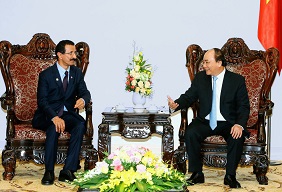
Photo caption: DP World Group Chairman and CEO Sultan Ahmed Bin Sulayem with Vietnamese Prime Minister Nguyen Xuan Phuc during their meeting in Hanoi.

New Priok Container Terminal One counts on VAHLE

0

The terminal began its construction in 2012 and has been developed in order to strengthen Indonesia’s position as a maritime nation. New Priok Container Terminal One (NPCT1) is a joint venture company owned by the four shareholders Indonesia Port Corporation (IPC), Mitsui Co. Ltd., PSA International and Nippon Yusen Kabushiki Kaisa (NYK Line) and is the international project name for the Kalibaru Terminal.

The electrification of the container terminal started in September 2015 and up to now there are 26 container blocks installed with VAHLE conductor rail to supply the new eRTG’s with power. This process allows NPCT1 to significantly reduce CO2 emissions, noise pollution and fuel costs (up to 90%). Due to the massive fuel savings terminal operators can competitively meet emission requirements and their goals for treating our environment with care. This whole investment would not only make the Kalibaru Project to be the biggest, most modernized terminal in Jakarta, but also to be the “Green Port” that appeals to the Indonesian Government as they are using the eRTG and also explores the “cold ironing” facility.

In total there are over 6.270 m of VAHLE infrastructure installed. The German company VAHLE has completed the electrification of this Greenfield project in cooperation with MHE Demag as a partner company from Indonesia in September 2016. The first of five expansion phases at Indonesia’s Tanjung Priok port was officially opened on September 13, 2016

VAHLE has supplied their eRTG solution to Mitsui Engineering & Shipbuilding Co., (MES) so that the new RTG Cranes could be equipped with the automated telescopic arms already in Japan. A lot of RTG Manufactures prefers VAHLE’s eRTG solution developed for original equipment manufacturers (OEM) which allows them to integrate the VAHLE solution in their system very easy. All eRTG’s will be pre-commissioned at the OEM site which makes the RTG fit for operation at the final destination in short notice. VAHLE has finished the commissioning of 12 eRTG in October and will complete the eRTG fleet with 3 more Cranes by end of this year.

All eRTG’s are installed with automated telescopic arms to enter and leave the electrification infrastructure automatically, synchronizer for seamless switching of the power supply between diesel-generator and grid to reduce fuel costs, auto-steering for fully-automated steering of the RTG and off-track protection to simplify the day-to-day business.