Friday, December 19, 2025
spot_img
Home Blog Page 182

Aumund: Six hours pro-active pricing strategy

0

Since inception, Aumund India, Chennai, has executed many key projects along with FLSmidth for the Indian cement industry. In many cases, Aumund India supported FLSmidth with quick response for offer submission, extending special pricing, even at their offer stage itself, to ensure continued relationship.

The additional support from Aumund Fördertechnik GmbH Headquarters, Germany, by extending the calculation program, had further strengthened the trust and relationship.

Considering the potential and the possible aggressive competition, AUMUND India went ahead with FLS with a pro-active pricing strategy.

Aumund India delivers for the AKIJ Cement project one bucket elevator type
BW-ZL, one belt bucket elevator type BWG, and first time three belt bucket elevators type BWG-GK instead of their conventional bucket elevator type BWZ. In the TANCEM project, FLS had specific design criteria and wanted a certain safety factor for the chain. Aumund India provided an optimised solution, which met these specific criteria and delivers two bucket elevators type BW-ZL, eight bucket elevators type BWG, eight silo discharge systems type SDI and one deep drawn pan conveyor type KZB. For the SHAH Cement project Aumund India will deliver two bucket elevators type BWZ.

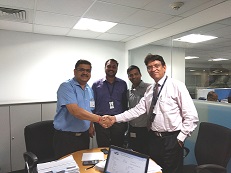
Photo caption: N. K. Priyani, Head Procurement FLS India, and his team shaking hands with Raju Gupta, Managing Director, AUMUND India.

Samskip and Rail Cargo Group combine multimodal networks to connect Romania and Sweden

0

A new chapter will open in the partnership between Samskip and the Rail Cargo Group (as part of the ÖBB – Austrian Federal Railways) from 1 January 2017, with the launch of seamless rail services connecting Romania and Sweden.

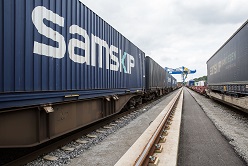
The new service will effectively join two existing, fully operational routes to form the first unified rail connection between the East European nation and Scandinavia, taking advantage of Samskip’s state-of-the-art railway hub in Duisburg, Germany. Lying on the western border of Romania, Curtici is a major junction in Central European railway network that connects to the country’s capital Bucharest.

“Until now, shippers wanting to transport shipments between the two regions have had little choice but to use road haulage, running the risk of road congestion, delays and unpredictable delivery times”, says Frank Gielen, Rail Development Manager Samskip Van Dieren Multimodal. “The rail connection offers shippers a more reliable alternative, as well as achieving substantially lower emissions per unit load.”

“Rail Cargo Group is delighted to enter into this broad cooperation with Samskip Van Dieren, as the two companies will be the first to offer an end-to-end connection between Turkey and Scandinavia, combining Rail Cargo Group connections between Turkey and Romania, and Romania and Germany, with Samskip’s network from Duisburg to various destinations in Scandinavia. The new offer to the market comes in high frequency, in very competitive transit times and at attractive price levels”, says Max Kindler, Business Unit Manager Rail Cargo Group Intermodal. Rail Cargo Operator, as the operating division of the Rail Cargo Group, connects European economic centres with technically mature intermodal logistics designs, system trains and a wide choice of train products.

The new multimodal freight service will offer competitive transit times compared to road, allowing shippers to transport cargo from Curtici to Stockholm in four to five working days.

Freight rail services in Romania have developed considerably in recent years, with investments including a new international link to Bulgaria across the Danube as part of the Pan-European Corridor IV, and the reconstruction of the line linking Constanta Seaport with Bucharest. Curtici offers a ‘turntable’ for Central & Eastern Europe hinterland transport and is a vital gateway to Western Europe.

Initially the Duisburg – Curtici shuttle has a scheduled four round trips per week but, by providing a more attractive option to road haulage, the partners are confident that the new route will stimulate an increased flow of goods between the two regions. Samskip and RCO envisage ramping up frequency to five roundtrips later in the year.

Shippers will benefit from a seamless terminal-to-terminal service, with a single Samskip point of contact dealing with the entire transit across the rail network via the Duisburg hub. In addition, Samskip provides shippers with a user-friendly online portal to manage bookings and monitor the progress of shipments through the network. The system also generates automatic departure and arrival notifications to provide reassurance to customers.

The new route from Curtici extends the penetration of Samskip’s intermodal network in Central and Eastern Europe through its fully-owned terminal in Germany, connecting Sweden and Denmark in the north to Italy and Turkey in the south.

Berth deepening mega-project out to tender

0

This follows the two environmental approvals secured from the Department of Environmental Affairs (DEA) last year for marine and landside works. The tender process for the landside works will follow at a later stage.

TNPA Chief Executive, Richard Vallihu, said: “The continued investment in infrastructure and modernisation of our flagship Port of Durban is pivotal in meeting the ever-increasing demands of the maritime industry, in particular the ever-increasing size of container vessels pulling into our ports.”

The DCT: Pier 2 Berths 203 to 205 reconstruction, deepening and lengthening project forms an integral part of Transnet’s Market Demand Strategy which is in its 5th year and aims to enable the effective, efficient and economic functioning of an integrated port system to promote economic growth.

The increased size of container vessels calling the Port of Durban has resulted in DCT: Pier 2 berths now operating beyond their original design specification in regards to water depth.
DCT: Pier 2 handles approximately 65% of the total containerised cargo of South Africa and is the main link to the country’s industrial and economic hub, Gauteng. It is estimated that the demand through the Port of Durban is expected to grow from 2.5 million TEUs (Twenty-Foot Equivalent Unit) to 3.5 million TEUs, over the next 10 years.

The overall R7 billion project aims to improve efficiencies and reduce costs for vessels calling at the port by deepening Berths 203, 204 and 205, as well as the basin and approach channel, from 12.8m to 16.5m. The effective berthing length will be increased from 914m to 1210m, to safely accommodate the simultaneous berthing of three Super Post Panamax vessels of 350m in length and draft of 14.5m.

Currently Super Post Panamax vessels take up two berths on the North Quay which decreases port capacity. In addition, large vessels requiring a deeper draft than 12.2m can only enter the channel at high tide, resulting in delays. Increasing the draft will enable vessels to enter at any time reducing the queue of vessels waiting at anchorage to enter the port.

The procurement sourcing strategy for all the project packages is clearly defined, including focus areas for Supplier Development (SD), B-BBEE Improvement Plans and Local Content (LC) that advance transformation and build capacity among Black Owned (BO), Black Woman Owned (BWO) and Youth Owned (YO) Companies.

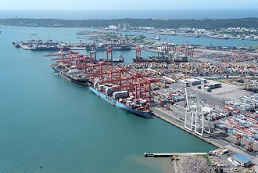
Caption: Durban Container Terminal Pier 2 Berths 203 to 205 will be deepened and lengthened as part of a R7 billion mega project by Transnet National Ports Authority.

Milestone for JAXPORT

0

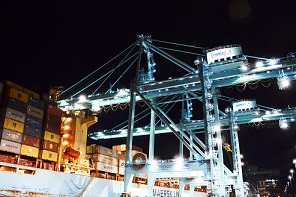
Each of the three cranes can lift up to 65-tons and reach 22 containers across a ship’s deck, significantly broadening the port’s cargo-handling abilities.

On Friday, stevedores used two of the three cranes to move containers from Maersk Line’s Sea-Land Comet.

The cranes were manufactured by Shanghai Zhenhua Heavy Industries, Co. Ltd. (ZPMC). JAXPORT invested $37.9 million in the purchase and installation of the three cranes, including a $15 million grant from the Florida Department of Transportation.

The port’s long-term strategic plan calls for the purchase of a total of ten 100-gauge cranes for Blount Island in the next 10 years.