
To be implemented from January 15, 2017, the new model is expected to improve ship handling performance.”Adjustments to the previous production and shift pattern model mean container gantry cranes and straddle carriers in particular will be able to operate at our terminal continuously – both throughout the weekend as well as during the week” Jens Hansen, Managing Director of the HHLA CTB, said.Hansen added that the terminal’s seaborne handling capacities will be increased with the introduction of the new production and shift pattern model.”We see our optimised services as a way to more closely connect shipping companies with Burchardkai and Hamburg,” he said. CTB plans to implement the new model as more and more ultra-large container ships (ULCVs) are joining the world’s container ship fleet. Several major container carriers have placed orders for 20,000 TEU boxships over the last couple of years, including CMA CGM, Mitsui O.S.K. Lines (MOL), Maersk Line, COSCO Container Lines Co. (COSCON) and Orient Overseas International Limited (OOCL). The first of these ULCVs are scheduled for delivery in the first half of 2017.
Adani Group to increase cargo handling capacity
The integrated infrastructure company aims to create similar operational capacities between its Dhamra and Mundra port, which is India’s largest commercial port in the Gulf of Kachchh. Dhamra Port Company Limited (DPCL) authorities aim to reclaim 2,000 acres of land for the expansion, with 686 acres already claimed from the Odisha government for its second phase expansion. This will increase Dhamra’s current capacity of 25 mtpa from its two berths to 100 mtpa. Both ports are wholly owned subsidiaries of Adani Ports and Special Economic Zone (APSEZ) ¬, which oversees ports and logistics operations for the Adani Group and is India’s largest private multi-port operator. According to Business Standard, an APSEZ source said: “Reaching a cargo volume of 300 mt is a long-term vision and may take 2030 or beyond to realise. We have already submitted a revised master plan to the Union environment ministry. This master plan envisages 35 berths compared to 14 approved in the original plan. Also, the cargo handling capacity is nearly thrice from 108 mt to 300 mt”.
European cooperation is essential in strengthening inland navigation
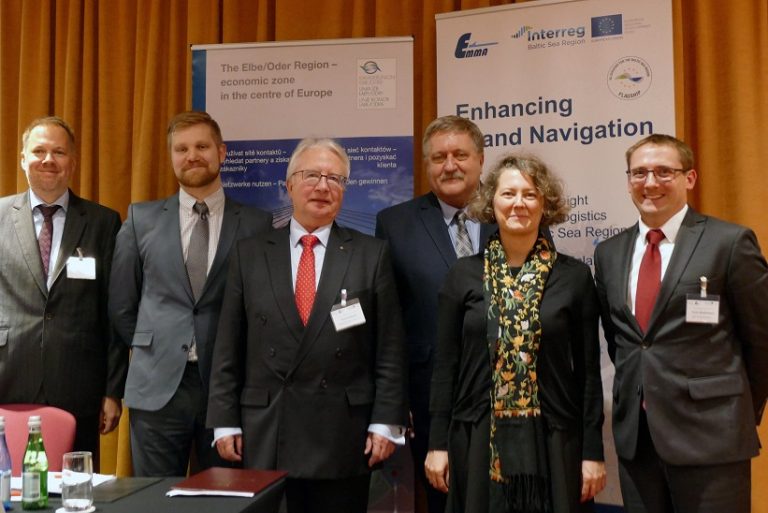
The Warsaw conference also served as the first annual conference of the three-year-long Interreg project EMMA together with the annual capital conference of KEO – Chamber Union Elbe/Oder. EMMA enhances freight mobility and logistics by strengthening inland waterway and river-sea transport and promoting new international shipping services.
“Now it is time to deliver results and to contribute to discussions on future European transport policy developments. More than 50 organisations are supporting EMMA to bring the project to success”, said Stefan Breitenbach from Port of Hamburg Marketing, being the Lead Partner of the EMMA project.
The potential of inland navigation is not yet fully utilized regardless of the benefits it carries. Inland navigation is cost-efficient, safe and environmentally friendly mode of transportation that provokes growth. Some important steps have already been taken in promoting it, for instance the creation of an EU waterway transport action plan NAIADES. Waterways are already integrated in the Trans-European Transport Networks (TEN-T), but appropriate financial framework to support the role of ports in TEN-T is still required from the EU.
“We also have need of policies supporting combined transport and burdenless regulatory framework for the sector”, reminded Roland Hörner, President of European Federation of Inland Ports.
EU aims to shift 30% of long-distance freight traffic from road to rail and inland waterways, as well as to have carbon-free city logistics by 2030. Enhancing inland waterway transport can contribute to improved environmental status and help to reach sustainability objectives.
“Changing patterns is not an easy task, but we want to change them so that inland navigation would have a higher share in transportation”, said Maciej Brzozowski, Head of the Port of Hamburg Marketing Representative Office Poland and Lead Partner of EMMA.
Port of Hamburg is nowadays the second biggest inland port in Germany. Since road and rail infrastructure is in some parts of the Baltic Sea Region overloaded, inland navigation with its huge potential offers a unique chance for expansion.
“Roads do not have enough capacity for rising amounts of hinterland traffic. The use of inland navigation will create capacity, so we are preoccupied with developing inland navigation”, confirmed Stefan Kunze, Chairman of the Board at Elbe Allianz.
Speakers and panellists of the conference emphasized that inland water transport has to co-exist with other transport modes.
“Inland waterways have to be upgraded and inland navigation layer be seen as combined with seaports, inland ports, railways, motorways and logistic centres”, stressed the keynote speaker Dimitrios Theologitis, Senior Expert at the European Commission’s DG MOVE.
Theologitis highlighted the importance of DINA, the digital inland navigation area, since digitalisation of logistics will improve information flows and assist in seamless logistic changes and the operation of the waterways. A lot of content is already in an electronic form, such as electronic charts, notices to skippers and vessel databases.
“Instead of having fragmented pieces of information we have to make them work together”, Theologitis stated.
In Warsaw EMMA engaged experts to discuss the transnational cooperation in the Oder region, the future plans for the Elbe as well as the importance of developing one strong voice for inland navigation in Europe.
“The added value from EMMA is that it brings all the Baltic partners together around the same table. It is important to cooperate and come closer to each other. There is more that we share than what divides us”, encouraged Karin de Schepper, Director of Inland Navigation Europe.
Port Authority enters into joint venture agreement for construction of port in Indonesia
The main purpose of this joint venture is to prepare the development of the port of Kuala Tanjung. Kuala Tanjung is a port project of national importance in the province of North Sumatra, strategically located on the Strait of Malacca. The joint team of Pelindo 1 and the Port of Rotterdam Authority have been entrusted with preparing an investment decision.
That same day, the Port Authority also signed a memorandum of understanding (MoU) regarding the expansion of the port of Jakarta. This MoU was entered into by Pelindo 2 (the state-owned port corporation bearing responsibility for Jakarta, among other ports), JakPro (the land development company of the City District of Jakarta) and the Port of Rotterdam Authority. The three parties have agreed in this MoU to jointly direct and support a preparatory feasibility study for the future expansion of the port of Jakarta at the so-called O, P and Q islands.
The agreements were signed during Dutch Prime Minister Rutte’s visit to Indonesia. The CEO of the Port of Rotterdam Authority, Allard Castelein – who signed the two agreements – received the Dutch delegation in Jakarta. The Port Authority opened an office in this city earlier this year, which is used to coordinate the Port Authority’s projects in Indonesia. “With the signing of two agreements, the delegation’s visit can be considered a resounding success for the Port Authority. The agreements are a major step forward for our activities here in Indonesia. They reflect the Indonesian government’s confidence in our efforts,” according to Allard Castelein.