Sunday, December 14, 2025
spot_img
Home Blog Page 191

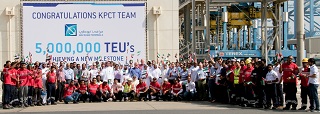
ADT celebrates 5 million TEUs milestone at Khalifa Port

0

The record number was achieved serving the CMA CGM, a vessel belonging to ADT’s long-term customer, CMA CGM Pegasus.

The new throughput milestone follows terminal operator ADT’s success in the first half of 2016, which saw Khalifa Port handle 11% more containers than the same period in 2015. Notable and consistent year-on-year growth since KPTC’s inauguration in 2012 represents its increasing role as a crucial logistics hub connecting local and regional trade to global markets. It also represents the success of ADT’s significant investments in KPCT’s infrastructure and facilities to create the Middle East’s first semi-automated and most technologically advanced container terminal.

“This milestone represents a great achievement in KPCT’s relatively short operational period and truly demonstrates that ADT is on track to become one of the leading container terminal operators in the world. It is a testament to ADT’s vision and spirit, and the investments we have made to continually improve and expand our capabilities and resources,” said Abu Dhabi Terminals CEO, Martijn van De Linde.

“We pride ourselves on our commitment to our loyal customers and they share in our success and we will continue to strive to exceed their expectations going forward,” he added.

Since its establishment in 2006, ADT has achieved regional and international industry recognition for its unwavering commitment to safety, innovation, and excellence, and its rapid growth and success have been globally lauded.

Kalmar partners with SSAB to develop a medium-range fuel cell forklift

0

The aim is to find a more sustainable solution for our customer SSAB and help them to contribute in diminishing carbon dioxide emissions at the site.

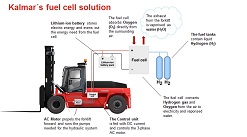
The forklift truck to be developed will have a lift capacity of 9-18 tons and it will use hydrogen gas as fuel. As the exhaust will be only water, the machine will provide a more environmentally sound solution for material handling. The project will last for approximately two years and it will include the development, demonstration and testing of the forklift truck. The equipment will be produced by Kalmar to be used at the SSAB production facility in Oxelösund, Sweden.

Thomas Malmborg, Vice President, Forklift Trucks at Kalmar, says: “Kalmar’s strategy is to become a leading provider of sustainable solutions for heavy lifting equipment and this initiative demonstrates our aim to co-create with the leading players.”

Jacob Sandberg, Vice President Production & Product Development at SSAB, says: “This is a very good project for SSAB in Oxelösund, where we can now really study the possibilities to reduce our fossil dependence. In addition to completely changing the fuel, we also get a better machine.”

NWSA sees strongest container volumes in four years

0

To support this peak shipping season’s strong agricultural exports, the NWSA has lengthened the extended gates program through Dec. 2. The main commodities moving through our gateway are hay, forest products, and fruits and vegetables.
Year to date, full imports are up 4 percent to 1,134,829 TEUs (20-foot equivalent units) and full exports increased 13 percent to 802,343 TEUs. The year’s total container volumes are essentially flat through October, down less than 1 percent to 2,963,157 TEUs.
While weak empty and domestic volumes continue to drag down overall container volume growth, domestic cargo tipped up in October with a 4.2 percent increase from the late run of seafood. Year to date, domestic volumes have been down as Alaska struggles with a decrease in oil- and gas-related project activity due to low commodity prices. The month’s overall domestic volume showed a modest increase, however, due to additional sailings related to a rise in demobilization of Alaska’s stock, equipment and gear away from the area.

In other cargo news:
Breakbulk cargo is down 28 percent year to date to 152,075 metric tons as the global downturn in agricultural, mining and construction equipment, and a strong U.S. dollar impact volumes.
Log exports declined 27 percent year to date to 150,962 metric tons due to decreased demand in China and competition from New Zealand.
Autos fell 10 percent to 8,630 units for the month because of production issues as well as supply chain shifts.

Drive to promote hazard awareness delivers results

0

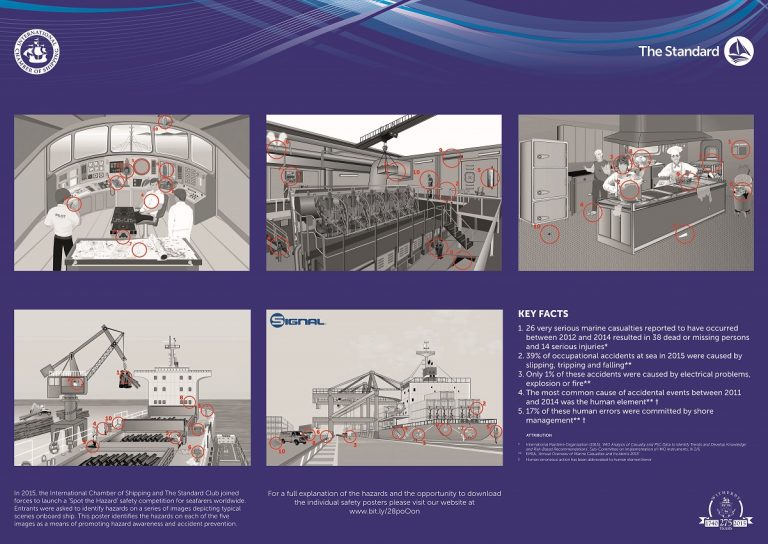
Seafarers across the world were invited to identify ten hazards within five typical scenes – bridge, deck, engine room, galley and port terminal. The scenarios were supplied in the form of posters which were delivered to shipping companies worldwide. To reinforce the safety messages, after the competition new posters were then issued identifying the hazards on the original scenarios. The level of engagement with the campaign was impressive. More than 1,300 entries were submitted by seafarers from 78 shipping companies, comprising a wide range of nationalities. The competition was also shortlisted for “Innovation of the Year” at the Continuity, Insurance and Risk (CIR) Risk Management Awards.

Competition winners were those entrants who identified the most hazards correctly and whose safety ideas were considered to be the most original and potentially effective for the improvement of onboard safety. Each winner received US$2,000 in recognition of their achievement in beating off stiff competition from over 600 other seafarers.

Analysis of the entries has provided some interesting insights regarding engagement with the initiative and trends in the identification of particular hazards. Of all the hazards included on the five posters, the ‘over-scaled ECDIS display’ within the bridge scene was the hazard which was most often mistaken or overlooked in competition entries. This was not particularly surprising and is consistent with The Standard Club’s observation that the levels of ECDIS proficiency amongst crew varies.

The results of the competition were encouraging, with many seafarers scoring top marks on each of the posters, yet every year there is a significant number of accidents that could have been prevented, so there is still work to be done in order to translate this understanding of what constitutes a hazard, into safe on board working practices. The latest poster will encourage everyone on board a ship to be responsible for its safety, by identifying hazards and understanding how they could escalate into serious incidents.

ICS Secretary General, Peter Hinchliffe, explained:
“ICS was delighted to see the high level of engagement with this initiative. By encouraging seafarers to think about the potential hazards around them, the competition has surely helped to promote an effective safety culture in the global shipping industry, which is a longstanding goal of ICS. The intention now is for this new poster to be placed on board as many ships as possible as a means of promoting the critical importance of an awareness of basic hazards.”

The Standard Club Director of Loss Prevention, Yves Vandenborn, stated:
“We consider this initiative to be a very successful example of how large maritime organisations can interact with seafarers to advance the cause of safety at sea. Our hope now is to ensure the spirit of the competition lives on by using these posters to remind seafarers of the importance of accident prevention as they go about their day-to-day tasks.”

Full details of the winners can be found on the competition webpage Spot the hazard .