
Saturday, December 13, 2025
spot_img
Home Blog Page 194

LaGrange highlights back-to-back record container volumes in annual State of the Port address

0

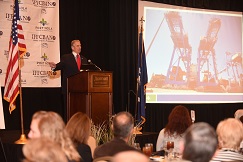
For fiscal year 2016, the port recorded 532,427 TEUs, up from 528,329 in fiscal year 2015. Port President and CEO Gary LaGrange made the announcement during the 30th Annual State of the Port Address hosted by the International Freight Forwarders & Customs Brokers Association of New Orleans.

“We continue to realize growth in our container market and expect that demand to surge in the coming years as about USD75 billion could be invested in large-scale industrial development in Louisiana over the next decade,” LaGrange said. “Those investments create chemical exports – namely resins and PVC – that will fuel volumes for years to come.”

In addition, LaGrange noted nearly USD40 million was invested last year to increase efficiencies and capacity at the Napoleon Avenue Container Terminal and the Port is preparing to invest more than USD25 million to expand container capacity to nearly 1 million TEUs by adding 28 acres of heavy-duty paving at the terminal’s Milan Upland marshalling yard in the coming years.

“The Port’s USD25 million Mississippi River Intermodal Terminal opened in March, a nearly $8 million refrigerated container racking system is now in place and two new rubber-tire container cranes were added by New Orleans Terminal,” LaGrange said. “All of these additions, combined with plans for expanding container storage capacity will position the Port to handle our anticipated growth in the short-term.”

Port officials and consultants are currently engaging stakeholders, tenants and customers while conducting a new Master Plan, which will be completed in 2017.

“The process is exciting and we are looking forward to unveiling our long-term goals and priorities, while focusing on developing the Port’s strengths and identifying new opportunities,” LaGrange said.

Current cargo figures illustrate the chemical sector’s growth. Through the first five months of 2016, the Port realized gains in chemical exports of 15.62 percent, the highest performing commodity port-wide. In addition, poultry exports rose 41 percent as major destination countries relax restrictions on U.S.-produced poultry in 2016. On the inbound side, the Port realized a more than 12 percent increase in coffee and non-ferrous metals traded on the London Metals Exchange – namely aluminum and lead. One of the Port’s top commodities – imported steel – has softened since recording 14-year highs just two years ago, as steel imports slipped more than 30 percent compared to last year.

“Imported steel is a direct reflection of global economic trends and tonnage is down about the same at ports throughout the nation,” LaGrange said. “The good news is our diverse cargo portfolio allows for growth in other commodities, while some are impacted by factors beyond our control.”

Supporting cargo operations is a growing number of tenants occupying industrial leases along the Port’s Inner Harbor Navigational Canal. These tenants, which collectively resulted in an all-time industrial real estate revenue total of $6.5 million in fiscal year 2016, provide critical value-added services for cargo destined for the Port’s deep-water terminals.

For example, TCI’s expansion of its “mega-plastics district” will begin operation in the first quarter of 2017 – packaging dry chemical cargo in containers for export. Braid Logistics signed a new lease to package liquids into flexi-tanks for container export and Miller Transport recently developed a new tank truck and ISO tank depot. On the break-bulk side, Kearney Companies is leasing and investing in former fabrication warehouses with the goal of serving the growing metals market.

Cruising from New Orleans continues to grow in popularity, as well, and cruise lines are investing in newer and larger ships. Carnival Cruise Lines repositioned the Carnival Triumph to the Port’s Erato Street Cruise Terminal in April, a 34 percent increase in Carnival’s year-round four- and five-day itineraries. Norwegian Cruise Lines will replace the Norwegian Dawn with the newer and larger Norwegian Pearl on Nov. 5, 2017.

“The Port is on target to top 1 million passengers for the third straight year,” LaGrange said. “Cruise lines are investing in bigger and better ships in New Orleans and we’re attracting more and more unique cruise ship calls to New Orleans as a destination city on a cruise itinerary.”

A robust inland riverboat fleet and new direct international flights to Panama, Germany and the United Kingdom via Louis Armstrong New Orleans International Airport will make it easier for international travelers to visit and cruise from New Orleans, LaGrange added.

The Port is also growing in an environmentally responsible manner, as its Green Marine Certification is paying dividends. The U.S. Environmental Protection Agency awarded the Port’s Environmental Services Department a USD727,000 Clean Diesel grant to fund the Port’s Clean Truck Replacement Incentive Program to assist short-haul and drayage truck owners working within the Port to purchase newer more fuel efficient and environmentally friendly models.

“I want to commend the strides our environmental department has made in pursuing grant funding and engaging terminal operators and tenants to assist them in achieving their environmental goals,” LaGrange said. “We will continue to pursue grant funding to support our stakeholders and their efforts to reduce emissions and improve air quality throughout the region.”

The Port’s success stories must be broadly communicated and LaGrange said the Port will continue its aggressive outreach to the community, elected officials and stakeholders.

“Our connections run deep in in the communities we serve, in the connectivity we offer our customers, and our market area as a whole,” LaGrange added. “Our Board has made it a priority to communicate that message through the airwaves, publications, partnerships and outreach activities. This effort is critically important today as we usher in a new Congress and Administration and work together with our state and local partners to have the ability to continue to expand, grow volumes, create jobs and meet our collective goals.”
Hamburg records throughput volume growth of 0.3 percent in the first three quarters of 2016

0

“Seaborne cargo throughput in the Port of Hamburg has stabilized and for the first three quarters of 2016 again increased. Seen separately, the third quarter with a 2.7 percent upturn to 34.7 million tons underlines the upwards trend. Both general and bulk cargo volumes developed positively for Germany’s largest universal port,” said Axel Mattern, Joint CEO of Port of Hamburg Marketing. The successful trend for seaport-hinterland rail transport was also maintained. “By comparison with other leading European ports, in the first three quarters of 2016 Hamburg further expanded freight volumes transported by rail. Transporting 35.5 million tons of freight and 1.8 million TEU, representing gains of 3.1 percent and 1.9 percent, rail once again achieved a substantial advance,” reported Ingo Egloff, Joint CEO of Port of Marketing.

In the first nine months of the year container throughput as a whole remained almost at the previous year’s level. Whereas containerized cargo volume advanced 0.4 percent to 69.3 million tons, at 6.7 million TEU the number of boxes handled was down just 0.1 percent, or almost unchanged. The container traffic with Asia that is especially important for the Port of Hamburg grew by one percent. Predominating in the Port of Hamburg, container throughput with Chinese ports also thrived. This attained a 0.6 percent increase. Container services in the North & South America trades produced overall growth of 1.2 percent. In the European container trade, results differed. On the one hand, a satisfactory of 4.4 percent advance to 337,000 TEU in container traffic with Russia signalled a slight upward trend. On the other hand, direct calls by container liner services in Gothenburg and Gdansk caused downturns of 15.4 and 14.1 percent in seaborne container traffic with Sweden and Poland, respectively. Declining by 1.7 percent, the European trade as a whole was still slightly negative.

A continuing rise in the significance of India was more gratifying. With throughout 6.8 percent ahead at 188,000 TEU, the country now ranks eighth among Hamburg’s top trading partners in container traffic. Positive trends here also produced growth of 18.0 percent with Mexico, 7.7 percent with the USA, 12.1 percent with United Arab Emirates and 13.3 percent with the United Kingdom. “For the first three quarters of the year the Port of Hamburg’s container throughput statistics indicated 0.5 percent growth to 3.5 million TEU in import boxes. Exports reached 3.2 million TEU, remaining 0.6 percent below the previous year’s figure. Despite the increase in import containers and an overall 0.5 percent advance for loaded containers, reaching 5.7 million TEU in the first three quarters, a very slight 0.1 percent downturn occurred in the Port of Hamburg’s overall throughput figure. That is primarily attributable to fewer transhipment services with ports in Poland and Sweden,” explained Mattern.

Bulk cargo throughput in Hamburg for the first nine months of 2016 was 0.3 percent up at 34.5 million tons, with import and export trends again differing. Imports during the first three quarters were 6.7 percent up at 25.7 million tons. On the export side, bulk cargo throughput at 8.7 million tons remained 14.8 percent below the previous year’s. Both a 14.1 percent advance to 3.2 million tons for suction cargoes – grain and oilseeds – and one of 14.0 percent to 8.0 million tons for the liquid cargo segment, especially oil products, ensured growth in imports. Grab cargo throughput, mainly of coal and ore, also grew, being 1.5 percent higher at 14.6 million tons.

There were various reasons for the 8.7 million tons or 14.8 percent fall in exports in the suction / liquid / grab cargo segment. Apart from the harvest-related downturn in grain exports, down by 21.9 percent or 2.7 million tons in the first half, and far weaker than in the especially strong previous year, oil product exports at 2.5 million tons were also 26.5 percent down. Poor throughput can primarily be explained by the closure of a major Hamburg refinery and cessation of its oil product exports. The grab cargo segment almost reached the figure for the comparable period of the previous year, with the total just 0.6 percent lower at 2.6 million tons.

In the first three quarters non-containerized general cargo throughput, of outsize plant elements and wheeled cargo for instance, was 9.5 percent down on the previous year at 1.2 million tons. On the import side, with the total 2.2 percent down at 419,000 tons, growing throughput figures for imports of timber, project cargo and oleaginous fruits failed to offset downturns for paper, metal and vehicles. On despatch of conventional general cargoes, reported as being 13 percent lower at 776,000 tons, growth for timber, iron and steel failed to compensate for lower vehicle exports.

Ingo Egloff and Axel Mattern, Port of Hamburg Marketing’s two joint CEOs, revealed at the port’s quarterly press conference that the universal port of Hamburg’s seaborne cargo throughput has stabilized, with an upward trend discernible. In stiff competition with the main ports of Northern Europe, Hamburg can report an outstanding trend on seaport-hinterland services. Against the general rail freight tendency for declining volumes, the quantity of freight shifted in and out of the Port of Hamburg by rail increased by 3.1 percent. The total number of containers transported by rail during the first nine months climbed by almost two percent to 1.8 million TEU.

More than 200 freight trains daily reach or leave Hamburg as Europe’s largest rail port, connecting it with all economically active inland regions. Hamburg’s very numerous connections and intense frequency of train departures are advantageous for rapid handling of export and import freight for inland shippers. “If the port is to continue to be expanded and remain competitive in its numerous functional areas, apart from the development of high-performance access and dispersal corridors for freight transport by rail, truck and inland waterway craft, dredging of the navigation channel on the Lower and Outer Elbe remains essential for enduring growth and employment,” said Ingo Egloff.

The Port of Hamburg is Germany’s largest universal port, guaranteeing more than 156,000 jobs in the Hamburg Metropolitan Region. The port is also a significant industrial location, its total added value of 21.8 billion euros being of immense importance for the entire German national economy. For 2016, the Port of Hamburg’s marketing organisation is reckoning with total seaborne cargo throughput at last year’s level of the order of around 138 million tons and container throughput of almost 9 million TEU.

Konecranes and the Georgia Ports Authority celebrate Konecranes' 1000th RTG crane

0

The Port of Savannah, Georgia, took delivery of it in August 2016 at the Garden City container terminal.

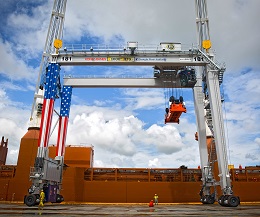
In honor of the occasion, the 1000th Konecranes RTG was specially painted with a “stars and stripes” design, mirroring the U.S. flag.

The Georgia Ports Authority took delivery of the first Konecranes RTG in 1995. That machine was revolutionary for its time. It was the world’s first container crane without hydraulics. It had Konecranes patented Active Load Control (ALC) system for the world’s highest container handling productivity. It also had eco-efficient AC drives supplied by Konecranes.

The 1000th Konecranes RTG now being celebrated is a descendant of that first RTG, with many evolutionary improvements. Most importantly it is electrically-driven, producing 95% less diesel emissions.

The Georgia Ports Authority has been growing steadily for decades, thanks to Savannah’s ideal demographic and geographic location. The south-east US has been the fastest-growing demographic region in the US for decades, with a manufacturing base that is close to the eastern seaboard. The Port of Savannah is also one of the few ports in America that has plenty of room to grow: it can offer customers well-placed locations for their distribution centers. It also has first-class rail services. Railroads operating in the eastern half of the USA are located on the GPA port grounds. Goods can be transported very efficiently and cost-effectively.

“Garden City is the single busiest container terminal in the United States. This star-spangled RTG is an inspiring sight here at the Port of Savannah,” said Georgia Ports Authority Executive Director Griff Lynch. “We now operate a fleet of 146 Konecranes RTGs and 22 Konecranes ship-to-shore cranes. This fleet is the linchpin of our business — the link between our road and rail connections and the most shipping services calling on any port in the U.S. Southeast.”

Tuomas Saastamoinen, Sales and Marketing Director, Konecranes, Port Cranes, added: “In 1995 we delivered our very first RTG crane to the Port of Savannah, Garden City Terminal. As we delivered more batches of cranes over the years, I appreciate how the GPA has worked closely with us to constantly improve our crane design. It feels wonderful to have delivered our 1000th RTG to the GPA in 2016, and to be celebrating that event with them. So much growth has occurred for both the GPA and Konecranes since 1995. I’m confident that we’ll keep on growing for many years to come.”

SEA-Invest places order for a SAMSON Eco Hopper

0

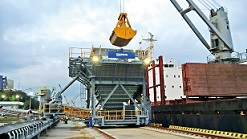
This Eco Hopper is designed to receive dry bulk materials such as cement clinker, limestone, gypsum and slag from a mobile harbour crane. The Eco Hopper will discharge onto a high-level quayside conveyor at a rate of 1,200 tph or via a dedicated outlet direct to trucks at 700 tph.

SAMSON Eco Hoppers provide an environmentally respectful import solution for dry bulk materials. With a variety of dust reduction and containment measures operators will reduce material wastage and limit fugitive dust. Robustly designed to withstand cross winds and grab impact damage, the Eco Hopper is reliable in busy ports and terminals.

SEA-Invest chose the SAMSON Eco Hopper for its flexibility. In addition to being able to handle a variety of different materials, the equipment can be configured at a later stage to suit evolving port operations. Port operators need to make sure that logistics costs are compatible with the market price of the materials being transported and that their equipment can respond to changes in market conditions. Mr Sébastien Ghesquiere, Director of SEA-Tech, the SEA-Invest Engineering subsidiary, confirms that “in a competitive market we need to ensure our service offering is reliable and value for money. Environmental responsibility is something that we take seriously at SEA-Invest. We endeavour to provide efficient, cost effective and environmentally appropriate service and we look forward to developing our port facilities with SAMSON”.

SAMSON Materials Handling has 50 years of experience in the design and manufacture of bulk materials handling equipment employed across a variety of different and diverse industries worldwide.