
Saturday, December 13, 2025
spot_img
Home Blog Page 195

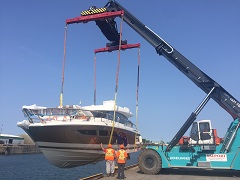
Konecranes do the heavy lifting for Valport, Canada

0

The machines arrived at the port mid-2015, and early 2016 respectively.

Valport provides stevedoring services at the Port of Valleyfield. Known as Canada’s largest small port, Valleyfield is a multi-modal port 70km outside of Montreal, with access to both the Atlantic and the Great Lakes.

The two new machines are destined to work with a variety of cargo; the port is known for its flexibility across a wide range of cargo and tends to handle everything from yachts to dry bulk and steel to containers. Another critical function the forklift and the reach stacker will support is Valport’s role in the annual sealift – a critical re-supply of arctic communities in Northern Quebec and Nunavut. “We are very pleased with our two recent purchases from Konecranes. Our SMV 4531 TB5 reach stacker has added more speed, productivity and safety to our port operations,” says Mark Beale, Valport Purchaser. The new machine has been attracting a lot of positive comments from shippers and operators, Mark continues, “The operators are impressed with its advanced technology and the tight handling the machine can manage.”

Praise is equally high for the Konecranes forklift. As Marks continues, “Then there is our hard-working SMV16-1200C forklift, which has attracted nothing but positive feedback from vessels during offloading and loading of steel product and general cargo. Our company looks forward to a bright future with Konecranes equipment,” Mark concludes.

“Our new partnership with Valport is very exciting, we are thrilled to see that the machines are already making a real impact at the Port of Valleyfield, and we remain 100% committed to Mark and the Valport’s operations team for support and backup”, says John Elisson, Konecranes Lift Trucks Regional Manager, Americas, together with Glenn Hughes, Konecranes Product Manager at Strongco Canada, who have been a Konecranes distributor since 2013.
Public support is needed to harness the potential of inland navigation in the Baltic Sea Region

0

This was highlighted by the panel that debated the future of inland navigation in Sweden as part of the 7th Strategy Forum for the EU Strategy for the Baltic Sea Region (EUSBSR). The Strategy Forum was organized in Stockholm and gathered together over 1200 participants to discuss future challenges and opportunities in the Baltic Sea Region.

The panel was organized by Interreg Baltic Sea Region project EMMA that aims to enhance inland navigation in the Baltic Sea Region. The panellists stressed that inland water transport is cost-efficient, safe and environmentally friendly compared to truck and train transport.

“Less than one third of energy is needed when carrying goods by vessel. It is a public task to support inland navigation”, emphasized Birgitta Schäfer from the German Federal Ministry of Transport and Digital Infrastructure.
While road and rail infrastructure is in some parts of the Baltic Sea Region overloaded, moving cargo from road to waterways reduces traffic jams and accidents.
“There is definitely potential for inland navigation in Sweden”, confirmed Johan Lantz, CEO of Avatar Logistics.

The panellists agreed that innovative solutions and right political framework are needed to make inland navigation an integral part of multi-modal transport chains. Germany is the forerunner here, and River Rhine is even called the motorway of inland navigation. In Sweden the main challenges include icing and pilot regulations as well as costs of pilotage.

“Development takes time and therefore each step should be taken into the right direction. Organizing transhipment is one of the issues that should be paid attention to. There are huge volumes that might be transported by inland barges and with all available information, means and technology such as river information systems we should overcome the problems”, advised Hans van der Werf, former General Secretary of the Central Commission for the Navigation of the Rhine.
Panellists admitted that there are lessons to be learned from other Baltic Sea Region countries in how to improve the administrative layout and framework.

“In Sweden there is a growing interest in inland navigation as well as good political engagement. Inland water transport should be competitive, and it can make a difference if we handle obstacles and recognize the Swedish prerequisites. We can learn from EMMA pilot projects that are going on”, said Stefan Engdahl, Head of Planning at the Swedish Transport Administration.
21 EMMA partners from Sweden, Germany, Finland, Lithuania and Poland develop efficient transport solutions together in order to assure cross-region applicability and benefits.

“There is clearly a need for cooperation and harmonization that EMMA project can support”, concluded Gunnar Platz, CEO of PLANCO Consulting and Project Manager of EMMA.

DP World leading environmental performance in maritime sector

0

In 2010, DP World was the first international marine and inland trade services provider to join the renowned CDP, which holds the most comprehensive set of global corporate environmental data. Through its climate change programme, thousands of the world’s largest companies disclose information on their greenhouse-gas emissions, energy use and climate change risks.

DP World’s Global Safety & Environment team has since been reporting action plans across its portfolio, monitoring energy use, making terminal operations more efficient, embracing renewable energy projects and investing in low-carbon technologies.

A recent example is the company’s ‘Go Green Week’, a collaboration in its third year with the world’s leading port operators to address three main ecological areas – Reuse and Recycle, Climate Change and Community. Different activities take place each year, often with neighbouring ports, across DP World’s global portfolio of 77 operating marine and inland terminals in 40 countries. Each business unit choses one or more of several activities, including reusing waste materials from the port, food waste composting, clean-up of terminal and surrounding areas, energy saving drives, tree planting, volunteering at local wildlife parks and supporting environmental education for local communities.

Another example is the DP World-commissioned installation of 88,000 rooftop solar panels on its Dubai facilities making it the largest distributed solar rooftop project in the Middle East. The panels will produce enough clean power for 3,000 homes a year and supports the UAE Vision 2021 for a sustainable environment.

Such programmes help the company achieve significant energy savings, evident in CDP results that show substantial year on year improvement. In 2013, DP World achieved a C score, meaning that the company has knowledge or “awareness” of climate change issues. It improved in 2014 scoring a B demonstrating coordinated action through their “management”. In 2015 and again this year, DP World has achieved a “leadership” score of A- proving that it is now implementing best practice in the transport industry.

In other CDP scoring categories such as governance and strategy, risk and opportunity management, and emissions management, DP World also excelled, clocking numbers much higher than sector and region averages.

DP World Group Chairman and CEO Sultan Ahmed Bin Sulayem, said: “I am delighted with the tremendous improvements in our environmental performance, which is key in helping us build a legacy for future generations. We strive to ensure everything we do leaves long-term benefits for the world we live in and reducing our carbon emissions is a top priority.

“We are making progress on other fronts too. Our collaboration with United for Wildlife to prevent trade in endangered species is just one example of a range of sustainability programmes on the environment, in education and support for communities across the world where we operate.”

DP World Global Safety and Environment Director Nabil Battal said: “Being able to measure and monitor our progress in reducing greenhouse-gas emissions is necessary to benchmark our efforts against those of other stakeholders with common goals. It ensures we all work together to improving our environmental performance and a combined effort is essential to make a meaningful difference.

“So while reporting on our efforts transparently and clearly through CDP will spur further improvements in our own performance, it can also help improve decision-making on climate change for investors, business and policy-makers.”

Containers continue to drive growth at SOHAR Port

0

The newly rebranded Hutchison Ports SOHAR, formerly OICT, part of the Hong Kong based group that operates the Omani container terminal, recently celebrated the official opening of Terminal C. The new, automated terminal features remote-controlled quayside cranes equipped to handle the next generation of 20,000 TEU container vessels.

Overall tonnage at the Port was up by over 6% in Q3 2016, compared to the same period last year, at over 13.4 million metric tonnes; or an average of over one million tonnes of cargo throughput each week. Despite the trend towards larger cargo ships, vessel movements at the Port were also up by 4%, compared to the same period of last year, with over 670 ships calling at SOHAR between July and September 2016.

Despite currently low oil revenues, Oman continues to invest heavily in economic diversification beyond its traditional petrochemical base. According to Frost & Sullivan, a Californian market research consultancy, the logistics industry in Oman is predicted to grow at a Compound Annual Growth Rate (CAGR) of 6.9% between 2016 and 2020. Plans are well advanced for container Terminal D at SOHAR, a fully automated facility that will quadruple the Port’s current capacity to 6 million TEU annually.

Mark Geilenkirchen, the CEO of SOHAR Port, said: “The introduction of containers from the mid-1950s, dramatically reduced shipping costs and became a major factor in globalization; sixty years later, there is no end in sight to the success of containerization in our industry. Our efforts today are focused on making containers smarter and even more efficient, by equipping them with tracking devices and sensors so we know not only where they are in the world, but also the condition of each cargo.”

SOHAR has seen phenomenal growth since it received its first vessel in 2004, and just last week was awarded Port of the Year Award 2016 by The Maritime Standards in Dubai, beating off tough competition from some of the region’s most prominent and longer established ports. SOHAR Freezone recently announced that it had won the prestigious fDi Magazine Free Zones of the Year Award for New Investments. fDi Magazine is part of the UK’s Financial Times Group and SOHAR was the only winner in this category in the Middle East region

Jamal T. Aziz, CEO of SOHAR Freezone, added: “Our prime position at SOHAR with a fast growing hub Port outside the Strait of Hormuz, and an adjacent, customer-friendly and optimally connected Freezone, is one of the biggest keys to our success. We look forward to more growth in the months ahead.”