
Friday, December 12, 2025
spot_img
Home Blog Page 197

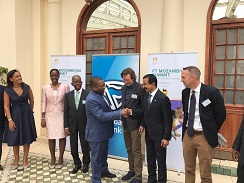
DP World Chairman meets President of Mozambique

0

In the backdrop of the Summit, Mr. Bin Sulayem and Mr. Nyusi discussed Mozambique’s growing trade and logistics sector, sharing views on the opportunities and challenges that lie ahead. Finding solutions to develop and connect Africa’s intra regional trade routes to unlock the continent’s huge potential was a common underlying theme of the discussions.

Mr. Bin Sulayem also delivered a keynote address at the Summit on the importance of partnerships, preceding a discussion entitled ‘Accelerating Infrastructure Transformation: Improving Ports, Roads, Airports, Marine Services, Telecommunications and Power Sector.’

DP World Group Chairman and CEO Sultan Ahmed Bin Sulayem said: “I have been to Mozambique many times and on another recent tour of Africa I’ve seen first-hand how each country is unique. Development solutions lie in partnership of governments, trading blocks in Africa and the private sector. Investors want to see policy frameworks, regulations and governance that are promoting trade and development.

“Africa has great potential and eight of the world’s top 20 fastest growing economies are still located here. Intra-regional connectivity through multi modal infrastructure, supported by investor friendly policies and regulation, and coupled with innovation are the keys to Africa’s potential.

“We’ve always expressed our readiness to support the development of ports and logistics centres in Africa. We’ve partnered with local governments in all seven of our ports in six African countries and look forward to developing our trade relations further in future years.”

According to Mr. Bin Sulayem, major indicators show a promising future for a vast continent filled with opportunities. There has been 6% growth in number of foreign companies investing in Africa and they are thinking long-term – investments into infrastructure related areas like power, construction and ICT have accounted for 44% of total FDI into the region.
He added that there is still a need to address the soft infrastructure gap and better internal trade integration is key.

Trade between Dubai and Mozambique was valued at over AED 724 million in 2015 and over AED 776.5 million in the first six months of 2016, while showing a significant increase in re-export trade in the last six months.
Liebherr Maritime Cranes delivers 3 new mobile harbour cranes

0

Port of Helsingborg
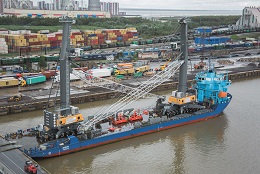
At the end of August, a new Liebherr mobile harbour crane, type LHM 550, the latest investment by Port of Helsingborg arrived at the Västhamnen. The crane was shipped fully assembled by barge from the Liebherr facility in the Port of Rostock.

“The crane was ready for operation immediately after rolling off from the barge onto our new quay. Together with the new pier, this state-of-the-art mobile harbor crane provides the basis for further expansion of the container business in the Port of Helsingborg. We increased the container handling capacity by 50%”, concludes Niels Vallø, CEO Port of Helsingborg.

The crane is equipped with a twin-lift container spreader that can handle two 20′ containers at the same time. Apart from container handling the crane can be adapted for project cargo and different special lift applications.

“The most decisive factor to opt for a LHM 550 is Liebherr’s arrangement of the drive system. The new crane is capable of running either on electricity or diesel, a feature which we highly value. The diesel engine gives us the freedom to move and position the crane at any pier we want. Once in place, we connect the crane to the main power supply, switch on the e-drive and operate the crane with eco-friendly energy”, says Niels Vallø, CEO Port of Helsingborg.

Container Terminal St. Petersburg
Almost simultaneously Container Terminal St. Petersburg has taken in two new Liebherr mobile harbour cranes, type LHM 550, also shipped from the Liebherr factory in Rostock.
“Both cranes are equipped with a low voltage electric main drive. “Plug in and turn the e-drive on. As long you have electricity the crane will work, but also in case you don’t have power there is still the diesel engine ensuring your operation never stops”, says Maxim Kim, Area Manager of Liebherr Maritime Cranes.

Scope of supply included two spreaders as the main task in the port is container handling. To ease the handling of big vessels the crane is equipped with a 4.8 metres tower extension. Thus, the elevated tower cabin provides the driver with an unrestricted view over the vessel.

Both LHM 550 come in a 4-rope configuration, which means true multifunctionality. With a quick change of the lifting attachment the spreader can be replaced by a mechanical grab. “Within minutes the Liebherr mobile harbour cranes turn into bulk handling machines. In that particular case, the cranes are used for the handling of aluminiumoxid”, Maxim Kim comments.

The terminal also benefits from the existing service-setup in St. Petersburg. The huge population of Liebherr mobile harbour cranes in the area can rely on on-site service engineers as well as a sorted spare parts stock for immediate trouble shooting.

ICS tells UN Climate Conference that IMO needs to agree CO2 commitments for shipping by 2018

0

At an official UNFCCC side event organised by IMO today, ICS Director of Policy and External Relations, Simon Bennett, said:

“We are very optimistic that initial CO2 reduction objectives can now be developed by IMO for the sector by 2018. The shipping industry thinks these should reflect the spirit and ambition of the Paris Agreement while being appropriate to the circumstances that apply to international shipping – just as the commitments made by governments to UNFCCC reflect the circumstances of different national economies.”

ICS says that the IMO Road Map (agreed by the IMO Marine Environment Protection Committee at the end of October) will build on the mandatory CO2 reduction regulations for shipping already adopted by IMO – four years before the Paris Agreement was adopted – which will ensure that ships built after 2025 will be at least 30% more efficient.

However, ICS believes the IMO Road Map will actually will go much further than the Paris Agreement.

“The final stage to be enacted by 2023 should establish a global mechanism for ensuring that these initial IMO commitments – which the industry wants to see agreed by 2018 – will actually be delivered.” said Mr Bennett.

ICS says this IMO mechanism could potentially include a legally binding Market Based Measure.

“This remains very controversial and is not yet universally supported throughout the shipping industry” said Mr Bennett. “But if this is what governments eventually decide, the clear preference of the majority of the industry would be for a global levy based on fuel consumption.” Mr Bennett added “Key to next steps is the mandatory global CO2 data collection system which IMO has now adopted. This will enable any initial CO2 commitments agreed in 2018 to be further refined using the very latest data on ships’ emissions which will become fully available from 2019.”

“But most importantly, the IMO data system will inform the development of a mechanism by IMO for ensuring that agreed CO2 reduction commitments are indeed fully met. This will no doubt include deciding the extent to which technical and operational measures alone might be insufficient to deliver the IMO CO2 reduction commitments that we hope will be initially agreed in 2018.” ICS says that the international shipping sector actually reduced its total CO2 emissions by more than 10% between 2007 and 2012, despite an increase in maritime trade – while the rest of the world economy, even taking account of the commitments made in Paris – will probably continue increasing emissions at least until the 2030s.

“But the shipping industry fully recognises that society expects more, and we therefore think it is vital that IMO Member States agree some truly ambitious CO2 reduction commitments by 2018.” said Mr Bennett.

ICS and its member national shipowners’ associations expect to come forward with some firm ideas about what these IMO CO2 reduction commitments might entail before the next IMO Marine Environment Protection Committee meeting in 2017. end

Sabah Ports will operate Terex machines in its Sapangar Bay Container Port

0

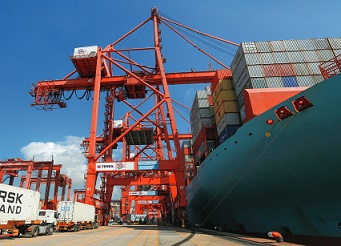
SBCP, situated on the north coast of the island of Borneo, is the premier transshipment hub for the Brunei-Indonesia-Malaysia-Philippines East ASEAN Growth Area. Strategically located along the busy shipping routes between the Far East and Europe, the port is faced with the challenge of constantly increasing handling rates. The STS cranes will help SBCP to enhance significantly the productivity of its operations. These cranes offer SBCP a lifting capacity of 41 t under twin-lift spreader, an outreach of 45 m and are designed to load and unload container vessels with up to 15 rows.

The two STS cranes for SBCP are part of a series of orders that Sabah Ports recently placed with TPS. In June 2016, one Terex® Gottwald Model 2 mobile harbour crane as well as two Terex® reach stackers, one for Sabah Port’s terminal in the Port of Sandakan and the other for the Port of Tawau, were put into operation. These machines supplemented the three mobile harbour cranes already purchased by Sabah Ports, one for Sandakan in 2005 and two for Tawau in 2005 respectively in 2008. Additionally, four Terex rubber-tyred gantry cranes (RTG) were ordered for SBCP. Mohd Sahid Hj Nawab Khan, Chief Operating Officer, Sabah Ports: “We have full confidence that the new cranes to Sapangar Bay Container Port will enhance the ports productivity level. We are committed towards strengthening our fleet of machineries with state of the art and innovative range of solutions provided by TPS to ensure we meet the demands of our users.”

Maurizio Altieri, Vice President Sales & Service TPS Asia, is pleased that the one-stop shop approach of TPS has convinced one of the fastest growing port operators in South-East Asia to extend the business relationship: “Sabah Ports is one of the most important players in Malaysia’s port business. Our technology which combines high productivity with economical total cost of ownership, as well as the availability of our service, will help the customer to continue to strengthen its leading position in this dynamic world region.”