

Monday, December 8, 2025
spot_img
Home Blog Page 200

India Port operator purchases eighteen Terex rubber-tyred and four Terex rail-mounted gantry cranes

0

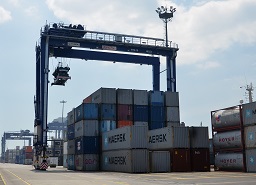
The orders include eighteen Terex® rubber-tyred gantry cranes (RTG) and four Terex® rail-mounted gantry cranes (RMG). The RTG order also includes an option on 18 additional units. The flexible, productive and environmentally friendly machines will be handed over in three batches of six units each of RTGs between September and November 2017 whilst the RMG cranes will be delivered to Mumbai in September 2017. The RMGs will be utilized in BMCT’s railyard, which can handle double stack container trains of up to 1.5 km long. BMCT will be the second Indian subsidiary of PSA to operate cranes from TPS. In 2015, four RTGs were put into operation by Bharat Kolkata Container Terminals Pte Ltd.

Customers worldwide are opting for stacking cranes from TPS
Maurizio Altieri, Vice President Sales & Service TPS Asia, is delighted by the confidence that BMCT has shown in the machines from TPS: “BMCT will be a key player in one of the most dynamic Asian markets and is a subsidiary of a globally leading port operator. We are proud that from the end of 2017 a total of 26 cranes from TPS will contribute to PSA’s rapid growth in India. The fact that the customer opted for Terex RTG and RMG cranes confirms our diversified portfolio strategy.”

RTGs: variable speed engines reduce fuel consumption
The RTGs for BMCT are equipped with 16 wheels. They provide a maximum lifting capacity of 40 t under spreader and can stack standard containers 1-over-5 with a lifting height of 18.1 m and a hoisting speed of up to 46 m/min. With a span of 23.7 m, the cranes cover six container rows and a truck lane. The new cranes are equipped for on-board power generation with diesel generators, whereby the diesel engines work in the fuel-optimized speed range (variable speed engines), which helps reduce fuel consumption by around one third, depending on the site and operational conditions. Moreover, exhaust emissions in the terminal are reduced over the long-term.

RMG: double sided cantilevers for flexible stack management
The four RMG cranes will be supplied with power from the terminal’s mains and will not generate any local exhaust emissions. With a 37.6 m span the cranes cover six rail tracks. They offer a maximum lifting capacity of 65 t under spreader and can stack standard containers 1-over-3 with a lifting height of 12.5 m and a hoisting speed of up to 40 m/min. The machines are equipped with a trolley rotation function that provides crane operators with an excellent view of the containers, railway cars and the entire working area. Moreover, the double-sided cantilevers cover two truck lanes on either side of the cranes’ rails. Finally the cranes offer BMCT highly flexible container stack management and particularly good utilization of limited space.

Ports should be at the heart of the UK's Industrial Strategy says ABP Chief Executive

0

He highlighted how the Port of Southampton, the UK’s leading export port, provided vital access to global markets ‘for manufacturers such as JCB and Jaguar Land Rover.
Around 300 MPs, maritime and UK manufacturing industry leaders gathered at the Foreign and Commonwealth Office for the reception to highlight the importance of the maritime sector to the UK economy.
The event was addressed by Trade Minister Mark Garnier, who echoed Mr Cooper’s call for the UK to have a global trading outlook.
Mr Cooper said: “The UK is a maritime nation. We are an island surrounded by sea. One might think that those drafting our new industrial strategy might usefully start by acknowledging that fact.
“There is a powerful case for ports and maritime to be at the forefront of a strategy to boost UK exports, front and centre of a wider industrial strategy that cuts across Government.
“The UK must raise its sights and adopt a global approach in our drive to boost trade and boost exports. Indeed a positive global outlook, being ambitious and being enterprising are qualities which are embodied by our maritime industries.”
Maritime Nation aims to raise awareness of the vital contribution of the marine and maritime sector and how it provides vital access to European and global markets for UK manufacturers.
The campaign is supported by a number of organisations, including ABP and the Port of Dover, and supports the Department for International Trade’s Exporting is GREAT campaign.
The campaign builds on three principles: 1) Ports and maritime are critical for UK trade; 2) Britain should build on its strengths as a maritime nation and 3) Britain should have a global trading outlook.

Maersk Line reports a third quarter loss of USD 116 million

0

Volumes were 11% higher as Maersk Line was able to win market share. Amongst others due to increased volumes following, Hanjin’s court receivership filing, increasing customer focus on financially solid carriers and increased volumes on back haul services.

Maersk Line’s capacity grew 3.8%. Maersk Line continues to manage capacity tightly resulting in high utilisation.

Maersk Line maintains its 2016 full year expectation of a significantly lower underlying result than for 2015 (USD 1.3bn) with the specification that the underlying result is expected to be negative.

“In the third quarter we made a loss, which is unsatisfactory. However, we continue to deliver on our growth and cost objectives. We won market share, we continue to take out cost and increase our utilisation,” says Pierre Danet, CFO of Maersk Line.

The container shipping demand growth was about 2% and the global container fleet (capacity) growth was about 3.3%. The gap between capacity entering and exiting the industry was the lowest in many quarters.

Compared to Q3 2015, Maersk Line’s average freight rate declined with 16%. However, for the first time since Q2 2014 it increased quarter-on-quarter with 5.5%.

“We have indications that rates may have bottomed out. Compared to the previous quarter, our rates increased, which is something we have not seen in the last two years. Furthermore, we expect that the more balanced supply and demand situation will lead to a more sustainable industry. So there are definitely encouraging signs,” says Pierre Danet, but also cautions.

“The market situation is still very challenging, our current rate level is unsustainable and demand remains low. That is why we will continue to manage our capacity efficiently, and have our already announced rate increases this month,” concludes Pierre Danet.

Maersk Line is part of the newly established Transport and Logistics division. The division will help Maersk Line improve the product offering and customer experience through innovative and digitalised solutions and services.

BLOK-BEAM container handling system – designed to ease port congestion

0

Designated “BLOK-BEAM”, the system enables six containers to be lifted and transported as one single block – largely using existing port infrastructure.

BLOK-BEAM comprises a pair of steel beams connecting the six empty containers together to form a single block, which can be lifted as one unit. While containers have remained relatively small and standard in size over the past few decades, container cranes have increased their capacity significantly, permitting increased loads to be handled.

According to John Evans, Managing Director of BLOK-BEAM Ltd: “Now that ships are able to deliver around 20,000 20ft containers on one vessel – and the cranes to service them can lift up to 100 tonnes at a time – it is the ports which, in spite of their improved efficiency, have become the focus of attention in ship-to-shore movement.”

Evans notes that ports handle over 500 million containers annually, of which as many as 25% are empty. With container terminals charging up to USD300 per lift, the potential savings to the industry are massive. Instead of extended dwell-times in port while extensive loading and discharge takes place, the ships could be at sea – or saving fuel by slower sailing.

Evans continues: “We estimate that if only one-third of empty moves of containers are handled by BLOK-BEAM, the industry would save over USD2 billion per year – before even considering the vast expense of idle time, fuel savings, general efficiency, losses at sea and safety.

For the ports to further enhance productivity, BLOK-BEAM Ltd has designed a special trailer, – the “OX” – which acts as a jig for BLOK assembly and then as a trailer for transporting the BLOK, neatly and quickly, to the cranes for loading. Preparing the OX is done away from the quayside, so that the stevedores can work regular hours in safety preparing the container “BLOKs” ready for the arrival of the ship. The jigging features of the OX enable the containers to be neatly positioned, whilst they are secured as a BLOK.

Martin Clive-Smith, BLOK-BEAM Ltd’s Engineering Director, quantified the improvements in safety offered by the system, as follows: “By moving 80% of container preparations off the busy quayside, the risk of accidents is reduced, while time is saved. Likewise, the BLOK-BEAM System has the potential to cut on-deck lashing by more than 50% and yet increase stability at sea.”

During unloading, cranes can drop the BLOKs straight onto the OX and just one driver can rapidly move the containers away from the busy quayside 6 times faster than normal. Because the BLOK is 3 containers wide, it is entirely stable and cannot be knocked over.