
Saturday, December 13, 2025
spot_img
Home Blog Page 224

The effects of the Fehmarnbelt fixed link on commodity flows and economic development

0

Yet all were unanimous on one point: The tunnel is coming.

Among the 120 participants were such high-ranking politicians and business representatives from Germany, Denmark and the EU as Pat Cox, EU coordinator for the Scandinavia-Mediterranean transport corridor of the Trans-European Transport Network (TEN-T). As Ingo Egloff, CEO of HHM, mentioned in welcoming the participants, their attendance underlined the importance of the topic. In his keynote speech Senator Frank Horch, Hamburg’s Senator for Economy, Transport and Innovation, explained the very high priority accorded to the Fehmarnbelt fixed link in planning by the Hamburg state government (Senate): “The Hamburg and Copenhagen metropolitan regions are natural partners: Building the tunnel will enable them to pool their strengths. This is equally important for the population, commerce and also universities in the two regions and for the whole of Northern Germany and Southern Scandinavia.”

Michael Svane, CEO of the Danish Transport Federation and Infrastructure Policies, threw light in his speech on the Fehmarnbelt fixed link project from the Danish point of view. Svane, who described himself as a true believer of cooperation and competition, primarily emphasized the immaterial aspects of such a tunnel: “This will not just be a piece of concrete, but will involve increased potential for companies, for the world of politics and above all for the population.” From his point of view there may be some losers due to the tunnel, but a distinctly larger number of winners. “The Fehmarnbelt fixed link will be a game changer, as proved by other crossings in Denmark like the Öresund Bridge to Sweden: A new multimodal transport corridor will strengthen cross-border trade, on the one hand, and improve quality of life for people in the regions, on the other.”

Intensive involvement of the civil public is the key
Following the keynote introductions, five speakers gave their views on the possible effects of the tunnel during a panel discussion moderated by Jens Assmann of the Hamburg Chamber of Commerce. Kurt-Christoph von Knobelsdorff, Schleswig-Holstein’s Deputy Permanent Secretary for Economic Affairs, and Frank Limprecht, Regional Head of Large-scale Projects at DB Netz, explained the extensive processes for involving the civil public in the planning of the tunnel and the German rail connections on a voluntary basis, for example through regional Round Tables and the general dialogue forum on the Fehmarnbelt fixed link. “Since major construction projects are usually perceived critically at the outset by wide sections of the population, such intensive and time-consuming involvement is a necessary and a good investment,” said Limprecht. In addition, citizens affected are able to receive a hearing through such statutorily prescribed processes of involvement as planning approval procedures. Well over 10,000 objections, for instance, are expected to be received by the Kiel planning authorities in the course of the plan revision procedure on the Belt Tunnel. Both representatives seemed to be confident, however, that construction of the tunnel and the related rail connection in Germany could start by 2020 at latest. “Let’s get it done” was von Knobelsdorff’s call to conference delegates.

What shifts may be expected to existing and forecast transport flows?
Prof Dr Sebastian Jürgens, Managing Director of Lübecker Hafen-Gesellschaft (Port of Lübeck) and Heiko Kähler, Managing Director of ferry operator Scandlines, are more critical about construction of the tunnel. For both, this entails a serious alteration of the conditions under which they do business. They therefore called a level playing field and fair and equal conditions for competition from the politicians. Despite the construction of a tunnel, infrastructure for linking the ports and for intermodal services should not be neglected. Jürgens reminded his hearers that in the overall view of the transport flows the tunnel should not lead to a modal shift in favour of the truck.

Jürgens is convinced that even after completion of the tunnel, he will still be able to operate successfully. The Port of Lübeck aims to evolve as a logistics and intermodal hub, and will therefore require a direct rail link to the tunnel, something not so far envisaged in Deutsche Bahn’s planning. Scandlines aims to broaden its range with new ferry routes, and will also deploy additional environment-friendly hybrid ferries to maintain its services on the Puttgarden-Rødby route.

Michael Svane concluded by emphasizing once again that in a market-driven society, only competition, plus cooperation will be appropriate to master the swiftly changing conditions in the light of new energy and environmental requirements. “Customers will always be persuaded by good intermodal concepts – also in Lübeck”, Svane assured Jürgens. At the same time, he held out the prospect of five new Danish customers, whom he intends to secure for the Port of Lübeck – a good example for stronger cooperation between German and Danish players. “Eventually, the tunnel concerns not only these two regions, but will bring future stimuli for the intermodal transport sector throughout the European Union,” concluded Svane.
Shortlist puts Bremen, Cartagena, Dunkirk, Guadeloupe and Riga in competition for the ESPO Award 2016

0

The jury selected these five applications from a total of 11 submissions. The theme of this year’s competition is ‘Nature in Ports’.

The award will go to the port authority that succeeds the best in safeguarding and further upgrading the nature and ecosystem (on land and/or waterside) in the port area and would also reward ports that succeed in opening up these areas for the people living around the port and let them enjoy that nature, notwithstanding ISPS restrictions. In general, European ports are part of very valuable ecosystems, both on the land and waterside. Many port areas are also neighbouring Natura 2000 areas or even consist of Natura 2000 areas. Port authorities in Europe invest a lot of time and efforts in maintaining and improving the quality of the nature in the port.

“It has been a great pleasure to chair my first ESPO selection jury. What it revealed has been an impressive standard of entries from a diverse geographical spread. In selecting a short list we did so conscious that in such a context there are no losers. What our five chosen entries capture and express are the capacity and qualities that permit them to act as a demonstration effect of good practice”, said Pat Cox, Chairman of the ESPO award jury.

The winner of the eighth ESPO Award will be announced during the Award Ceremony taking place on 9 November in Brussels. The shortlisted projects will be presented on the ESPO website in the running up to this event.

The ESPO Award was established in 2009 to promote innovative projects of port authorities that improve societal integration of ports, especially with the city or wider community in which they are located. In this way, the Award wan

Navis Launches N4 3.2

0

Supporting industry expectations, this new release of N4 executes on the vision to provide a technology platform that increases the productivity and efficiency of terminals in various operational environments. N4 3.2 includes a rich set of features and enhancements that help terminal operators to meet the new regulatory requirements of SOLAS, help IT teams administer and maintain N4, and provides innovative solutions for terminals using automated equipment.

New features and enhancements in N4 3.2 include:
• Support for SOLAS VGM: N4 3.2 has built-in weight verification fields for the SOLAS mandate, including VGM Weight (Verified Gross Mass), VGM Verifier (to capture the party/entity authorizing VGM Weight) and Gross Weight Source (to identify the source that generated the Gross Weight of the unit).
• Functional Improvements and Enhancements that provide improved visibility for multi-lift operations, increased yard equipment utilization and more functionality for gate operations.
• N4 System Administration and Maintenance Improvements help IT teams to monitor, maintain and support N4 systems.
• More Functionality for Rail Operations that improve productivity and flexibility during load and discharge process at the rail.
• New Functionality for Terminal Automated Equipment that includes the addition of schedulers for Auto Shuttles and Quay Cranes and enhanced transfer zone management. The new automated equipment functionality increases productivity by minimizing equipment wait times, maximizing resource utilization and balancing the demands on resources.

“At a time when the ocean shipping industry is more complex than ever, Navis is committed to providing essential, best-of-breed technology to help terminals around the world tackle the major challenges of productivity and cost-effectiveness,” said Scott Holland, VP of Product Management at Navis. “N4 3.2 embodies stability and reliability, two necessary stepping stones to help the industry’s universal end-goal: increased productivity through greater operational efficiency.”

Port of Tyne supports school's football initiative

0

More than 100 young people from north and south of the River Tyne were involved in the Football and Business in Partnership Enterprise delivered by the Foundation of Light, Sunderland AFC’s registered charity, and the Newcastle United Foundation.

The unique initiative developed business, social and personal skills and helped the students gain a certificate in Business and Enterprise. Part of the six-week long programme was to create an advertising campaign to promote a strong message to keep rivalry friendly between the fans of both teams.

Four schools took part and came up with strong advertising campaigns to promote greater harmony between both football clubs’ supporters.

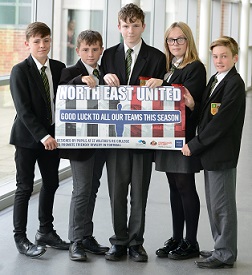
The winning campaign came from Year 7 pupils of St Wilfrid’s RC College in South Shields and was designed by Alexi, Ben, Codi and Kyle.

They showed how football can bring people together without hostility. They demonstrated this with really strong images of the tributes paid to the Newcastle fans who died in the Malaysian air disaster, compared to ugly derby match scenes when fans had lost control. Their slogan ‘North East United’ is featured on the striking design, which includes the iconic Angel of the North symbol and a ‘good luck’ message to all North East teams this season.

Susan Wear, Director of Corporate Affairs for the Port of Tyne, said: “We are very proud of the effort and thought that all of the school teams put into this project.

“It was very difficult to choose a winner from the finalists, but the pupils at St Wilfrid’s really understood the emotion that football evokes and linked it to the impact this has on the image of the North East. They came up with a positive message that hopefully will begin to inspire better understanding between the fans of two football teams in two great cities.”
The programme used Newcastle United Football Club, Sunderland AFC and Port of Tyne as business models.

Chris Towers, Education Officer at Foundation of Light, said: “Port of Tyne’s hands-on approach and commitment to making the pupils’ concepts into reality has really brought this project to life.
“All of the youngsters taking part produced really creative and thought provoking work which demonstrated their pride for not just Newcastle and Sunderland but for the whole of the North East.”

Kate Bradley, Head of Newcastle United Foundation, said: “All of the young people worked incredibly hard throughout this project and it’s fantastic that through the support of Port of Tyne the winning group are seeing their campaign live across Newcastle and Sunderland. The Football and Business in Partnership Enterprise is a really innovative project that really captured the minds of the pupils we worked with.”