
All of these ports, including Almirante, Balboa, Colon and Cristobal, saw some mixed results in their container throughput, with growth dragged down by the economic crisis facing its main trading partners as well as internal problems. On the Atlantic side, at Colon – the “home” to four container terminals including Manzanillo International Terminals (operated by SSA Marine), Colon Container Terminal (operated by Evergreen), Panama Ports Co (operated by Hutchison Whampoa) and Colon Port Terminal – mixed results were recorded. Evergreen’s Colon Container Terminal (CCT) saw container volumes rise by 57.1% to 789,663 TEUs due to the return of several services. Last year, CCT was upgraded in order to dock 14,000 TEU vessels and raise terminal capacity from 1.5 to 2 million TEUs. The expansion has added a fourth berth with 16.5m depth alongside and a quay of 640m, equipped with three gantry cranes able to handle ships with 23 rows of containers. Future plans call for a 2.4 million TEU capacity terminal by lengthening the quay to 780m in order to dock two 12,000-14,000 TEU ships simultaneously. The 74-hectare Colon Container Terminal serves the regional markets of the Caribbean, and North, South and Central America with shipments mainly originating in the Far East. Manzanillo International Terminal (MIT) is a multi-user, private-owned and operated container and ro-ro cargo trans-shipment hub located at the Northern entrance of the Panama Canal. In 2015, the terminal handled 1,974,979 TEUs – a 5% decrease compared to 2014. Being mostly a trans-shipment terminal, economic and political situations have a direct impact on the terminal throughput. Estimates for 2016 show 0% growth based on the economic conditions of Asia and South America. In October 2015, Manzanillo International Terminal, the largest terminal in Colon and located on the Atlantic Coast of Panama, took delivery of four new ZPMC container cranes – the biggest container cranes ever received for a container terminal in Panama and the Caribbean. The environmentally-friendly cranes are capable of handling the biggest vessels in the world (with 25 container rows on deck) and are ready for operation from a remote control station. Upon commission, a total of 11 post-Panamax and 8 super post-Panamax container cranes will be lined up along MIT’s 2km container quay. The cranes are part of MIT’s new USD270 million expansion plan which included the deployment of the first six Automatic Stacking Cranes in Latin America back in June 2015. When completed, it will increase MIT’s yearly handling capacity to 4 million TEUs. Other investments completed in 2015 include the construction of a 400m container berth and dredging to 16.5m alongside two neo-panamax berths, turning basin and access channel. The terminal is served by Panama Canal Railway Company, connecting cargo to and from the port in the Pacific coast of Panama. MIT also offers a strategically placed logistics park, which serves multinational companies by providing commercial facilities for cargo sorting, grading, packing and re-packing, labeling, storage, transit and assembly. This new model of logistics operations created in Panama integrates all the benefits of Colon Free Zone activities with a full multimodal system interface that includes ocean, air and rail facilities. MIT’s adjacent rail facilities and logistics park, along with its modern infrastructure, makes it the leading distribution and logistics hub of the region. Cristobal’s container throughput, the terminal operated by Hutchison’s Panama Ports, was up to 812,783 TEUs. On the Pacific side, container volume at Panama Ports Co’s Balboa dropped by 4.9% to 3.08 million TEUs and PSA-Panama’s throughput also decreased by 6.9% to 216,012 TEUs.
Katoen Natie receives 1000th Hyster truck
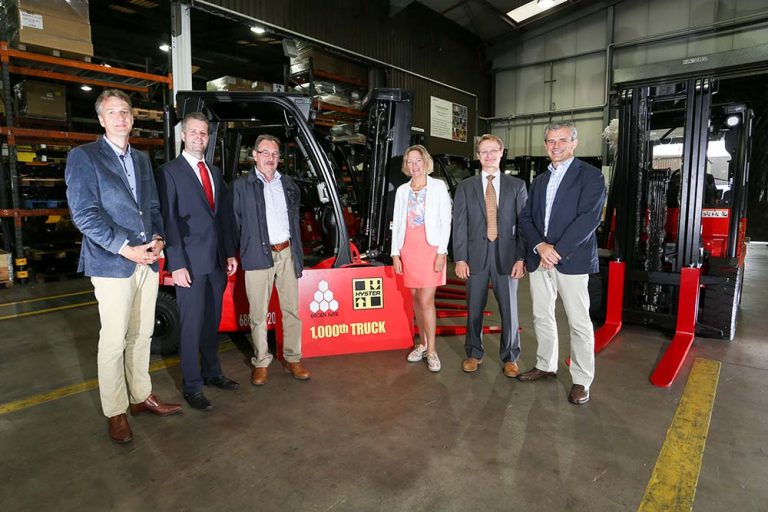
Representatives from Katoen Natie recently visited the factory where Hyster® trucks are produced in Craigavon, Northern Ireland, for the handover of the latest trucks to join the fleet – including an LPG powered Hyster® H2.5FT forklift – the 1000th unit ordered by this customer. Harry Sands, Senior Vice President and Managing Director for Hyster EMEA, presented the truck to Danny Senecaut from Katoen Natie.
“We previously didn’t believe that there was a truly worldwide truck manufacturer that could support our international operations,” says Danny Senecaut from Katoen Natie. “We were glad to find that Hyster could offer a global solution to meet our needs, and we look forward to continuing to work together.”
Present in 33 countries across 5 continents, Katoen Natie delivers a wide range of services, including loading and unloading cargo, operating logistics platforms for storage and handling of industrial products, and supply chain design and management.
Having compared the product offering to that of a competitor brand, and following successful cooperation in Belgium, Katoen Natie chose to introduce Hyster® trucks to its varied international operations in 2011. Hyster® solutions are now supporting the company to deliver services in 21 countries, across the US, Europe, Middle East and Asia.
To best meet the customer’s specific needs, the Hyster Special Engineering Team applies a package of customised features to all Katoen Natie’s trucks to enhance ergonomics and performance for drivers and support best operating practices. This includes features such as a high visibility seatbelt, an engine shutdown system where required and a pedestrian awareness light. In addition, all of the trucks are bespoke painted to match Katoen Natie’s branding, which ensures seamless integration into the fleet of trucks used within their different customers’ operations.
Due to the exceptional support of local dealers around the world, in particular B-CLOSE in Belgium, alongside the proven performance of Hyster® trucks, Katoen Natie has already ordered a large volume of new equipment in 2016.
The latest truck received will be used in Antwerp, Belgium where the company is headquartered and will join a mixed fleet of electric and LPG vehicles, from 1.6 tonne capacity forklifts through to high capacity lift trucks and container handlers. Katoen Natie has recently acquired its 25th Hyster® ReachStacker, so on their recent visit to Craigavon to celebrate acquiring 1000 Hyster® trucks, they were presented with a scale model of a ReachStacker specially customised to Katoen Natie’s brand colours.
“We are delighted to supply Katoen Natie with a range of high quality lift trucks and services that help them to meet the challenges of different applications around the world,” says Henrik Caesius, Major Accounts Manager, Northern Europe for Hyster. “With a strong working relationship based on trust, our focus is ensuring that we continue to grow alongside our customer and continually fulfil all their requirements despite any challenges we might encounter.”
“Our handling operations are intensive, varied and demanding, so reliability, low cost of ownership and responsive services are key requirements within Katoen Natie’s port handling and logistics operations,” says Sophie Van Kerckhove, Head of Purchasing, Katoen Natie.
Katoen Natie is fully supported throughout its international operations by the local Hyster distribution partners globally, providing rapid engineer response and planned maintenance.
Port boosted by handling business
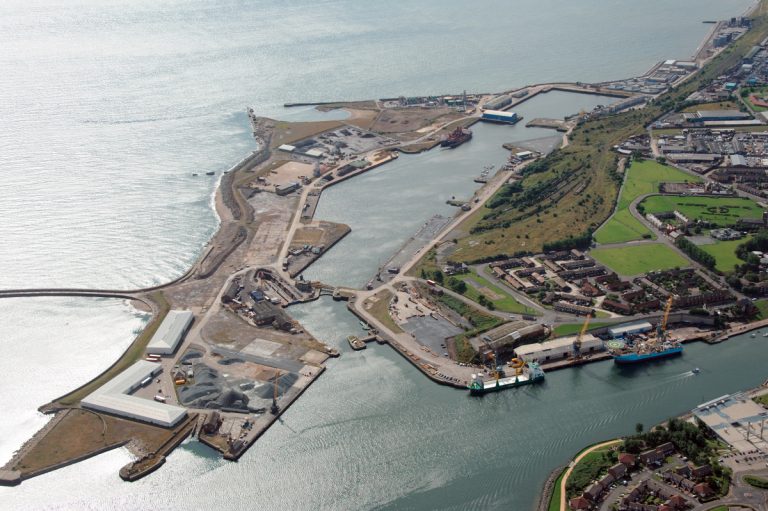
Last year, Port of Sunderland handled almost 750,000 tons of cargo, however bosses expect that 2016 will see it deliver increased record tonnage figures.
Matthew Hunt, port director at Port of Sunderland, said: “To date, it has been a fantastic year for Port of Sunderland, and we’re on course to beat figures from last year.
“While many ports have seen a decrease in business, Port of Sunderland has not left itself exposed, and has continued to service a broad range of business, meaning that it has been well-protected against any slowing in the current economic climate downturns.”
He added: “It has been fantastic to see the port so busy and we know this is only just the start. We have cleared areas of land across the Port of Sunderland, which will allow us to service an increased volume of business going forward. And this, teamed with recently purchased handling equipment, and the reconnected rail link along the Hendon Branch line that leads right into the heart of the facility, connecting it to the East Coast mainline, and from there to the wider rail network and mainland Europe via the Channel Tunnel, means business is set to be bright for many years to come.”
Port of Sunderland has enjoyed something of a revival over the last six years, after bosses worked in partnership with its municipal owners, Sunderland City Council, to lay out a masterplan for the growth of the port, one of the city’s key assets.
Initially the focus was on capturing business in the renewable energy sector. However, without the expected government policy backing for the sector, there has been a slow down in the project pipeline in that industry that has seen the port focus its attention back on traditional maritime activities, including bulk cargo handling and project cargoes.
Mr Hunt added: “Many ports, operating up down the country, have been hit hard by the dip we have seen. It has simply been necessary to go back to basics and that is exactly what we have done, attracting bulk cargoes which has led to the increased volumes we have seen passing through the port over the last year.”
Next year marks 300 years since the opening of Port of Sunderland. It has enjoyed a run of success since the arrival of director Matthew Hunt in 2010.
Councillor Paul Watson, leader of Sunderland City Council and chair of the Port of Sunderland board, said: “Port of Sunderland is a real natural asset, and it is fantastic to see it being utilised to great effect to the benefit of the whole city.
“As well as an increase in traditional business the port has diversified over the last few years, including the arrival of three cruise ships consecutively over the last three years, something that hadn’t happened for decades.
“The level of ambition that exists at the port has never been so high, and it is exciting to think about the vast potential that we will be able to unlock over the coming months and years.”
2015 sees growth taper off at the Port of Lianyungang

However, in 2015, the port of Lianyungang (affected by the sluggish Chinese economy as per many other ports in the region) saw its giant growth spurts taper off handling a total of 5.01 million TEUs – up just 0.8% compared to 2014 when it handled 5 million TEUs. The slowdown may just be a one-off “glitch” in the overall performance of the port, although the issue may have been compounded by the rumours that Lianyungang might be on the Government’s list to become a dedicated bulk port rather than a container port. Last year the port handled 211 million tonnes of cargo and welcomed 7 new shipping routes including a cargo container liner service. The port is one of Kazakhstan’s strategic sites abroad and offers effective transit developments and transport potential for the country. Hence, the port started a regular container service by rail to an intermodal hub in Almaty. The “Lianyungang-Almaty” service sees more than 20 container trains with export and transit cargoes. By the end of 2015, the volume of export and transit traffic via the Kazakhstan intermodal terminal achieved well over 250,000 TEUs and expectations are that this number will be doubled within 5 years. In April 2015, the port announced it decided to dissolve and liquidate its loss-making subsidiary Lianyungang Xindongrun Port Terminal Co. The terminal was jointly established by Lianyungang Port and China Shipping Terminal Development in 2007. China Shipping Terminal Development sold its 49% equity shares to Lianyungang Port in December 2014. In a statement the port revealed that the terminal has been suffering financial losses from the start and has little room for business expansion. In June 2015, Lianyungang Port awarded CCCC Third Harbor Engineering Co Ltd the contract for the construction of the West vertical breakwater and splash zone in the Xuwei zone. The project is an integral part of the construction of the Xuwei zone. Total value of the contract is USD121.7 million with a construction period of 25 months. Earlier this year, the port commissioned five newly constructed container berths and related facilities, adding an additional annual capacity of 2 million TEUs and around 400,000 square meters of container storage yard.