
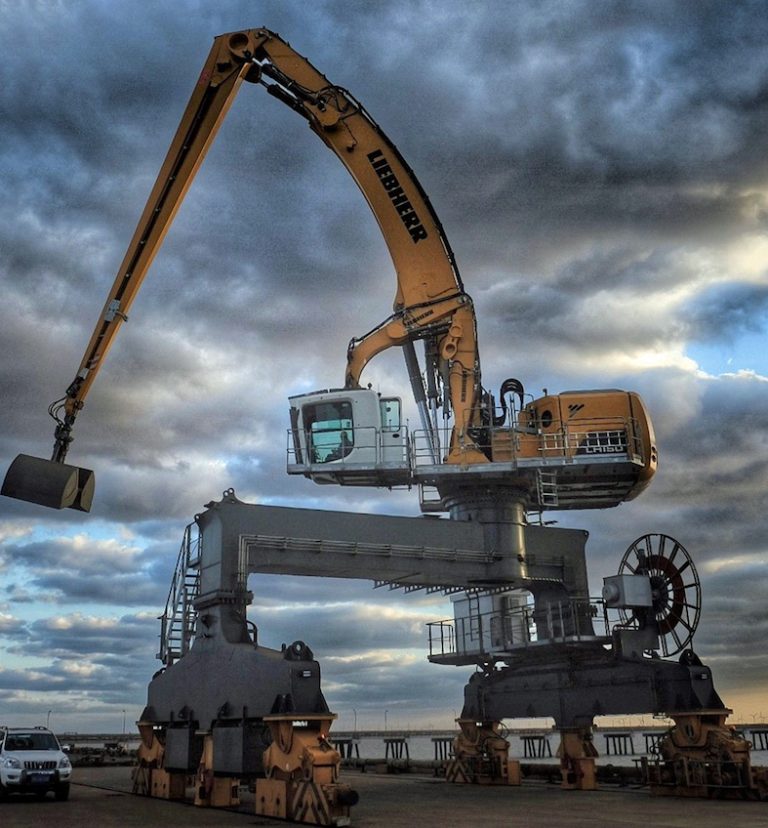
It is also the world’s largest electrically- operated Liebherr port handling machine with gantry undercarriage as well as the largest port handling machine Liebherr has ever produced. The machine was handed over and commissioned in DaFeng Port in the Chinese province of Jiangsu. The entire port handling machine has been supplied by Liebherr: All components were developed, produced and tested by Liebherr-Hydraulikbagger GmbH in Kirchdorf an der Iller, Germany; from the attachments to the work equipment, the hydraulic cab elevation and uppercarriage. The rail-mounted portal of this giant was developed in close cooperation with Liebherr- MCCtec Rostock GmbH. With an operating weight of approximately 200 tonnes, the machine is fitted with Liebherr’s standard ERC system, in addition to the engine power, it can also store energy when lowering the equipment available. This allows the LH 150 ET Gantry Port Litronic to achieve an output of up to 614 kW with energy savings of 30% at the same time. An additionally integrated high-voltage transformer reduces the 10 kV supply voltage of the local mains network to 400V which is then used to operate the main drive of the machine, a 400 kW Liebherr electric motor. Liebherr’s port handling machine is specifically tailored to meet the customer’s requirements. For example, the uppercarriage has not been seated in the conventional manner, centrally on the rail mounted portal. Instead it has been positioned off-centre, towards the side facing the sea. With its 16.5 m long, angled boom and 15 m long, straight stick, the LH 150 ET Gantry Port Litronic can cover the entire working area of a 10 thousand tonne timber-handling ship and more than 70% of a 30 thousand tonne timber-handling ship. The freely positionable spacious cab provides the operator with a perfect view and the Liebherr hydraulic quick coupler system is used to change the mechanically operated attachments quickly and safely from the cab. In total, approximately 207,000 containers and 51.14 million tonnes of material were handled in the port in 2018. DaFeng Port is the most important hub in the center of Jiangsu province. It is making enormous efforts to develop its four business areas of loading/unloading wind turbine blades, the timber trade, the RO-RO service and grain processing and to increase their efficiency.
Port of Savannah sets calendar year record
In Roll-on/Roll-off trade, GPA handled 657,685 units of cars, trucks and tractors in 2019, an increase of 12,167 units, or 2 percent. “Both Savannah and Brunswick are outperforming the market, with Garden City container trade growing at a rate three times faster than the U.S. total, and Brunswick Ro/Ro units increasing despite a drop in US vehicle sales in 2019,” said GPA Board Chairman Will McKnight. Ocean Terminal picked up two new customers in 2019 – GM and Volvo – with both carmakers exporting vehicles to Australia and New Zealand via Savannah. Volvo also began exporting cars to South American markets via Brunswick. Total tons crossing all GPA terminals reached 38.5 million, up from 36.9 million tons in 2018, an increase of 4.3 percent. Lynch credited steady volumes in breakbulk cargo, combined with growth in tonnage for both bulk and containerised goods. Highlights of the year included a burst of new cargo handled via the Appalachian Regional Port, totalling approximately 36,000 TEUs, and the announcement of two new resin-handling facilities near Savannah, which are expected to increase export totals by around 90,000 TEUs per year. Lynch said the Authority is building the infrastructure necessary to take on new business while maintaining the free flow of cargo. He said an ambitious infrastructure plan will double annual rail capacity at the Port of Savannah to 2 million TEUs, expand berth capacity to handle up to six 14,000-TEU vessels by 2026, and develop another 400 acres on Colonel’s Island, enough to nearly double the autoport’s annual capacity from 800,000 vehicles to 1.5 million per year.
All-time high rail traffic boosts Port of Gothenburg container volumes
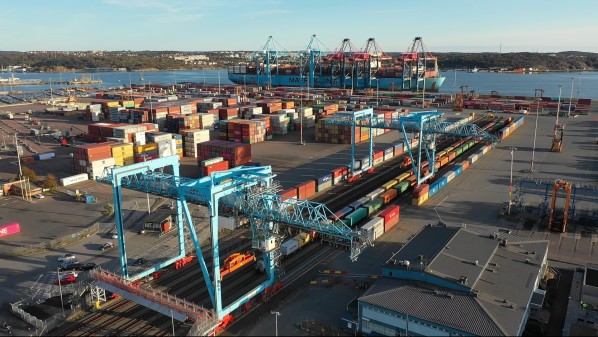
Container freight from the whole of Sweden is being increasingly channelled to the Port of Gothenburg by rail. In total, 456,000 TEUs were transported through the port by rail – this is the largest rail volume in the port’s 400-year history. “Growth in rail volumes is reassuring on several levels. The fact that we are the port of Sweden – from north to south – is very obvious. It is also confirmation that our investment in the port’s trans-shipment potential and rail infrastructure is the right path to follow,” said Elvir Dzanic, Gothenburg Port Authority Chief Executive. Container volumes, reported as 20-foot equivalent units (TEUs), rose during 2019 by three percent to 772,000 units. The past two years have seen a marked increase in container traffic at the Port of Gothenburg. In 2018 growth stemmed mainly from the local catchment area – in 2019 it had the whole of Sweden as its base. A great deal of long-distance freight for export comprises basic materials used in industry, such as steel, paper, and timber. These are generally transported by rail from inland locations to the Port of Gothenburg for onward transport by container ship to markets on the Continent. During 2019, 456,000 TEUs passed through the port by rail, up 14 percent on the previous year. The volume of containerised freight moving into or out of the port by rail rose from an already record-breaking level. The share of quay turnover transported to or from the port by rail is unequalled by any other major international port in the world. “In 2019, the Port Authority adopted a new environmental goal where the company was set the target of reducing the port’s CO2 emissions throughout the whole of the Gothenburg region by 70 percent through to 2030. To achieve this goal, the ongoing transition from road to rail is vital,” said Elvir Dzanic. Through quarter three, the port of Gothenburg increased its share of the Swedish container market by one percent. The figure for the full year has not been established as the total volume for all Swedish ports is not yet available.
Collaboration key to port's future

Cordero was introduced by Long Beach Harbour Commission President Bonnie Lowenthal in front of an audience of more than 750 industry partners, community members and civic leaders gathered at the Long Beach Convention Center Grand Ballroom.As a leader in environmental sustainability and community engagement, Lowenthal said the port is poised to have a prosperous 2020 despite dramatic changes within the goods movement industry.“Ours is the task of promoting trade so that this city, region, state and nation can thrive,” Lowenthal said. “It’s our responsibility to see that port resources are used wisely to keep us competitive and a leader in goods movement.”The port wrapped up 2019, its second-busiest year on record, with 7,632,032 TEUs moved, a decrease of 5.7% from the record-setting pace logged in 2018. Imports slid 8.3% to 3,758,438 TEUs. Exports totalled 1,472,802 TEUs, down 3.3%, while empties decreased 2.8% to 2,400,792 TEUs.Terminal operators and dockworkers moved 665,261 TEUs in December, a 10.3% decline compared to December 2018. Imports were down 13.4% to 323,231 TEUs. Export TEUs jumped 10.6% to 125,395 units, while empties dropped 15.1% to 216,635 TEUs.Looking ahead into 2020, Cordero sounded an optimistic note of “better times ahead” and progress on trade war discussions, while also pointing out the challenges of lagging business investment and continued uncertainty in the industry.“At the end of the day, we need to be ready for whatever may come,” Cordero said in his speech. “We need to compete, we need to innovate, we need to lead. And most of all, we need to collaborate.”The best way to do that, Cordero said, is to distinguish Long Beach as the Port of Choice by working toward operational excellence with labour, shipping companies, ocean carriers, truckers and other industry partners.Key projects launched over the past decade are nearing completion, including the replacement for the aging Gerald Desmond Bridge. The new cable-stayed span is scheduled to open to traffic later this year.Additionally, construction is scheduled to wrap up in 2021 on the final phase of the Long Beach Container Terminal, creating the greenest, most technologically advanced terminal in North America. Over the next decade, the Port also plans to invest an additional USD1 billion in rail improvements that will speed the flow of goods across the country while reducing local road traffic.Cordero also unveiled a new logo for the port, aimed at conveying a message of operational excellence, and a commitment to partnership with industry and the community.And coming soon, the port will launch a completely redesigned website, making it easier for businesses and the community to interact with the port and find essential information. The new polb.com will be mobile-friendly and easy to navigate and search, featuring stunning imagery and new interactive features.