
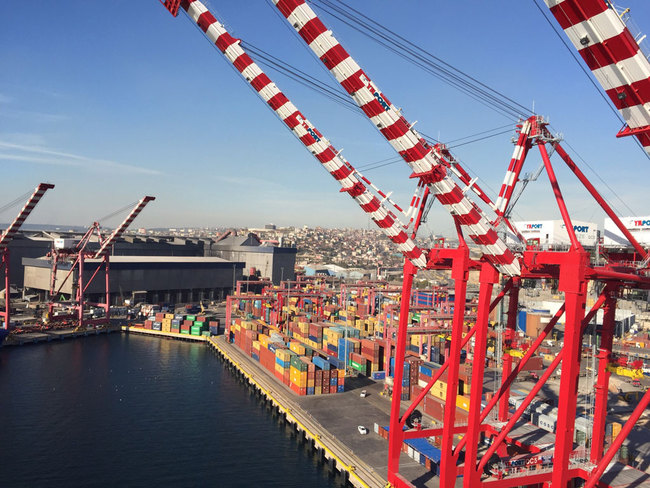
The Navis project was part of a full terminal modernisation effort to help take them from a manual terminal down a path of implementing more automated and data-driven services to increase terminal capacity and strengthen the terminal’s operational performance. Located in Ecuador, YILPORT Puerto Bolivar handles over 150,000 TEUs and one million tons of break bulk annually and has been growing steadily over the past several years. To help the terminal scale and operate at its full potential, the YILPORT team has put an emphasis on bringing in technology to improve its service and offerings including a recent investment in a new fleet of ship-to-shore (STS), electrified rubber tyred gantry (E-RTG) from Mitsui, and now N4 with enhanced features including Compass. With the help of their in-house and local implementation teams, YILPORT was able to successfully go-live with N4 at the end of October 2019. “Before we made steps toward applying automated services at Puerto Bolivar, we were using outdated systems for tracking and reporting our terminal operations thus, they were not being recorded in real-time,” said Orkun Cakir, TOS Deployment Manager at YILPORT. “With the help of our diligent teams on-site we were able to implement N4 and supporting Navis features, to bring more value to our customers in the new year and beyond.” Along with N4 3.7, the Compass Visual Workflow Management Application, Crane Team User Interface, Expert Decking and Autostow will also be used at YILPORT Puerto Bolivar to help meet their business goals and streamline service. “We are always looking for ways we can help our customers improve their processes and digitise their offerings to keep a competitive edge in the industry,” said Chuck Schneider, Chief Customer Officer at Navis. “Data and analytics have become increasingly important for efficient decision making and we are thrilled to be working with YILPORT Puerto Bolivar to help bring their terminal into their next phase.”
Strong regulations help the Caribbean’s ‘Blue Economy’ to grow and thrive

Welcoming delegates to a week-long workshop intended to share knowledge and best practice of IMO regulations and to boost Caribbean maritime co-operation, the Director General of the MAJ, Rear Admiral (ret’d) Peter Brady said: “Full and complete implementation of our treaty obligations require incorporating international maritime legislation in domestic law and investing in adequate human resources and facilities.”Pointing out that Jamaica conducts 93% of its trade by sea, Admiral Brady said: “Maritime issues are of critical importance to the Caribbean States. Our countries are bordered by the Caribbean Sea and most of us are island States and we share the love and respect for these still yet pristine waters on which an enormously large amount of our trade and economic well-being depend.”Highlighting the fact that the ‘Blue Economy’ both locally and globally depends on a well-regulated maritime transportation system, he said: “The livelihood of a significant number of Caribbean people therefore depends on the ships trading, also cruise tourism and inter-island transportation, but many also depend on fishing, various commodities and minerals including exploited hydro-carbons which all constitute the myriad benefits of our Blue Economy.”“Our economies are so linked to the maritime domain that we must have in place comprehensive strategies, legislation and practice to provide for the sustainable use of the seas as a transportation corridor, for exploitation and extraction of resources in a carefully managed way. Such shipping must set safety and environmental standards consistent not only with our own situation but also circumscribed by the international standards promulgated by International Maritime Organization. After all shipping is an international business governed by international treaties, rules and standards to which we sign up.”Admiral Brady highlighted the various IMO programmes and international projects which the Caribbean region’s maritime industry has benefited from, including boosting infrastructure and capacity building, protecting the environment and enhancing the training and diversity of seafarers.“The IMO’s role in assisting the Caribbean Region over the years, greatly coordinated by the IMO Regional Maritime Adviser, to promote safe, secure environmentally sound, efficient and sustainable shipping, has been immensely appreciated by our respective Caribbean States,” he said.In an innovative approach, Maritime leaders, along with international and regional development agencies, have gathered in Kingston, Jamaica this week to participate in the first Caribbean Regional Knowledge Partnership Workshop on maritime technical cooperation activities, organised by the International Maritime Organization (IMO) in collaboration with the Maritime Authority of Jamaica (MAJ). Representatives of maritime communities from Caricom States and overseas territories will share information on marine-related activities they are currently undertaking and communicate the best practice application of Official Development Assistance (ODA) funding. The workshop aims to develop knowledge partnership mechanisms for development cooperation activities in the maritime field, to share IMO’s resource mobilisation strategy and to seek possible cooperation opportunities.Representatives from a number of agencies from across the Caribbean are attending the workshop, including Maritime Authorities of Antigua and Barbuda, Bahamas, Barbados, Belize, Curacao, Dominica, Grenada, Guyana, Haiti, Jamaica, Saint Kitts and Nevis, Saint Lucia, Saint Vincent and the Grenadines, Sint Maarten, Suriname, Trinidad and Tobago.
Port of Sept-Iles welcomes first ship in ports waters in 2020
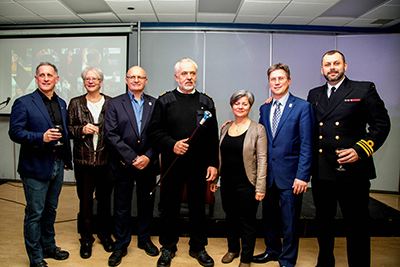
The ship was in ballast and had to remain at anchor until January 14 before leaving two days later for Japan with a cargo of 170,000 tonnes of iron ore from the IOC Rio Tinto company. Built in 2016, the 300-metre-long bulk carrier has a total cargo capacity of 209,113 tonnes. The ship is owned by the Oldendorff Carriers company and is operated by a crew of 25 sailors. Captain Yvan Dikiy was presented with the prestigious Port of Sept-Îles cane by Port of Sept-Îles President and CEO Pierre D. Gagnon last night during the Port of Sept-Îles New Year’s cocktail reception at the HMCS Jolliet in the presence of members of the Sept-Îles business community. Now in its 33rd year, the tradition marks the arrival of the first ship of the year to call at the port. To be eligible, the vessel must come directly from a foreign country and be bound for a foreign destination.
Pioneering Norwegian autonomous-ship project receives NOK 200 million in EU funding
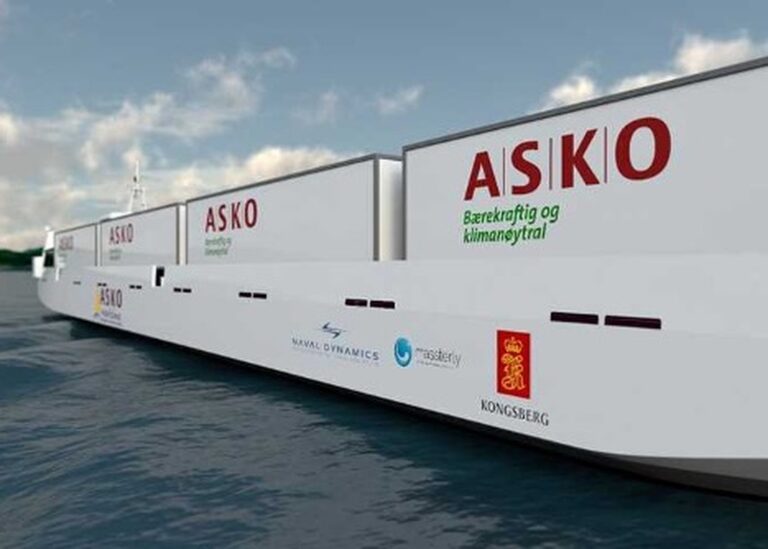
This project is receiving funding of almost NOK 200 million (Euro 20.1 million) – one of the largest grants ever given to Norwegian players – from Horizon 2020, an EU research programme. “The Norwegian maritime cluster, of which KONGSBERG is a part, is the world leader in autonomous shipping. Now we are further strengthening our position through the AUTOSHIP project, which will accelerate the realisation of next-generation autonomous ships and create a roadmap for commercialising autonomous shipping in the EU in the next five years,” says Egil Haugsdal, CEO of Kongsberg Maritime. AUTOSHIP, a four-year Horizon 2020* project, is a collaboration between KONGSBERG and Norway’s leading research organisation, SINTEF, as well as several European partners. The Research Council of Norway is also providing support. Two autonomous vessels will be demonstrated for use, especially in short sea coastal shipping and Europe’s inland waterways. “The AUTOSHIP project gives Northern Europe, with Norway, a leading edge in developing the next generation of autonomous vessels. The race is underway internationally. The technology contributes to safer, more efficient and sustainable operations at sea, both in transport and aquaculture. The project will now receive one of the largest allocations ever made from the EU’s Horizon 2020 program to a Norwegian player. This is a NOK 200 million mark of quality,” said Iselin Nybø, Norway’s Minister of Research and Higher Education. The recent event took place in Kristiansund on board the Eidsvaag Pioneer, which is one of the two vessels that will now be equipped for remote-operated and autonomous maritime transport. This ship is owned by the Eidsvaag shipping company and operates along the Norwegian coast and in vulnerable fjord areas where it carries fish feed to fish-farms. The markets for both short sea coastal shipping and transport on inland waterways are expected to dramatically expand in the next few years, both in Norway, Europe, and worldwide. “We will demonstrate that it is possible to remotely operate several ships from land and over large geographical areas. The technology is used in different ways on the vessel to show that the solutions can be applied widely. This is a market with a significant potential,” says Haugsdal. The aim of the project is to test and further develop key technology linked to fully autonomous navigation systems, intelligent machinery systems, self-diagnostics, prognostics and operation scheduling, as well as communication technology enabling a prominent level of cyber security and integrating the vessels into upgraded e-infrastructure.“We will contribute by developing cloud-based communications systems and advanced simulations to test and ensure that the autonomous vessels operate safely and optimally,” says Hege Skryseth, the CEO of Kongsberg Digital. The other vessel to be equipped with autonomous technology is a Belgian pallet shuttle barge owned by Blue Line Logistics NV. This operates on canals in Europe, transporting goods to and from large container ports. Europe’s inland waterways can achieve major environmental gains by using new technology. An autonomous barge in operation is expected to take around 7,500 trucks off the roads each year and will result in reductions in both traffic congestion and emissions. “There is increasing market demand for waterborne transport in the EU. The results of the AUTOSHIP project will lead to safer and greener transport in Europe with one of the major outcomes being a shift of goods transport from roads to waterways,” says Haugsdal. * This project has received funding from Horizon 2020, an EU research and innovation programme, under grant agreement no. 815012.