

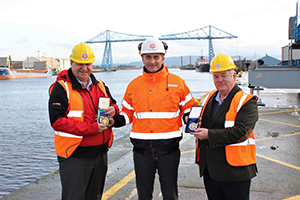
Gary Dawson, AV Dawson Managing Director and Garry O’Malley, Redcar Bulk Terminal (RBT) Managing Director take on the chair and vice chair roles for the industry body, the Tees and Hartlepool Port Users Association (THPUA). Dawson takes over the reins from former chair, Stuart Brookes, ConocoPhillips, whom he has supported as vice chair for the last two years. Dawson and O’Malley bring a wealth of experience to their new roles; both from the perspective of their roles as senior business leaders but also the businesses they represent. AV Dawson and RBT are both successful port facilities on the Tees that have been going from strength to strength; each has recently made announcements of major investments and new contract wins. Both business leaders also bring expertise and contacts through their involvement in supporting international businesses import and export a wide range of cargoes through the Tees. Garry O’Malley, THPUA vice chair said: “The THPUA is a long established organisation with a huge heritage and a strong membership today that includes the entire shipping industry supply chain from port operators to agents and pilots, through to Teesside’s industry heavyweights that use the river including British Steel, ConocoPhillips, Huntsman Polyurethanes, ICL Boulby, Stobart Energy and SABIC. “I’m really proud to be at the helm of such an established, well regarded membership group. I’m looking forward to working with Gary Dawson and continuing in the good work that he and Stuart Brookes have started over the last two years to reinvigorate this group and work with all our members, the Statutory Harbour Authority, government and international contacts to promote trade on the Tees.” Gary Dawson, THPUA chair said: “The Tees Valley Mayor, Ben Houchen has been very open in his views about the River Tees, the importance of industry on the river and how critical it is to the future success of the region. He is keen to work together with the THPUA to increase river trade and thereby improve the region’s economy. This is therefore a fantastic opportunity for us to work more collaboratively with the Mayor and the Statutory Harbour Authority PD Teesport for the greater good of the river and the region.”
Port of Virginia sets new annual volume record in 2019
The port saw increases in the movement of loaded imports, up 3 percent; empty export TEUs, up 10 percent; growth in barge volume, up more than 18 percent; and the amount of cargo moving over Richmond Marine Terminal, up 19.5 percent. Truck volumes were up 2 percent and rail volume was static. “We look at how we served our customers and what we accomplished, so 2019 was landmark year for The Port of Virginia,” said John Reinhart, CEO and Executive Director of the Virginia Port Authority. “We had a very successful year, having set a new record for volume, though our growth was not as much as we had planned. Trade thrives in a predictable environment and the tariffs created some uncertainty across the industry that had an effect on our year-end totals, but we don’t measure success only in terms of cargo volume. Throughout the year we made significant gains on our projects. We debuted an expanded Virginia International Gateway (VIG) in June, got underway with our dredging effort that will make Virginia the deepest port on the U.S. East Coast in four years and are on track and on budget to bring the expansion of Norfolk International Terminals (NIT) to a close in late 2020.” Reinhart also pointed to the port’s expanding role in driving economic investment and job creation throughout the Commonwealth. In 2019, the port was instrumental in helping to generate more than 3,500 new jobs and the development of nearly 5 million square feet of space that had a total investment value of USD2 billion. “We are listening to our customers, cargo owners and partners and always looking for new, innovative ways of moving their cargo with greater velocity and doing so safely,” Reinhart said. “When we do this well, we build confidence with the ocean carriers and cargo owners, volumes expand and businesses grow. That growth equates to economic investment and new jobs for Virginia.”
December is the half-way mark in fiscal year 2020 and thus far the TEU volumes is 1,483,509 units; gate volumes are up 2.3 percent; loaded imports, up 3 percent; and barge volume up 18.6 percent. The calendar year was completed with December TEU volumes of 224,902 units, a decrease of 6.7 percent when compared with last December. Also in December, Richmond Marine Terminal volume was up 29 percent; loaded exports, up nearly 4 percent; and total barge volume up almost 19 percent. “The accomplishments of 2019 are a tribute to our team and our port partners,” Reinhart said. “The cargo we handle is important and we know we can always improve in our delivery of service to all of the port’s users and customers. We will continue to do those things that will make 2020 another landmark year at The Port of Virginia.”
The Port of Kiel concludes the last year with good results
In addition, there is the bulk cargo business at independent facilities so that all in all the 7 million ton mark could be affirmed despite the decommissioning of the local coal power station. Dr Dirk Claus, Managing Director at the Port of Kiel: “Kiel was able to pursue its growth course in its core business areas – the ferry traffic and the cruise business sector. At the same time, the focus of our investments lies on the implementation of the BLUE PORT strategy – on the shore power plants and the intermodal traffic, so that the port of Kiel will be climate-neutral by 2030.” About 15 million Euros are currently being invested in the construction of shore power plants so that they will be ready for operation at all three ferry and cruise terminals in the city port in the course of this year. The Color Line ferry has been supplied with shore power at the Norwegenkai Terminal on a daily basis since early summer 2019 and is a forerunner in Kiel. The Port of Kiel is currently investing nearly 30 million Euros in terminal facilities and environmental protection. After the apron in Ostuferhafen was completely redesigned last year in order to optimise logistical processes and to create more space for trucks, trailers and passenger cars, the construction projects now focus on the city port. The construction works at the new terminal building for cruise passengers at the Ostseekai are now in the final phase. The interior construction of the new terminal measuring 3,700 m2 is in full swing while the works on the exterior façade are nearly finished. The 10 million Euro building will be inaugurated in spring with the beginning of the season and thus it is going to further enhance the service quality in Kiel. However, the largest single investment of the PORT OF KIEL is the shore power supply plant for the Ostseekai and Schwedenkai terminals amounting to 13 million Euros. Construction works at the shore power supply plant started last autumn and the structural as well as the civil engineering is currently in progress. The technical equipment will follow so that the power plant can start test operations still during the season. Dirk Claus: “The shore power plant at the Ostseekai will be the first one to supply power both to a cruise ship and a ferry at the same time. It is our aim to supply shore-side power to 60 to 70 cruise ships during the first full operational year. In the future, 60 % of the energy demand by the ships visiting Kiel is supposed to be met by shore-power from regenerative sources.”
Port Everglades and the Port of Barranquilla sign MoU
As Port Everglades’ 5th largest trading partner, Colombia’s largest port along the Caribbean Sea, the Port of Barranquilla, has agreed to enter into an MOU to promote bilateral trade. Port Everglades’ trade with Colombia has increased by 29 percent over the last four years.
“International trade promotion is a priority of our Port and County for generating economic prosperity,” said Broward County Mayor Dale V.C. Holness, who signed the MOU document on behalf of Port Everglades. “Our port’s trade with Colombia alone in 2018 reached $1.19 billion.” The two ports want to establish an alliance of cooperation aimed at facilitating international trade and generating new business by promoting the sea trade routes between the two countries. The MOU outlines joint initiatives, including marketing activities and market studies, training, and sharing of information on technology, modernisation and improvements.“As the logistics platform that connects Colombia to the world, it’s important for us to be Port Everglades’ partner in order to share best practices, increasing demand for Colombia’s perishable goods in the United States, and to be able to offer added value services to our clients for whom Florida is a main commercial destination,” said Rene Puche, President & CEO, Port of Barranquilla, who signed the MOU document. “Colombia is an important trade partner for Port Everglades and the nation,” said Acting Chief Executive & Port Director Glenn Wiltshire, who signed the MOU document for Port Everglades. “Port Everglades ranked number six for United States’ trade with Colombia, accounting for 4.12 percent of the nation’s total trade in 2018.” In recent trade with Colombia, Port Everglades handled 33,207 TEUs from October 2018 through June 2019. Top import commodities included aluminium, wood, fruits, beverages, glassware, ceramic, plastics, and vegetables. Top export commodities included printers, machinery, vehicles, furniture, iron, steel, wood, essential oils, and perfumes. Nearly a third of Colombia’s trade with Port Everglades was with the Port of Barranquilla, primarily aluminium, glass, and ceramic commodities.