
Tuesday, December 16, 2025
spot_img
Home Blog Page 30

Coronavirus impacting the global shipping industry

0

The virus spread coincides with the Chinese Lunar New Year (CNY), which marks the traditional low season for shipping markets. Thus, the virus’ knock-on effects have been hard to single out so far with next to no hard facts and figures to substantiate the matter. However, it does remain abundantly clear that an extended shutdown of China will temporarily cripple the shipping markets and hit hard on freight rates. Every week that China remains “closed” will mark a slowdown of economic growth. Seaborne trade is closely linked to economic developments in Asia and the effects are already felt in several different ways. While we are probably still in the early stages of the outbreak, it is evident that this health crisis will put a drag on Chinese economic growth in the first quarter of 2020, potentially taking a toll on annual GDP growth as well. Consumer spending, associated with CNY celebrations, has certainly taken a substantial hit. This dip in consumption cannot necessarily be made up for once the virus has been contained. The lock down of large parts of the transport system has limited the consumption of oil, and refiners have cut crudes runs across the board. Demand lost because of this is unlikely to return to boost shipping demand after the crisis is over.


Advanced Economies’ imports of manufactured goods from China remains the main driver of container shipping with seven out of the ten largest container ports located in China. Wide-spread factory shutdowns results in a slowdown of manufacturing and industrial production. The intra-Asian container shipping market, the largest in the world, will be the first trades to feel the fallout from the coronavirus if intra-Asian supply chains are disrupted. Secondly, the long-haul trades to North America and Europe will be affected. Extended blanking of sailing (meaning cancellations, ed.) by global liner companies have been the first measure taken to ease the pressure of low demand. But if goods are not produced at all, the short-term alternatives do not exist. Medium term alternatives will rise fast though, meaning alternative producers of the goods, just as we have seen as an effect of the ongoing trade war between the US and China.


Aside from stepping up their efforts to contain the virus, the Chinese government has also rolled out fiscal stimuli to combat the economic impact from the coronavirus. If judged by the share prices on the stock exchange, it’s working. But it is not limiting the spread of the virus nor is it boosting shipping demand at present. Quite a few countries have already started to implement measures to curb the virus spread from seafarers. On 3 February 2020, Australia introduced a 14-day limit for port calls in mainland China and Australia, de-facto quarantining seafarers onboard the ships. Singapore have since then followed suit. The virus illustrates just how dependent the world has become upon China with many supply chains deeply embedded into the country. Anecdotal evidence suggests that South Korean car manufacturers have started to reduce output due to supply shortage of Chinese goods. 


Dry bulk shipping rates have extended its rout over the past two months, driven largely by seasonality and the newly implemented IMO2020 Sulphur Regulation, which has sent fuel oil costs soaring. Chinese imports of dry bulk commodities are the main driver for the dry bulk market and with a slowdown of industrial production in the short-term, the outlook for Q1-2020 is not shaping up particularly well. Freight rates will stay low, until Chinese merchants get back into the market for the usual commodities, such as grain, coal and iron ore.

The traditional dry bulk low season is usually in Q1, and the market tends to rebound post-CNY. Yet, with the coronavirus not under control yet, the slump will inevitably be more protracted. The Capesize index fell into negative territory on 31 January 2020 and has continued its descent to reach -133 index points on 4 January 2020. If large parts of China remain under quarantine, it is likely that earnings will continue to drop across the dry bulk segments. 


China also holds a significant share of global shipyard industry. Data on newbuilt deliveries for January 2020, doesn’t seem to be impacted. But for the coming months, BIMCO expects to see an effect. This goes for retrofits of scrubbers, ballast water treatments systems etc. as well. Tanker shipping has certainly felt the heat in the past week, partly from the virus, but also with the lifting of US sanctions for a lot of Chinese-owned oil tankers. A lot of the oil tanker business is carried out in the spot market and freight rates have already seen substantial changes. China is the largest crude oil importer in the world with a staggering 506 million tonnes of crude oil imported in 2019. A shutdown of China will bring with it a transitory slump of crude oil imports and accompanying refinery cuts in run rates. Such cuts have already been taking place in extent to the seasonal CNY cuts of crude runs. 


The market has been turned on its head in a single month, where VLCC earnings from the Middle East Gulf to China has dropped from USD 103,274 per day on 3 January 2020 to USD 18,351 per day on 3 February 2020. The outbreak has sent the oil prices on a rapid decline over the past month too and rumour has it that the Organization Of the Petroleum Exporting Countries (OPEC) is scheduling an emergency meeting in February to discuss production cuts in an effort to establish a floor under the dipping prices (Source: The New York Times). 

In the 15 January-signed US-China “Phase One” trade agreement, China pledges to buy a
n additional USD 200 billion of US goods over a two-year period, of which a lot of energy and agricultural products will be seaborne. It remains questionable whether these purchases, will ever see the light of the day, and the virus outbreak could prove to be an additional hindrance to this Chinese pledge. White House economic adviser Larry Kudlow has said that the “export boom” of US commodities will be delayed as a result of the virus.   

As the virus continues to spread, it remains immensely difficult to forecast the medium to long-term implications, yet the short-term consequences are clear: demand and freight rates are dropping. 


With past epidemics, the markets have rebounded sharply in a matter of months, so the question is essentially about how long China will stay locked down in a quarantine? 
Swissterminal and DP World enter strategic partnership

0

DP World has taken a stake of 44% in Swissterminal Holding AG with the Mayer family, who founded the business, remaining the majority shareholder. The parties have agreed not to disclose financial details of the transaction. Swissterminal, which is headquartered in Frenkendorf close to Basel, operates additional locations in Zurich-Niederglatt, Basel-Birsfelden, Basel-Kleinhueningen and Liestal. The terminals are well connected to Europe’s leading container ports in Rotterdam and Antwerp as well as the ports of La Spezia, Genoa, Ravenna and Trieste south of the Alps. DP World has grown from its roots in Jebel Ali Port in Dubai to be a leading global trade enabler offering end-to-end logistics to cargo owners through its network of 150 operations in more than 50 countries including ports, economic zones, warehousing, feeder services and inland transport. Focusing on faster growing markets and key trade routes DP World is developing technology to remove inefficiencies in the supply chain. Through DP World Inland, the company is well established in the German and Belgian inland markets and operates four terminals including trimodal transport systems supporting trade flows to connect to the northern range seaports in Europe. The Swissterminal and DP World partnership is expected to deliver a strong competitive advantage and enhance the industry-leading position of both companies. The cooperation is anticipated to expand the companies’ terminal networks, increase efficiency and grow their service portfolios. With the transaction, no major structural changes within the respective companies are planned, and Roman Mayer will continue to serve as Swissterminal’s CEO. Dr Martin Neese, Managing Director of DP World Logistics, said: “We are excited to invest in an innovative container terminal operator with extensive industry know-how, committed employees and strong values. The strategic partnership with Swissterminal strengthens DP World’s position as a leading provider of inland supply chain solutions. Swissterminal is a perfect match to our existing inland and seaport operations in Europe. We look forward to developing new intermodal solutions together for the benefit of our customers”. “We are delighted to welcome DP World as our partner, particularly at a time when we are seeing numerous opportunities for Switzerland to grow its success as a major global logistics hub,” said Roman Mayer, CEO Swissterminal AG.

“By merging our family-owned business with such a large, international organisation which shares our long-term vision, we will be well-equipped to deliver long-term sustainable growth and cater to a changing industry landscape”, he added.

Port NOLA sets new container record in 2019

0

The record marks the sixth consecutive year the Port surpassed the half million TEU-mark at its Napoleon Avenue Container Terminal, which is operated by New Orleans Terminal and Ports America. “Port NOLA has now seen double-digit growth in total container volumes for two consecutive years, primarily driven by the Panama Canal expansion, exports from Louisiana’s booming petrochemical industry and a growing market for imports,” said Brandy Christian, President and CEO of Port NOLA and CEO of the New Orleans Public Belt Railroad Corporation (NOPB). “Additionally, these record container numbers are balanced by significant loaded import growth, up 12% in 2019.”


Louisiana’s only international container port also continues to expand its ocean carrier service network, a sign that the largest carriers in the world are confident in the Port NOLA gateway. The Port gained a new direct service to Asia when it welcomed MSC’s Lone Star Express weekly service in 2019. Maersk and ZIM partner on the new service which fortifies the Port’s direct connectivity with Far East markets and offers more shipping options for customers. This is the second direct-Asia service to New Orleans in addition to CMA CGM’s PEX 3 service with COSCO, Evergreen and OOCL as partners. Port NOLA now features 12 weekly container services from three major global alliances as well as independent carriers, with direct connections to 60 global ports and more than 450 others through connecting services.           

The container-on-barge service between Baton Rouge, New Orleans and Memphis continues to thrive and offers shippers an efficient and environmentally-friendly option for moving their cargo. The service repositions containers from Memphis to Baton Rouge, where they are loaded with plastic resins and shipped by barge to Port NOLA to be loaded onto container ships for export to global markets. Port NOLA continued to see visible results of alignment with the New Orleans Public Belt Railroad in 2019, a year after the Port’s acquisition of the short line railroad in 2018.


Intermodal growth was up 20% in 2019, fueled by the Kansas City Southern (KCS) direct service between New Orleans and Dallas. Intermodal services by CN Railroad into Memphis, Chicago, Detroit and Toronto and KCS’ weekly service into the Dallas-Fort Worth market are critical inland markets that continue to further grow volumes in New Orleans. “Moving cargo between rail, river and road requires efficient coordination and a unified vision,” said Christian. “NOPB provides a significant competitive advantage and has resulted in true logistics integration of the New Orleans freight gateway.” Port NOLA’s container volume growth warrants new infrastructure investments both in the near term and for the next generation. Port NOLA has embarked on a $100 million expansion plan that includes the procurement of four new 100-foot-gauge container gantry cranes and other enhancements to the container terminal. This investment will add significant capacity to the Napoleon Avenue Container Terminal and allows the Port to work larger ships more efficiently.

“These cranes will be Louisiana state assets that produce jobs, provide economic output and keep Port NOLA among the most competitive seaports in the Gulf,” said Christian. “An economic impact study found that just two additional cranes would create 1,147 jobs and $3.6 million in tax revenues for Louisiana.” The new cranes are expected to be operational in mid-2021. “Continued investment in existing and new assets will put us in the best position of any port in the Gulf to serve our ocean carriers and operators with personalised shipping and logistics options,” said Christian. “Our future is that of a state-of-the-art integrated gateway, that moves freight efficiently and meets the industry’s changing needs.”

Oversized crane part moved through JAXPORT

0

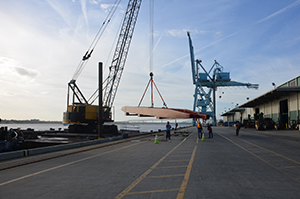
The equipment, part of a ship’s onboard crane, is 120 feet in length and weighs 25 metric tons. The part arrived at JAXPORT from Poland aboard the Spliethoff general cargo vessel Sluisgracht. Stevedores lowered the beam onto the terminal before lifting it onto a barge for transport to its destination at a North Florida shipyard where it will be added to a ship as part of a vessel refurbishment. Talleyrand Marine Terminal offers 4,780 linear feet of berth space, on-dock rail, and is conveniently located near three U.S. interstates, I-10, I-95 and I-75. Jacksonville’s skilled workforce offers a variety of labour options, including highly trained master riggers specialising in heavy lift and project cargo.