
Monday, December 8, 2025
spot_img
Home Blog Page 324

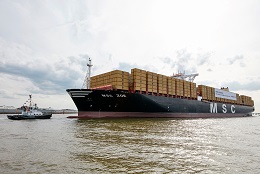
MSC and INTTRA enter into a new digital partnership to address VGM requirements

0

Under the agreement, MSC will use INTTRA’s eVGM software as a channel for receiving verified gross mass (VGM) submissions from shippers.

As of July 1st, under the International Maritime Organization’s Safety of Life at Sea amendment (SOLAS VGM), no container will be cleared to be loaded onto a ship until the shipper or its designee provides a verified weight to the carrier.

“We are pleased to partner with INTTRA to implement their innovative ‘eVGM’ software on a global basis,” said Fabio Catassi, Chief Technology Officer of MSC. “INTTRA’s eVGM tool will help us to continue to provide superior customer service and make it as easy as possible for our clients to submit VGMs digitally. We believe this tool will help minimize potential disruption to our customers’ shipments and additional costs associated with terminal storage or transportation.”

In addition, MSC has joined INTTRA’s eVGM Initiative – a non-commercial group of over a dozen leading carriers, freight forwarders, and terminals. INTTRA launched the Initiative to express a preference for digital transmission of VGM and establish common technology and business process standards for it across the industry.

Common standards for VGM submission are essential to the industry’s efforts to reduce the cost and disruption resulting from the implementation of the new amendment. MSC is joining the eVGM Initiative to share its expertise and help the shipping community continuously refine eVGM messaging standards.

“We are happy to partner with MSC in globally adopting INTTRA’s eVGM for Carriers platform, and we appreciate that they are adding their expertise to the eVGM Initiative,” said INTTRA CEO John Fay. “MSC is taking a strategic step to embrace our eVGM solution on a large scale and is an early leader in using technology to resolve the changes that SOLAS VGM has created for the industry. “

INTTRA’s industry-leading eVGM software – available in two versions, for Carriers and Shippers – offers the benefits of a standardized approach, a high level of flexibility and reporting capabilities. It helps to achieve SOLAS VGM compliance in time for implementation of the amendment and reduce disruption to existing business processes. It can also facilitate transmission of VGMs from carriers to terminals – another step required before a container can be loaded – and provide the necessary audit reporting.

INTTRA eVGM for Shippers enables timely submission of VGMs to carriers, whether or not shippers book containers or submit shipping instructions through INTTRA. Both solutions will be offered in a range of EDI and Web service formats, and accommodate eVGM submission via email.
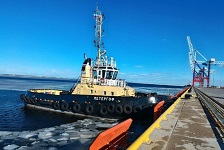
Tugboat Petergof of Port Fleet redeployed to Port Bronka

0

“To reduce ship owners’ extra costs it was decided to redeploy the tugboat to Bronka. This will let considerably decrease the chargeable time of mooring operations since there is no need to shift the tugboat from the First District of Port Saint Petersburg to Port Bronka and back,” explained Yevgeny Savkin, Director General of Port Fleet CJSC. The Company’s tugboats have been assisting vessels to moor at Bronka from February 2016. “With the new tug service shipping lines are able to make use of the favourable navigational location of Port Bronka”, Alexey Shukletsov, executive director of Port Bronka added.

Port Fleet Company was founded in November 1997. As of today, it performs a considerable part of service operations in the Port of Saint Petersburg and neighbouring ports of the Russian part of the Gulf of Finland. The main activity of Port Fleet is operation auxiliary fleet. The company operates the fleet of 20 vessels including tugboats, bunkering tankers and oil barges. It can perform any tasks on comprehensive servicing of ships within and outside the Port of Saint Petersburg.

Port Bronka is located at the South coast of the Gulf of Finland in the area of the dam and Saint Petersburg ring highway connection. Bronka includes the following three specialized complexes: container terminal, Ro-Ro terminal, logistics center. MSCC Bronka first stage throughput will allow handling of 500,000 TEU of container cargoes and 130,000 units of Ro-Ro cargoes per year. In future the capacity will be increased up to 1.9 million TEU of container cargoes and 260,000 of Ro-Ro cargoes per year. With a water depth of 14.4 metres the port is able to handle Panamax class container vessels and Finnstar class ferries

Rentel selects ABB AB for export cable offshore wind farm

0

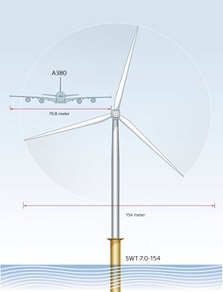
This leading power and automation technology group will design, produce and install the approximately 40 km long cable connecting the offshore substation to the onshore grid. The cable installation shall be performed by ABBs new-built vessel.

By awarding the contract for the export cable, Rentel sets another decisive step towards the realisation of the fourth Belgian offshore windfarm. Recently the contract for the offshore substation has been awarded to STX France SA. Contracts for the supply and installation of the 42 wind turbines and foundations are set to be finalised shortly. Siemens is the preferred supplier for the wind turbines.

The offshore wind farm Rentel has an installed capacity of 309 MW. The expected annual production of more than 1 GWh corresponds to the annual consumption of 288,000 households.

The investment is estimated at 1,250 million euros. RENTEL aims to complete its project financing by the summer of 2016 in order to immediately start the construction works. The new wind farm will supply renewable energy as from mid-2018.

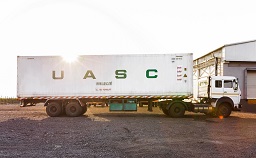
UASC continues to grow in South America

0

Following several initiatives including significant investment in new reefer units and a cooperation agreement with Hamburg Süd opening up new services to East Coast South America, UASC aims to highlight its expanded service.

Uffe Østergaard, Chief Commercial Officer at UASC said, “UASC has expanded its presence in South America in 2015, now serving all major ports along the Brazilian East Coast and the River Plate on a weekly basis and providing customers with access to an enhanced product offering, connecting the South American markets with Asia, Indian sub-continent, Red Sea, Middle East, North Europe and Mediterranean.”

“The enhanced service coverage enables us to cater effectively for many of the key companies in different industries in South America”, Mr. Østergaard added.

“South America is a key market for UASC and as part of our ambitious growth plans, new agencies will be inaugurated soon in Brazil and Argentina in addition to the newly opened agency in Uruguay; these developments mark the next stage of our evolution in South America and gives a flavor of our longer term aspirations”.

“Providing the highest quality of service excellence and reliability standards is our philosophy in doing business, UASC’s participation in Intermodal South America 2016 and the opening of new agencies will allow us to be closer to our customers and maintain ongoing dialogue with them on the ground to explore further enhancements to our services”.

“Having a local touch in each market is a differentiator that enables us to serve our customers better. Our offices globally are run by local, competent, experienced and enthusiastic individuals. It translates into better service and a more satisfied customer”, he concluded.

In 2015, UASC took delivery of 5,500 reefer containers with reefer technology provided by Daikin, marking a milestone in the expansion of UASC’s reefer services and reiterating its ongoing investment in the most cutting-edge solutions for the carriage of frozen and chilled cargoes. In addition, UASC’s fleet is boosted by the delivery of six of the world’s greenest ultra-large container vessels, in addition to several new 15,000 TEU vessels.