
Of course, this was an April’s fools day joke…..
BREAKING NEWS: UK Maritime and Coastguard Agency sets 5% tolerance on VGM
The SOLAS amendment prescribes two methods of verifying the gross mass of a container. Given below is how the UK has implemented both methods.
Method 1: Using weighbridges, or lifting equipment fitted with load cells, or other approved (and calibrated) weighing equipment to determine a loaded container’s Verified Gross Mass (VGM). Calculations may be used as part of the method 1 process.
Method 1: users are required, on request by the MCA or other body, to provide both of the following:
Evidence that the weighing equipment has been supplied/maintained for the purpose of determining the VGM of a loaded container and is capable of producing a ticket (electronic record). Each ticket must include the container number, the VGM of the container, and the procedures for, and records of, any calculations which have been made. If this information is produced as an electronic record, it is essential that it is able to be produced without delay as a paper document.
Records kept of maintenance and verification (calibration) procedures, including any corrective / remedial actions taken.
method 2: involves a summation of the weight of the cargo, weight of pallets, dunnage (items used to secure the cargo etc.), and the tare weight of the container.
The UK Method 2 process was developed with the assistance of an industry working group with the aim of minimising bureaucracy whilst using shippers existing procedures. It is envisaged that the registration process provides a level playing field for all shippers. It should be noted, that the requirement to provide a gross mass has always been required by SOLAS and the change is that shippers now need to verify that they have arrived at an accurate value using either Method 1 or 2 – it is the shippers choice of which method is used.
The verified gross mass should be as accurate as reasonably practical taking into account methodology and operational variances.
The MCA will begin issuing ‘Method 2’ approvals by the next financial year (beginning 6 April 2016).
The MCA made the decision after the following new paragraphs 4 to 6 were added after the existing paragraph 3:
4 In the case of cargo carried in a container*, except for containers carried on a chassis or a trailer when such containers are driven on or off a ro-ro ship engaged in short international voyages as defined in regulation III/3, the gross mass according to paragraph 2.1 of this regulation shall be verified by the shipper, either by:
4.1. weighing the packed container using calibrated and certified equipment; or
4.2. weighing all packages and cargo items, including the mass of pallets, dunnage and other securing material to be packed in the container and adding the tare mass of the container to the sum of the single masses, using a certified method approved by the competent authority of the State in which packing of the container was completed.
5 The shipper of a container shall ensure the verified gross mass** is stated in the shipping document. The shipping document shall be:
5.1. signed by a person duly authorized by the shipper;
5.2. submitted to the master or his representative and to the terminal representative sufficiently in advance, as required by the master or his representative, to be used in the preparation of the ship stowage plan***
6 If the shipping document, with regard to a packed container, does not provide the verified gross mass and the master or his representative and the terminal representative have not obtained the verified gross mass of the packed container, it shall not be loaded on to the ship. ______ * The term “container” should be considered as having the same meaning as defined and applied in the International Convention for Safe Containers (CSC), 1972, as amended, taking into account the Guidelines for the approval of offshore containers handled in open seas (MSC/Circ.860) and the Revised Recommendations on harmonized interpretation and implementation of the International Convention for Safe Containers, 1972, as amended (CSC.1/Circ.138/Rev.1).
** Refer to the Guidelines regarding the verified gross mass of a container carrying cargo (MSC.1/Circ.1475).
*** This document may be presented by means of EDP or EDI transmission techniques. The signature may be an electronic signature or may be replaced by the name, in capitals, of the person authorized to sign.”
CKYHE re-affirm their presence at the port of Le Havre
Cosco, K-Line, Yang Ming, Hanjin and Evergreen confirm their presence at the port of Le Havre. Owing to transport overcapacity, shipping companies have to quickly adapt to market needs and cannot wait for the reorganization of alliances that will happen within a few months. In this context, it is important to reassure importers and exporters that despite the economic downturn, the CKYHE alliance continues to provide quality transport service to and from Le Havre, including with their own ships.
Between Le Havre and Asia: Due to current overcapacity in the Asia-North Europe Trade, alliance members have decided to streamline port coverage and have taken the decision to withdraw the CES / NE8 service from the end of April.
However, members of the alliance continue to offer import and export services via Le Havre with excellent transit times because Le Havre is the first or the last port of call in Northern Europe:
FAL3 and FAL1, for Cosco NEB, for K-Line, AX7, for Yang Ming CFN for Hanjin FAL 3 and FAL1, for Evergreen.
Between Le Havre and North America: The alliance members operate together the TASCO/TAE/TAS service.
APM Terminals announces new port investment in Morocco
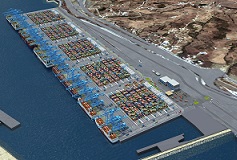
The new terminal will have annual capacity of five million TEU. Total investment in the new terminal is expected to be EUR 758 million. Maersk Line will be an important customer of the new terminal. The new terminal is scheduled to open in 2019, under the terms of a 30-year concession agreement with the Tanger Med Special Agency (TMSA), which has responsibility for the development and management of the Tanger Med port complex.
The Tanger-Med port complex is strategically located on Africa’s northwest coast near the mouth of the Mediterranean Sea on the Strait of Gibraltar, where the Atlantic Ocean and Mediterranean Sea meet. Tanger-Med is the second-busiest container port on the African continent after Port Said, Egypt. The new APM Terminals MedPort Tangier terminal will increase the port’s total annual throughput capacity to over nine million TEU.
APM Terminals MedPort Tangier will feature state of the art technology and have up to 2,000 meters of quay length and will feature the technology pioneered at the APM Terminals Maasvlakte II Rotterdam terminal which opened in 2015.
APM Terminals will create a new organization in Tangier, adding a large number of new jobs and be responsible for the completion of the terminal yard, surface, buildings, container handling equipment, and integrated automated systems. The quay wall construction and site reclamation for the first 1,200 meters has been completed by the Tanger Med Port Authority, which is part of TMSA.
“APM Terminals has been in Morocco since the creation of our first company APM Terminals Tangier in March 2005 in partnership with AKWA Group and the start of port operations in July 2007. Today’s announcement shows our strong commitment to investing in trade and improving supply chains in the West Med market. Morocco and its port arm, TMSA, have been very supportive of APM Terminal’s vision for the West Med. APM Terminals MedPort Tangier will bring important innovation and future capacity into the West Med market on one of the world’s most strategic seaways – the Strait of Gibraltar” said APM Terminals CEO Kim Fejfer.
For APM Terminals the Western Mediterranean is an important market. APM Terminals Algeciras, on the Spanish side of the Strait of Gibraltar, operates in tandem with APM Terminals Tangier as an integrated Western Mediterranean transshipment hub. APM Terminals Algeciras handled more than 3.5 million TEU in 2015, and has completed a major upgrading of its cranes and quay infrastructure to accommodate Ultra-Large Container Ships (ULCS) of 18,000 TEU capacity and above.
The location of the Tangier and Algeciras facilities provide a natural transshipment location for cargoes moving on vessels to and from Africa from Europe and the Far East on the primary East/West shipping route through the Mediterranean Sea; over 200 cargo vessels pass through the Strait of Gibraltar daily on major liner services linking Asia, Europe, the Americas and Africa. While African ports at present account for only 4.5% of global port throughput (including transshipment cargoes), the United Nations 2015 World Population Prospects Report projects that more than half of the world’s population growth between 2015 and 2050 will occur in Africa, with the African population more than doubling from 1.1 billion to 2.4 billion over the next three and a half decades. Significant investment in port and transportation infrastructure will be required to meet the anticipated needs of the expanding African population and corresponding economic growth.