

Henderson will be responsible for providing legal counsel to the NWSA Managing Members and the executive leadership team. She will dual report to the NWSA co-chairs and CEO John Wolfe. Henderson brings more than 20 years of experience in both public and private practice. Since 2013, she has served as general counsel for Pierce Transit, the second largest public transit agency in Washington state. She also worked as a litigator and maritime law practitioner earlier in her career. The hiring process was led by a Legal Services Review Committee, comprised of Port of Seattle Commissioners Courtney Gregoire and Ryan Calkins, Port of Tacoma Commissioners John McCarthy and Don Johnson and CEO Wolfe. Henderson earned her undergraduate degree at the University of Washington and graduated from Tulane University School of Law
Port continues RMT investments; federal grant allows for power-pack, equipment purchases
In recent weeks the U.S. Department of Transportation announced that the port will receive $189,840 from the U. S. Maritime Administration’s America’s Marine Highway Programme; Virginia was one of nine grant recipients. The federal grant will be matched with $47,460 from the port to purchase a large portable generator capable of providing continuous power to multiple refrigerated containers during transit, four large steel bins used for storing equipment used to secure containers and a specialised rack for storing and transporting the steel bins. This equipment, said John Reinhart, CEO and Executive Director of the Virginia Port Authority, will provide a more efficient level of service to current and future customers. “There is high demand for reefer service to RMT and the addition of this power pack [generator] will enable the port to meet the needs of the cargo owners using the barge,” Reinhart said. “We now have refrigerated capacity on both barges, which is important to the owners of cold cargo and to the growth of our reefer business. “The storage bins and rack will create greater efficiency during on- and off-loading. It takes about 40 minutes to offload and load the steel bins at each stop and during this time the containers cannot be lifted. The rack will bring everything off at once allowing us to get to work more quickly and provide greater service to the cargo owners.” Two years ago a similar power pack was purchased using federal grant money from the Marine Highway Projects grant programme and matching money from the port. In 2018, the port received funding under the America’s Marine Highway Programme to buy a new – second – barge, called the Richmond Express, to support the service’s growing demand. The second barge allows for the flexibility to increase the number of weekly sailings, based on demand, and a more regular maintenance schedule. “We are investing at RMT to create efficiency and more opportunities for cargo owners,” Reinhart said. “We are grateful for the federal government’s recognition of the effectiveness of the barge service and the growing importance of RMT in America’s Marine Highway Programme.” In 2019, the thrice-weekly barge service moved more than 37,700 containers, an increase of nearly 20 percent vs. 2018.
New rail destination from the Port of Felixstowe
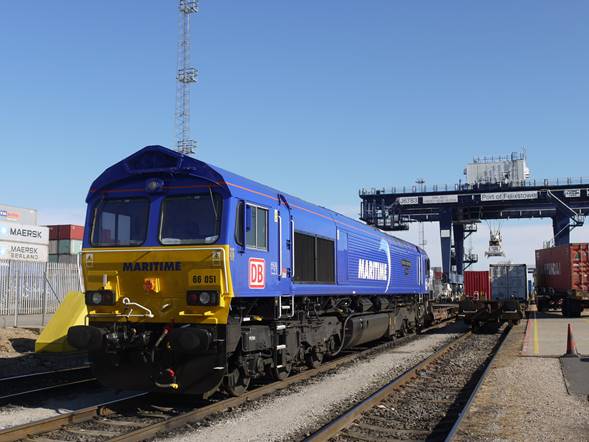
The new service caters for ever-growing demand for rail at Felixstowe and follows hot on the heels of two new rail services to iPort Rossington and Hams Hall introduced from the port in the latter part of 2019. Commenting on the latest development, Clemence Cheng, Chief Executive Officer at the Port of Felixstowe and Executive Director of Hutchison Ports, said: “The Port of Felixstowe has enjoyed a long and successful relationship with Maritime Transport; initially as a road transport operator and more recently as a fully-fledged multi-modal logistics provider. As one of the largest privately-owned transport businesses in the UK it is fitting that they have introduced the first regular service to East Midlands Gateway from the country’s largest container port and intermodal rail hub. Rail is an increasingly important element of the transport mix and through three dedicated rail terminals at the port we offer more rail services to more inland destinations with greater frequency than any other UK port. “We believe this Felixstowe to East Midlands Gateway service will be a huge benefit to our customers,” said John Williams, Executive Chairman at Maritime Transport Ltd. “The movement of freight from the Port of Felixstowe continues to increase as does the demand for a greener solution for our customers. This service is the latest to be introduced as part of our intermodal offering and we look forward to announcing further rail services into this new terminal over the coming months.” East Midlands Gateway, situated at Castle Donington in Leicestershire, is Maritime Transport’s first strategic rail freight interchange. Located alongside the M1 motorway the 17-acre site is ideally placed to serve as a regional distribution hub. When fully operational it will be capable of handling up to sixteen 775metre-long freight trains per day. In addition to this state-of-the-art terminal, Maritime also operates rail terminals in Tamworth, Tilbury, Wakefield and Trafford Park and have over 30 transport depots throughout the UK to support their customers’ growing demands. Other destinations served by rail from the Port of Felixstowe are Glasgow, Manchester, Liverpool, Leeds, Teesport, Birmingham, Birch Coppice, Doncaster, Selby, Hams Hall, Wakefield, Ditton (Widnes), Rotherham, iPort Rossington and Cardiff.
Konecranes wins crane move and recommissioning contract in Italy
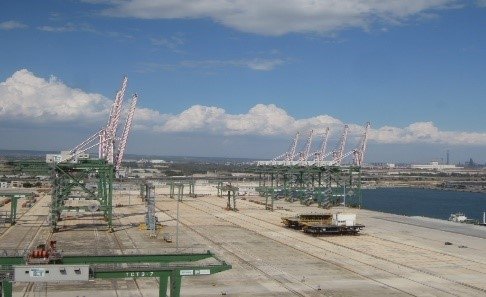
The Turkish company plans to use the port’s central location to create a thriving Mediterranean hub, supporting its broader ambition to become one of the top ten container terminal operators in the world.Robert Yildirim, owner of Yilport Holding, says of the partnership: “We have strong ambitions in the Mediterranean. The opportunities presented by Taranto port require tremendous focus and we are pleased to have Konecranes on board. We look forward to having the port back in full operation by the end of 2020, with more exciting reinvestment plans to follow.” The contract with Konecranes includes the recommissioning of seven Ship-to-Shore (STS) cranes and 16 Rail-Mounted Gantry (RMG) cranes that are currently inactive. Konecranes will begin the project in January 2020, aiming to first move the seven STS cranes 100 meters down the quay so they can start operations. Several of the RMG cranes will also be recommissioned in the first half of 2020, and the remaining RMGs will be brought online by the end of 2020.The agreement supports Konecranes’ strategy to become the premier port services provider to brownfield terminal developments. Konecranes continues to grow its aftermarket port services and product range, including turnkey projects on any brand of crane.