
The European Parliament confirmed the outcome of the Transport committee. 451 MEPs voted in favour of the deal reached by the rapporteur and the shadow rapporteurs. 234 MEPs voted against, while 18 MEPs abstained. An even larger majority voted in favour of giving the rapporteur the mandate to start negotiations with the council in view of reaching a first reading agreement.
ESPO welcomes the outcome of the vote in the Parliament as a solid basis for starting the negotiations with the Council.
“With this vote, Parliament has given a strong signal in favour of an organisation of port services that takes into account the diversity of ports in Europe, in favour of more transparency and in favour of more autonomy for the European ports to set their charges. To play their role as gateways to the world and to face the various global economic, political and environmental challenges, port authorities need certain tools that allow them to pursue a proper strategy. We really hope that these principles will not be watered down in the further negotiation process with the Council” says ESPO’s Secretary General Isabelle Ryckbost.
At the same time, ESPO expresses the wish that Parliament will be able to support the more pragmatic approach taken by the Council when it comes to the relations with port users and stakeholders and the establishment of a good and efficient framework for the handling of complaints.
Port Regulation: European Parliament vote brings ports one step closer to autonomy
DP World builds on Trade Partnerships in The Philippines
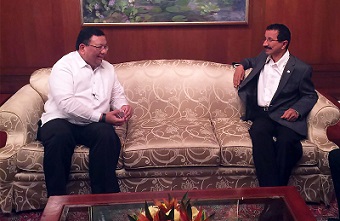
During the meeting held in Manila with the Cabinet Secretary Jose Rene Almendras, discussions revolved around the government’s plans for development of the maritime sector, privatisation and efforts to develop infrastructure. Commenting on the meeting, HE Sultan bin Sulayem, said: “We had a cordial and fruitful meeting with HE Jose Rene Almendras who expressed great support of DP World’s operations in the Philippines and praised our contribution to the economic growth of the country. The Philippines is a strategic location for DP World and a key part of our Asia Pacific region operations. We are keen to share our experiences and apply our proven expertise in the marine, logistics and trade sectors to further develop our partnerships there. We look forward to building on our excellent relations in the future.”
DP World operates four terminals in the Philippines and is a partner in Asian Terminals Inc., which operates the modern South Harbour in Manila, the capital. ATI is the sole container terminal and multi-cargo port operator of South Harbour, the Philippines’ key terminal in the country’s biggest market providing services for containerised and non-containerised cargoes and passengers.
The company also provides integrated port solutions to customers through facilities outside Manila which include:
Port of Batangas – a modern seaport located 110 km south of the capital. Batangas Port handles passengers, ro-ro transport, bulk and break-bulk cargo and Batangas Container Terminal has an annual throughput capacity of 300,000 TEUs.
According to the World Bank, growth in the Philippines has averaged above 5% in the past decade. Economic growth was forecast to be 5.8% in 2015, rebounding to 6.4% this year.
Caption to photograph:
HE Sultan Ahmed Bin Sulayem, Group Chairman and CEO, DP World and Chairman of Ports, Customs and Free Zone Corporation (right) with Cabinet Secretary Jose Rene Almendras, Office of the President of the Philippines
Bigger ships than ever call at the Port of London as trade increases
PLA chief executive, Robin Mortimer said:
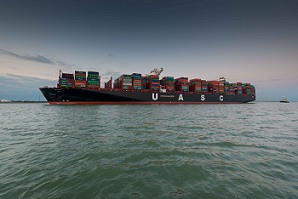
“Last year a number of operators introduced new, bigger ships and records were broken. The record breakers included container ship, UASC Barzan and cruise ship Viking Star. The 400 metre long Barzan set a new benchmark as the biggest-ever ship on the Thames when she called at London Gateway Port in September. Viking Star became the largest-ever cruise ship in central London when she called at our Greenwich cruise ship moorings on her inaugural trip in May.
“Since August, the Port of Tilbury has welcomed over 20 calls from Grimaldi’s new-generation, larger capacity con-ro ships, operating on routes between Europe and West Africa. Longer and wider than their predecessors, they are handled at Tilbury’s new landing stage berth, rather than in the docks. And the Thames’ busiest service operator, CLdN has much larger, “game changer”, ships being built as well.
“It’s developments like these, combined with the planned £1 billion of investment by Thames terminals and operators over the next five years, that give us confidence in the future. The Thames Vision project, looking at how the Thames will develop over the next two decades has set a goal of port trade growing to over 60 million tonnes.”
The tonnage of cargo handled at terminals on the Thames last year was 45.4 million tonnes, 0.9 million tonnes (or 2%) up on 2014. Growth was principally in containers and trailers (unitised traffic) up 4% to 16.9 million tonnes; aggregates and cement increased again as construction continued to recover from 9.7 million tonnes (11%) up to 10.7 million tonnes. Oil trades fell by 8% to 10.9 million tonnes, with volumes particularly low at the beginning of year.
At the Port of Tilbury, P&O Ferries passed a milestone, handling its one millionth freight unit at the port and the port handled over 40 million bricks. Not only that, a record 100,000 passengers passed through the London International Cruise Terminal. At London Gateway Port, development of the third berth continued as increasing numbers of ultra large container ships called, benefitting from the port’s ability to continue operating even in high winds.
Port of Rotterdam to redirect 4km of port section of Betuwe Route
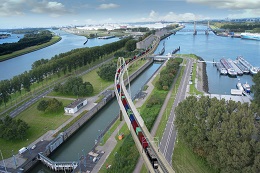
It will also bring an end to all the noise nuisance caused by the rail track near the village of Rozenburg. Construction of the new route will cost around EUR 275 million. The Ministry of Infrastructure and the Environment is contributing over EUR 100 million, the European Union EUR 62 million and the Port Authority the remainder. That is close on EUR 100 million. The Port Authority will construct the new route and then hand the railway line over to ProRail.
Splitting traffic flows
The Caland Bridge near Rozenburg is a steel vertical lift bridge that will reach the end of its technical lifespan in 2020. The bridge is an important traffic hub, used by rail and road traffic. By redirecting the railway line over the Rozenburgse Sluis and via Theemsweg, the increasing rail traffic to and from Europoort and the Maasvlakte will no longer be obstructed by shipping. This will considerably improve the flow of traffic.
Project organisation for Theemsweg Route
COO of the Port of Rotterdam Authority, Ronald Paul, on the investment in the Theemsweg Route: “The connections to the hinterland are essential for the port’s competitive position. That’s why we want to see a solution to the capacity problem. But because the Government doesn’t have sufficient funds to do this in the coming years, we suggested to the Ministry of Infrastructure and the Environment that we, as Port Authority, would pay a large proportion of the costs for the Theemsweg Route and execute the project ourselves. On completion, we will hand the new stretch of track over to ProRail. The ministry responded positively to our proposal. We will produce the final design for the railway line in collaboration with ProRail. The new route will be approximately 4km long and run over a raised railway viaduct. The track will have two arched bridges and link up again with the existing track where it meets the A15.”
No equal playing field
It is very unusual in Europe for a port authority to invest as heavily in public infrastructure as is currently the case in Rotterdam. In Hamburg, Wilhelmshaven, Bremerhaven, Antwerp and Zeebrugge, the authorities not only pay for the public infrastructure such as railways, but also contribute towards investments in the development of ports, or the government settles the losses suffered by the port authorities. This was revealed by the study ‘Level playing field’ (2014), conducted by RHV-Erasmus University and Ecorys, by order of the Ministry of Infrastructure and the Environment. As a result, clients of these ports do not pay a realistic price, there is no equal playing field and the Dutch ports lose out on cargo, work and revenue. The researchers calculated that Rotterdam lost out on about one million TEU containers a year, as just one example, due to this unfair competition. As the Port of Rotterdam Authority makes a substantial contribution to public infrastructure, the situation here is the precise opposite of that in many other European ports.