Monday, December 8, 2025
spot_img
Home Blog Page 340

Marseille set for interim spend during intermodal project re-think

0

The February board meeting accepted that the overall project should be modified to reinforce the ‘harmonious integration’ required under the City-Port Charter – but meanwhile agreed in principle to short-term works estimated at €10-12 million for essential modernisation of intermodal facilities within the port perimeter.       

Stressing this would have no impact outside the port perimeter, the board said the work was essential to support the indispensable growth of rail transport and accompanying growth in both container and ro-ro traffic. 

Ultimately the Mourepiane project is also intended as an urban development handling the Marseille region’s continental traffic.  The board said the interim work would be conceived in a way that preserves the potential synergies of this traffic with port business. 

Pointing out that the port generates 18,000 jobs, the board added that its decisions underlined both a commitment to the port’s economic development and a wish to fully contribute in devising a new and mutually beneficial urban project.                

DEME invests in Flemish high-tech

0

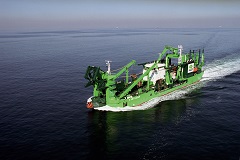
Laser cladding is a coating technique in which a laser melts metal powders into objects. The wear-resistant and anti-corrosive layers that are applied improve the durability of the mechanical parts. In a pilot phase, the method was used on dredger incisors and was successfully tested by DEME: even in extreme working conditions the incisors could be used for longer.

Now the initial research will be progressed through economic evaluation via the spin-off Laser Cladding Venture (LCV) which will further develop the technique with DEME during a three year cooperation agreement.

Dominique Durt, Director Applied Development & Innovation DEME: “DEME is heavily focused on innovation. It is thanks to innovative and improved techniques that we can continuously enhance our dredging and related activities. Where possible, DEME cooperates with leading Flemish companies and research institutes. The cooperation with VITO, now continued with LCV, is a good example of this”.

Besides coating, LCV also focuses on so-called additive manufacturing, the industrial version of 3D printing. Research institute VITO is particularly proud of the success of one of its spin-offs.

Walter Eevers, Director Valorization and Strategic Cooperation VITO: “It is VITO’s mission to use its technological knowledge to stimulate sustainable development and to enhance the Flemish economic and social fabric. With 17 years of experience in state-of-the-art laser technology VITO has a strong lead. Since 2010 VITO has focused on laser cladding and additive manufacturing especially. Meanwhile the laser cladding technology had become so marketable that VITO decided to launch a spin-off, while contributing VITO patents and machinery. VITO’s Venture Development Team grouped the right people and financiers together, refined the business plan and in doing so, helped launch the company. This meant that LCV had a strong starting position to turn laser cladding in Flanders and beyond into a success story. The contract with DEME is the first confirmation.”

Backing for Liverpool2 as Maersk announces new service

0

The feeder service will strengthen Liverpool2’s Irish Sea hub offering and establish direct cargo connections to and from the North West of England to Ireland and onwards to the Mediterranean, providing trade links to North and West Africa. The new service will offer 6 days transit time between Algeciras and Liverpool, with vessels arriving and departing on Wednesdays.

This is the first time that the Maersk Group Company has used Liverpool for UK cargoes in over 10 years and will be Maersk Group’s first ever direct connection to the Irish capital.

The announcement yesterday (2nd March) follows the news last month that WEC Lines, which is owned by MSC, has introduced a number of new services to the Port of Liverpool. X-press, the world’s largest independent common carrier of containers, has also launched a new service via the city.

Patrick Walters, Commercial Director at Peel Ports, said: “The two services that have already been announced, combined with these additional new services, are a strong signal of intent from lines in the run up to the opening of Liverpool2. Carriers are being increasingly convinced of the arguments around the strength of shipping closer to market via the North-west; partly due to the excellent support we’ve received from cargo owners who are looking for ways to reduce costs, carbon emissions and congestion in their supply chain.”

Liverpool2 is to have a phased opening, with marine trials beginning in April and other elements of the semi-automated terminal coming online throughout Q2 of 2016. The first phase of the new terminal will be fully operational in the autumn.

“We are thrilled to offer a new connection to Liverpool and expand our product portfolio for markets in the UK and Ireland”, shares Seago Line General Manager for UK & Ireland Robert Clegg. “With competitive transit times and convenient berthing windows, we are well-placed to serve customers who seek new opportunities through this Mediterranean connection.

“Furthermore, our customers located in the Liverpool hinterland can now access South European and North African markets with Seago Line as a complementary addition to our existing offer.”

Brian Godsafe, Managing Director at Maersk Line UK & Ireland comments: “This service is a positive addition to our current portfolio. The Irish Sea feeder offers flexibility to customers in the Liverpool area and the wider North-west region”

In January, WEC Lines announced a weekly service linking Liverpool with Sines, the major transhipment hub in Portugal and other Iberian ports. This service will connect with South American, Canary Islands and Far East services at Sines.

The first call to Liverpool by SEAGO Line is planned on April 13th.

The Montreal Port Authority welcomes the development of industrial port areas in Quebec

0

“We believe in the merits of the concept of industrial port areas, and we are very pleased with these major investments. Montreal is a natural, ideally suited site to implement such a concept. Like the Port of Montreal, ports are real engines for attracting business and there will definitely be no shortage of interest in developing business in this stimulating context,” stated Sylvie Vachon, President and CEO of the MPA.

As Greater Montreal’s freight transportation hub, the MPA plans to fullyparticipate in this project, alongside its many partners, such as CargoM, the municipalities and the Government of Quebec.

The implementation of industrial port areas throughout Quebec is part of the Quebec government’s Maritime Strategy 2015-2020 Action Plan, a policy made public in June 2015 and hailed with
great satisfaction by the MPA.

“The project to develop industrial and port areas is a perfect fit with our business strategy, called Port+, which aims to pool efforts toward common issues and opportunities, and to provide value-added services close to port facilities,” added Ms. Vachon. “Our project to develop a container terminal at Contrecoeur is also bound to contribute positively to the
government’s commitment to maximize the attraction that a port holds for business.”

The MPA also hails the Government of Quebec’s commitment to invest in port and intermodal infrastructures through a $200 million budget provided for by the Ministry of Transport, Sustainable Mobility and Transport Electrification.