Monday, December 8, 2025
spot_img
Home Blog Page 341

Cargotec completes the acquisition of maritime software company INTERSCHALT

0

The acquisition strengthens Cargotec’s and its business areas’ Kalmar’s and MacGregor’s software strategy and complements Cargotec’s strategic aim to be the leader in intelligent cargo handling.

Cargotec will consolidate the results of INTERSCHALT software business into Kalmar business area results and the results of INTERSCHALT services business into MacGregor business area results as of March 2016.

The Port of Gothenburg is set to expand with the construction of a new terminal

0

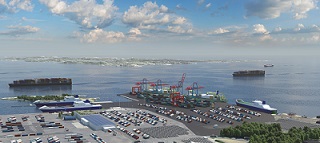
It is the largest expansion project at the port since the 1970s. The terminal will be built using dredging spoils and is expected to be completed at some point after 2020. The Land and Environment Court has granted the Port of Gothenburg
consent to build a new freight terminal beside the existing terminals.

“We are extremely pleased to receive this decision, which will strengthen Gothenburg as the logistics capital of the Nordic region. The terminal is an important part of our future expansion and will present us with an opportunity to handle the increase in demand for sea transport via the Port of Gothenburg,” said Magnus KÃ¥restedt, Port of Gothenburg chief executive.

The maximum draught for vessels calling at the terminal will be 11 metres. This means that traffic will probably take the form of intra-European freight transport – either as a final destination or to the major transshipment hubs in northern Germany, the Netherlands and Belgium for onward movement to various parts of the world.

“We have already noted an increase in demand from the market. There is also a political ambition in Europe to switch more and more transport from land to sea in order to alleviate pressure on the roads and mitigate environmental impact,” said Magnus KÃ¥restedt.

It has still not been decided what type of goods the new terminal will handle – containers, rolling goods such as trailers and cars, passenger traffic or a combination of several types of freight.

“The permit will allow us to adapt the design of the terminal to what the market will be like in the future.”

The terminal will be run by an external operator in precisely the same way as the current freight terminals at the Port of Gothenburg.

“Exactly who it will be has not yet been decided although we already know that there is considerable interest in operating a terminal at the largest port in the Nordic region,” Magnus KÃ¥restedt said.

The area will be 220,000 square metres, equivalent to 30 football pitches. The cost of the investment is expected to be in the region of one billion kronor.

The new terminal will be built using dredging spoils from maintenance dredging that is taking place throughout the port area*. The spoils will be deposited in an embanked area in the bay at Arendal and will be made solid by being mixed with cement.

“By using dredging spoils in the construction, we can reuse material that would otherwise be simply sent to landfill,” said Magnus KÃ¥restedt.

Once the new port area has been constructed, eelgrass will disappear from the seabed. Eelgrass is an important part of the marine ecosystem and acts as a nursery for several species of fish.

“As is always the case when we expand, we compensate for our encroachment on nature and we will therefore replant eelgrass that at least matches the eelgrass that disappears from the bay at Arendal,” Magnus KÃ¥restedt explained.

USD 20 million for efficiency in commerce and trade for Texas ports

0

Program funds will directly benefit road improvement projects at Port Corpus Christi. The Port’s construction project includes widening a portion of the Joe Fulton International Trade Corridor where it connects with Mike Carrell Road. Mike Carrell Road construction will improve the safety and access of traffic traveling to the new M&G Chemicals facility, and the new Port Corpus Christi Public Oil Dock 14. Approximately half of the cost for these road improvements are covered under the Texas Transportation Commission approved funding.

Nine Texas port projects will receive a share of the $20 million to use in combination with local and other funding sources. These projects are included in the Unified Transportation Program recently approved by the commission and funded from Rider 48 of the General Appropriations Bill of the 84th Legislative Session, which provides $20 million for port capital improvement projects recommended by the Port Authority Advisory Committee. Port Corpus Christi Executive Director, John LaRue is Chairman of the Port Authority Advisory Committee.

“Each of the projects approved will have a benefit on its local region and contribute to the entire Texas Transportation system,” said Chairman John LaRue, Port Authority Advisory Committee. “The Texas ports are pleased to partner with TxDOT to improve the movement of commerce and trade thereby creating additional economic opportunities for Texas.”

“Texas ports are our gateway to international trade,” said Texas Lt. Gov. Dan Patrick. “The facilities in our ports are crucial and so are the roads and bridges that connect them to the rest of our country. These projects address those links between the ports and our highways, and help maintain our prominence in worldwide commerce.”

ESPO joins 'Think Climate' initiative

0

Think Climate brings together major international associations with interests in waterborne transport infrastructure, with the objective to help the sector respond to climate change.

By further understanding, providing targeted technical support and building capacity, the coalition has a double aim: first of all, to promote the reduction of greenhouse gas emissions, by shifting to low carbon maritime and inland waterway transport infrastructure, secondly, address ways to adapt maritime and waterborne infrastructure and operations to the potential impacts of climate change such as sea level rise and extreme weather conditions.