Monday, December 8, 2025
spot_img
Home Blog Page 343

NILEDUTCH upgrades the Europe – West Africa Trade

0

Port rotation – WEWA

The existing West Europe – West Africa Service, known as WEWA, will be upgraded
to weekly sailings and will start on March 9, with the following port rotation:

Antwerp – Le Havre – Leixoes by rail to Lisbon – Lisbon – Algeciras – Tanger –
Pointe Noire – Luanda – Lobito – Namibe – Abidjan – Tanger – Antwerp.

Port rotation –
EUWA

A new service to Dakar and Abidjan will provide extra loading ports. This new
Europe West Africa service (EUWA) will start on March 6 with the following port
rotation:

Dunkerque – Tilbury – Antwerp – Dunkerque – Le Havre – Montoir – Tanger –
Algeciras – Dakar – Abidjan – Dakar – Algeciras – Dunkerque.

NileDutch’s West
African network

Pointe Noire (Congo) will serve as NileDutch’s hub for shipments to and from Douala, Libreville, Bata, Malabo, Boma, Matadi, Cabinda and Soyo.

NileDutch

NileDutch Africa Line BV (NileDutch), headquartered in Rotterdam (NL), is amajor container shipping company, focussing on links between West Africa and the rest of the world. The company has over 30 years’ experience of working in Africa and has a large network of offices and agents. This presence in the region means NileDutch is familiar with the needs of the African market and can respond quickly to changes in the situation and offer their customers a reliable service. The company’s fleet of vessels provides efficient access to smaller ports in West Africa.

Puget Sound gateway preparing to serve big ships of the future to grow cargo volumes and jobs

0

The Benjamin Franklin has capacity for 18,000 20-foot equivalent container units (TEUs). That’s more than double the cargo of most container ships calling at Northwest Seaport Alliance terminals. If laid end-to-end, the 18,000 TEUs would stretch from Tacoma to Everett, a distance of about 68 miles.

At 1,310 feet long and 177 feet wide, the Benjamin Franklin is longer than two Space Needles or five Boeing 747s placed along its length.

Mega-ships like the Benjamin Franklin are entering the trans-Pacific trade sooner than expected, as shipping lines seek increased economies of scale to reduce operating costs and environmental impact. Last fall, the NWSA welcomed two 11,400-TEU vessels, the CMA CGM Callisto and CMA CGM Cassiopea, and 10,000-TEU ships call regularly in the North and South harbors.

“The entire cargo industry is upsizing to big ships. To keep the Puget Sound gateway competitive, we must invest in our terminal facilities and road and rail networks to efficiently handle these larger vessels and additional cargo,” said John Creighton, president of the Port of Seattle Commission.

The larger vessels require terminals with deeper berths, stronger piers and bigger container cranes. The NWSA’s 10-year strategic plan identifies key investments in our facilities to meet
customer needs and grow jobs, including planned upgrades in the North Harbor’s Terminal 5 and South Harbor’s Terminal 4.

These complement investments already made by SSA Marine and the NWSA to make Terminal 18 big-ship ready now. Additionally, the Seattle home port and U.S. Army Corps of Engineers are halfway through a deepening feasibility study to evaluate alternatives for deepening the navigation channels in the East & West Waterways up to 55 feet.

“A vibrant, growing maritime sector is good for Washington state, where 40 percent of jobs are tied to international trade,” said Connie Bacon, president of the Port of Tacoma Commission. “We are committed to doing our part to create more jobs and economic opportunities for the region, and supporting a great quality of life for the Puget Sound region.”

According to a 2013 study,NWSA marine cargo operations support 48,000 jobs in the Puget Sound and generate nearly $4.3 billion in economic activity. If we factor in the farmers
and manufacturers who ship products through the two harbors, NWSA’s activities reach 443,000 jobs across the state.

“I’m proud to welcome the Benjamin Franklin to Washington state, because it shows the world that we are big-ship ready and open for business supporting the efficient, clean and prosperous shipping trends of the future,” said Gov. Jay Inslee.

“The arrival of the Benjamin Franklin highlights the critical role ports play in supporting jobs and economic growth in Washington state and the nation,” said Sen. Patty Murray. “As The
Northwest Seaport Alliance works to compete in the global marketplace, I will continue to advocate for federal policies that better support our ports’ sustained growth and success.”

“This is a significant milestone for the Port of Seattle and Washington state. This mega ship demonstrates that Washington’s ports and maritime industry remain a leader in global trade,” said Sen. Maria Cantwell. “The Benjamin Franklin further proves that when we make smart investments in our freight infrastructure, we can create more jobs and have more containers moving through our ports. Moving forward, we must continue our efforts to reform the harbor maintenance tax to help Washington ports compete in the global economy. At the end of the day, the
faster freight moves, the faster Washington’s economy will grow.”

Damco expands logistics capacity in Vietnam

0

Together with the recent development of the Haiphong warehouse in North Vietnam to 11,500 m2, Damco Vietnam’s warehouse capacity now stands at an impressive 73,000 m2 across five sites.

Damco’s growing Contract Logistics operation has over 25,000 m2 of space to serve customers in the industrial, retail, fashion and chemicals sectors. This unrivalled capacity offers a greater array of supply chain efficiencies which in turn optimize costs for customer’s logistics operations.

The new container freight consolidation facility is equipped with the latest technologies such as a High Jump CFS management system, RF scanning, a sprinkler system and a digital CCTV system. It also incorporates a quality control room and an on-site customs office, supported by a dedicated country management team which works closely with other Damco teams in origin and
destination countries.

The expanded facility will enable Damco to support Vietnam’s projected economic growth with greater efficiency. These developments are in tandem with the establishment of the ASEAN Economic Community (AEC) in December 2015, the Trans-Pacific Partnership (TPP) agreement, and the Free Trade Agreement (FTA) between Vietnam and the European Union. Also on Damco’s stable is the recent establishment of the consolidation hub at Cai Mep in South Vietnam, from where a domestic ocean container can be transported serving the Hai Phong port in the North.

Marco Civardi, Area Managing Director for Damco in Vietnam & Cambodia, adds: “In preparation for the upcoming years of strong economic growth, Damco Vietnam has invested substantially to upgrade our capacity in both geographical areas of North and South. Within our facilities we are now able to perform new value added activities on behalf of our customers. Noteworthy is also the acquisition of our bonded license capability in Haiphong and the possibility to perform activities such as metal detection, CNI (Certificate of No Impediment)
and inner carton checking within our Ho Chi Minh facility. These developments demonstrate Damco’s commitment to the Vietnamese market and our clear goal to be here for the long-haul!”

Damco’s Southern Vietnam Logistics Center has broadened and strengthened the range of logistics services for customers and investors alike, both foreign and domestic. The new facility will enable Damco Vietnam’s customers’ supply chains to become more competitive by optimizing their logistics costs while ensuring a tangible reduction of their environmental emissions.

Two Terex ship-to-shore cranes for Tanzania International Container Terminal Services

0

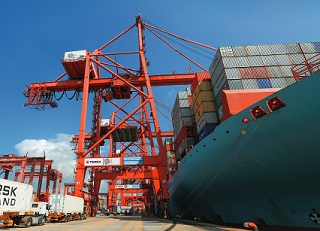
TICTS, situated in the capital Dar es Salaam, is Tanzania’s largest container terminal. As TICTS is the major logistics gateway to Eastern, Central and Southern Africa, it must meet the challenge of constantly increasing handling rates. The two new STS cranes will help TICTS to enhance the productivity of its operations significantly. They offer a lifting capacity of 41 t under twin-lift spreader, an outreach of 42 m and are designed to load and unload container vessels with up to 15 rows. Being supplied with power from the terminal’s electricity supply, the low noise cranes will not generate any local exhaust emissions.

With this order, Hong Kong-based HPH will further strengthen its business relationship with TPS. In the past few years, the subsidiary of the multinational CK Hutchison Holdings Limited (CK Hutchison) has placed several orders for its terminals around the globe. In 2012, TPS supplied seven Terex rubber-tyred gantry cranes (RTG) to the Balboa terminal of HPH’s subsidiary Panama Ports Company (PPC), followed in 2013 by four STS for PPC’s Cristobal site. In 2015, another four RTGs were delivered to HPH’s Saudi-Arabian branch International Port
Service Co. Ltd (IPS) in Dammam, where two more of these machines will be brought into service in summer 2016.

Maurizio Altieri, Managing Director of TPS Xiamen location, is pleased that TPS continues to extend its business relationship with one of the fastest growing terminal operators in the world: “In order to support the rapid development of its global business over the long term, HPH has now decided to rely on TPS again. Our cranes combine high productivity with economical total cost of
ownership.”