

Monday, December 8, 2025
spot_img
Home Blog Page 347

FTA welcomes transparency in shipping line prices

0

The fifteen shipping lines involved in the three-year enquiry into price signaling have agreed to change future pricing regimes. The news is a major victory for FTA’s British Shippers’ Council, whose members first raised concerns about uncompetitive behaviour in 2010.

The European Commission today published a communication in the Official Journal confirming that the lines have offered commitments to the way prices are announced. The Commission’s commitments decision will introduce a degree of transparency into maritime transport pricing for the first time.

In particular the lines have agreed that they will cease to announce general rate increases and publish the actual prices available to customers on an individual basis.

Under Article 9 of the main EU competition law procedural regulation (Regulation 1/2003), the Commission has now published a notice in the EU Official Journal giving interested parties, such as shippers, one month from 16 February 2016 to comment on its proposed commitments decision. This is called a ‘market test’.

Chris Welsh MBE, FTA Director of Global and European Policy, said: “We welcome the Commission bringing this important case on liner shipping prices to a satisfactory close. As one of the original complainants, FTA will respond to the market test now that the Commission has published its Notice.

“We look forward to a new clear and open approach by the shipping line operators which will remove the need for our members to resort to court proceedings for competition damages, an option which has been made easier by the 2014 EC Competition Damages Directive and the new Consumer Rights Act 2015 competition legislation in the UK.”

The Notice details the content of the competition law infringements issued to the parties and confirms that the proposed changes to future pricing behaviour are acceptable to the Commission.

While the Notice also acknowledges that the shipping lines deny any infringements that does not alter the Commission’s original assessment of the allegations. What it means is that the Commission has agreed not to continue its investigation in exchange for a commitment from the shipping lines to significantly change their pricing behaviour in the future.

While the lines involved will not be the subject of a decision finding infringements nor fined, they have agreed to stop the behaviour which the Commission considers unlawful and undertaken to improve the system of price announcements in future.
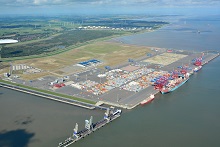
Results of the JadeWeserPort II feasibility study released

0

The requirements analysis was prepared by the ISL Institut für Seeverkehrswirtschaft und Logistik in Bremen (Institute for Shipping Economics and Logistics). Olaf Lies, Niedersachsen’s Economic Affairs and Ports Minister, said at the publication of the study: “It is good that the feasibility study is now available for the second construction phase. This shows that the construction of a second container terminal in Wilhelmshaven is not only technically feasible, but also economically prudent in the medium term.

According to the study, the current port will reach the limits of its capacity by 2027. We will invest in the construction planning in future when this forecast is increasingly underpinned by facts. We have therefore decided to only push ahead with more planning when JadeWeserPort has clearly passed the one million TEU per year container handling milestone for the first time.”

The study covered eight aspects in total, including the main operating parameters such as quay length and site depth for a competitive and independently-operating container terminal, as well as the cost-benefit ratio. Other aspects analysed included the evaluation of the building plot and sand extraction, a differential assessment of road and rail connections, as well as a nautical simulation to analyse the safety and easy handling of the shipping traffic. Other aspects included a noise assessment, as well as an impact forecast concerning any possible negative environmental factors.

The evaluation of the environmental aspects revealed that nothing would jeopardise the basic ability of the project to acquire all the  necessary authorisations. The draft terminal design recommends a 1.8 kilometre-long quay in a northerly direction, with a quay position angled at 10 degrees, and a terminal depth of 620 metres.

Andreas Bullwinkel, Managing Director of Container Terminal Wilhelmshaven JadeWeserPort-Marketing GmbH & Co. KG, says: “We are delighted to now have the findings of this comprehensive study, and that the basic feasibility, including the ability to acquire all the necessary authorisations, has been confirmed. We continue to work at full speed ahead for the success and the future of our port.”

Shredder feeding with the SennebogenN 821

0

For over 125 years, CarlF has stood for waste disposal and recycling like no other transport company in the Malmö region. While transport with horse-drawn carts was at the forefront of their business in the early years, the family-owned company, now in the 3rd and 4th generation, has since become a recycling specialist.

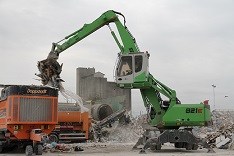
Yellow and red are the company colors of the Swedish recycling enterprise based in Malmö. From A to Z, everything is in red and yellow – everything except a green SENNEBOGEN 821, which was added to the machine park at short notice due to the good order situation in 2014. Now in the fourth generation, the family-owned enterprise has taken care of waste disposal in the Malmö region since 1888 and collects and sorts around 120 tonnes of construction rubble and industrial waste every day. The two 818 material handlers and the new Sennebogen 821 are used especially for feeding a Doppstadt shredder.

Because the two 818’s had already worked reliably and impressively for over 7500 operating hours and there was a good cooperation with the responsible sales and service partner, OP System, the responsible people decided on a Sennebogen material handler again. The new 821 E-Series is equipped with a 97 kW strong diesel engine and has a range of 11 m. The attached sorting grab presorts the incoming material and feeds it to a Doppstadt shredder. At the same time, the comfortable Maxcab, which can be elevated by 2.7m, offers an optimum view of the shredder and ensures the maximum level of work safety.

CarlF exclusively relies on small, maneuverable machines that can move flexibly around the scrap yard. With an operating weight of around 23 tonnes and all-wheel drive, the new 821 can quickly go wherever it is needed with speeds of up to 20km/h.

Vice President Biden visits Port of New Orleans

0

“I’m here today to talk about smart investments we made in shaping the future of the economy in Louisiana and around the country,” Vice President Biden told a crowd of more than 150 invited guests at the Port. “Right here at the Port of New Orleans a $16.7 million TIGER Grant has had an enormous impact.”

The Port received a $16.7 million Transportation Investment Generating Economic Recovery (TIGER) grant in 2011 to build the 12-acre Mississippi River Intermodal Terminal, which is scheduled to begin operation in March. The terminal has four rail tracks and two 60-long-ton rubber-tire gantry cranes. The terminal has an annual capacity of 160,000 twenty-foot-equivalent units and a marshaling yard with 389 slots for stacking loaded containers five-high.

Vice President Biden toured the new terminal with Port President and CEO Gary LaGrange, Louisiana Governor John Bel Edwards, U.S. Rep. Cedric Richmond, New Orleans Mayor Mitch Landrieu, Louisiana Secretary of Transportation Shawn Wilson, U.S. Secretary of Agriculture Tom Vilsack, and Under Secretary of the U.S. Department of Transportation Victor Mendez.

“It is an honor to host Vice President Biden and this group of dignitaries today,” LaGrange said. “The importance of investing in maritime infrastructure cannot be understated as we strive as a Nation to compete in the global marketplace.”

The Port of New Orleans is the only U.S. seaport served by six Class-One railroads and the new intermodal terminal will allow shippers to more efficiently utilize rail to service customers throughout the nation. “The Port’s rail access includes 132,000 miles of connecting rail tracks,” LaGrange said. “The new terminal will facilitate the movement of marine and rail cargo, stimulate international commerce and enhance safety all while reducing the carbon footprint of regional and national transportation systems within our market – which constitutes 62 percent of the consumers of the United States.”

Gov. Edwards reaffirmed his commitment to investing in Port infrastructure in Louisiana during his remarks, pledging to double the State’s investment into the Louisiana Port Construction and Development Priority Program in the upcoming fiscal year.

“This will be the largest single year investment in the Louisiana Port Priority Program in eight years,” Gov. Edwards said. “We are committed to investing in our ports and transportation infrastructure to help move Louisiana forward.”

Vice President Biden said many people do not understand the importance of the Nation’s ports and stressed the role the Port of New Orleans plays in the U.S. economy.

“You have been the economic heart of America for more than two centuries, connecting the agriculture and industrial power of Middle America to the rest of the country and the world,” Vice President Biden said.

He ended his remarks with a quote from American author and humorist Mark Twain: “Mark Twain said of this Great River, ‘it is not a book to be read once and thrown aside, for it had a story to tell every single day.’  It is still telling that story. It is a story about the industrial and agriculture might of this great country, but it cannot be fulfilled without the great Port of New Orleans and ports all along the Mississippi River.”