
Thursday, December 11, 2025
spot_img
Home Blog Page 349

New productivity records set at Port of Santos

0

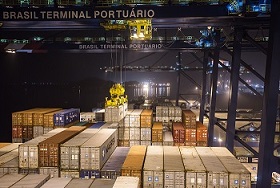
On February 10th while working the 6328 TEU capacity MSC Geneva, 206 moves per hour (MPH) were achieved while handling 1,980 containers, representing 44 crane moves per hour (MPH), surpassing the previous record of 35 crane MPH set in January.

A joint venture between APM Terminals and Terminal Investment Limited (TIL), BTP began operations in November 2013, and handled 1.14 million TEUs in 2015, growing its volume by 35% over 2014 levels in its first full-year of operation, to become the largest container terminal at the Port of Santos. Santos is South America’s busiest container port, with over 3.7 million TEUs handled in 2015. Brazilian ports handled a combined total of 9.1 million TEUs in 2015, representing approximately 29% of the Brazilian trade (Brazilian Ministry of Ports).

“Consistency in excellence is our priority, including safety performance, operations, and customer service,” said BTP CEO Antonio Passaro.

Brazil is a becoming an increasingly important market for global containerized trade for the APM Terminals Global Terminal Network; with particular growth in commodities such as frozen poultry and soybeans, despite the current economic downturn. The Brazilian government has projected a quadrupling of exports by 2030, and has announced a USD $50 billion infrastructure investment plan (at current exchange rates) that will include almost USD $10 billion in port construction and upgrades to accommodate this anticipated trade growth driven by a population of 205 million people, the largest market in Latin America.

APM Terminals also owns and operates APM Terminals Itajaí in Brazil’s second-largest port complex, and has a 75% share in APM Terminals Pecém, in northern Brazil. APM Terminals Itajaí is currently negotiating a lease extension, and APM Terminals Pecém is undergoing an upgrade in preparation for the delivery of two new STS cranes for use on larger vessels following the
opening of the expanded Panama Canal locks.

Growing its business by improving productivity is a priority for BTP: “Agility in delivering services, along with a streamlining of bureaucracy, are crucial factors for the recovery of national economic growth and to ensure Brazilian competitiveness globally. We at BTP have been seeking to innovate; along internal initiatives, we will combine our efforts to achieve Authorized Economic Operator (AEO) certification, which will reflect BTP’s higher level of reliability and agility in cargo handling” stated BTP COO João Mendes.

AEO is an internationally recognized quality mark granted by the Custom Union. The certificate indicates that the company’s role in the international supply chain is secure and its customs controls and procedures are efficient and compliant.

“Our vision is to achieve international standards of port operations, in order to elevate the Port of Santos to a global standard in productivity,” said  Mendes.

Kalmar to deliver nine forklifts to support Stora Enso's European sawmill operations

0

The order comprises eight Kalmar DCG160-12 medium-sized forklifts and one Kalmar ECG55-6 electric forklift, and is a continuation of the long-term relationship between Kalmar and Stora Enso, who have relied on Kalmar equipment to support their Central European sawmill operations since the early 1980s. The trucks will join the Kalmar rental fleet (totalling approximately 80 machines) at Stora Enso. They will be used to handle loads of sawn timber at Stora Enso’s network of sawmills across Europe, which includes sites in Austria, Germany, Poland and
the Czech Republic.

Jürgen Wurzer, Managing Director of Kalmar Austria, says: “Kalmar is a long-term supplier to Stora Enso, which has outsourced its mobile equipment fleet to Kalmar Austria since 2004. The fleet consists of approximately 12 logstackers, 30 medium-sized forklifts, 30 light forklifts and 12 back-up machines. This cooperation helps Kalmar develop the reliability and efficiency of its products and allows Stora Enso to focus on its core business.”

Kalmar’s next-generation forklift trucks are designed to offer the best possible return on investment over their entire lifespan, and are ideal for demanding applications such as timber handling. They combine low fuel consumption and superior lifting performance with easy maintenance and excellent reliability. The ergonomic EGO cabin provides maximum visibility and comfort for operators, and features a driving seat that can be turned 180 degrees to ensure safe operation when handling heavy or bulky loads.

APM Terminals opens new Medical Centre for all truckers serving the Nhava Sheva

0

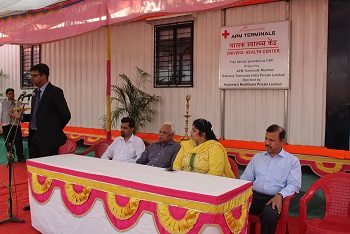
The purpose of the new medical facility is to provide the trucking community with free access to basic hygiene, health and sanitation facilities as part of an overall effort to improve safety and the basic living and working conditions of the trucking community who play an integral part of India’s logistics supply chain.

At the formal opening of the inauguration of the health center on January 29, Mr Yash Vardhan, Director, Container Corporation of India (CONCOR), representing the Board of Directors at APM Terminals Mumbai commented, “This initiative will help in strengthening the most crucial link impacting India’s logistics chain and the society at large.”

India, with a population of 1.25 billion, and the world’s third-largest economy, calculated by Purchasing Power Parity, has partly through trade-enabled economic development, seen a reduction in the national poverty level from 41.6% of the population in 2005, to 23.6% of the population in 2012, according to the World Bank’s Global Monitoring Report for 2014-15 on the Millennium
Development Goals.

Located near the village of Jaskar, Uran, in Maharashtra State, at the entry of the dedicated access road to APM Terminals Mumbai, the clinic’s services are available to all truck drivers serving the four JNP terminals, including APM Terminals Mumbai, the busiest container terminal at the port complex, handling 1.91 million TEUs in 2015, and representing 42.6% of the record-setting
cumulative 4.47 million TEUs handled by the port in 2015.

APM Terminals Mumbai works with approximately 2,200 truck drivers each day, or about 66,000 drivers per month, who deliver and pick up cargo and containers to and from the terminal. Drawn from segments of the community with limited access to medical treatment, many of the drivers suffer from oral hygiene and other health issues, some of which require urgent attention.

APM Terminals Mumbai CEO, Pradip Agrawal added, “We hope to lead by example. We calculate more than 18,000 drivers can benefit annually from the health center. If replicated elsewhere in India, the program will have a significant impact on India’s supply chain by promoting an awareness of the profession, and addressing the issue of shortage of tractor-trailer drivers faced by the
industry.”

“Travelling long distances on difficult road infrastructure makes these drivers susceptible to professional hazards, while poor working conditions and long hours only worsen the situation; we are hopeful of bringing a positive change by helping the drivers maintain a healthy body and sound mind behind the wheel, and encouraging safe and responsible driving” said APM Terminals Mumbai COO, Ravi Gaitonde.

APM Terminals Mumbai plans to adopt several other initiatives which will be rolled out in a phased manner to cultivate safer, improved working and physical conditions for the industry’s truck drivers, serving as an example for the rest of India’s expanding logistics supply chain.

Long Beach welcomes 'Benjamin Franklin' Megaship

0

Longshore workers are expected to move about 12,500 cargo containers on and off the vessel before it leaves the Port of Long Beach on February 24th. The figure is two-and-a-half times the world-leading 5,000 containers
that Long Beach terminals move during the call of an average-size vessel. “Our PCT terminal is just one of our facilities able to accommodate these megaships,” Board of Harbour Commissioners President Lori Ann Guzmán said. “Preparing for still larger ships, our new LBCT (Long Beach Container Terminal) Middle Harbour terminal opens this spring.” The USD1.3 billion Middle
Harbour terminal will be the most technologically advanced in the Western Hemisphere.

As a nearly all-electric, near zero emissions terminal, Long Beach’s Middle Harbour facility is a green, highly productive model for the worldwide shipping industry. Once it is fully completed in 2020, Middle Harbour will be able to move 3.3 million TEUs a year, and handle 24,000-TEU ships. The project is part of an ongoing USD4 billion capital program to modernize facilities at the Port of Long Beach to bring long-term, environmentally sustainable growth. “The Port of Long Beach is the most direct route from Asia to U.S. markets,” said Port of Long Beach CEO Jon Slangerup. “We are strengthening our value proposition by working with all of our customers and stakeholders to optimise the speed and efficiency of our marine supply chain as we continue
building the Port of the Future.” CMA CGM, the world’s third-largest shipping company, was established in 1978 by founder and Chairman Jacques R. Saadé.

Based in Marseilles, France, the company transports 13 million container units each year with a fleet of 470 vessels to 400 ports across the globe.