Saturday, December 13, 2025
spot_img
Home Blog Page 357

Nautilus International and Metro move into new Long Beach Headquarters

0

The new address is 3806 Worsham Ave., Long Beach, California, 90808. The post office box address is P.O. Box 93121, Long Beach, California, 90809-3121. General phone number is 310.816.6500.

The new 40,000-square-foot headquarters is located on 2.57 acres at Pacific Pointe at Douglas Park. The company will shift approximately 65 executive and administrative personnel (with capacity to exceed 120) for the holding corporation and each of its subsidiaries.

Nautilus is proud the new building satisfies the California Green Building Standards Code. The building is LEED Gold Certified  (Leadership in Energy and Environmental Design), with 170 parking spaces, which include 10 electric vehicles charging stations. The parking area encompasses a carport structure utilizing solar panels as the cover to power the building.

New G HMK 6507 crane for Swedish SCA Logistics AB in Sundsvall

0

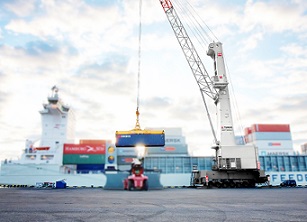
Since mid-2014, TPS has delivered several machines to a range of locations in the area, and now the Swedish company SCA Logistics AB (SCA) has ordered a Model 6 mobile harbour crane in the G HMK 6507 two-rope variant. From mid-2016, the logistics division of the leading manufacturer of paper, pulp and timber products SCA Svenska Cellulosa Aktiebolaget, will use the crane at its terminal in Sundsvall, approximately 400 km to the north of the Swedish capital Stockholm. The new mobile harbour crane for SCA will supplement an existing rail-mounted harbour crane in Sundsvall. The Terex Gottwald mobile harbour crane designed for professional loading and unloading of containers offers SCA a maximum lifting capacity of 125 t, a radius up to 51 m and achieves
lifting speeds of 120 m/min. It will help SCA to meet the constantly growing demand in the container handling business. Urban Häggkvist, Terminal Manager, SCA: “We expect particularly
high growth rates in the container business. That is why we have also moved the container activities to the Korstabäcks quay of the SCA terminal, where it is possible to moor much larger container vessels than before. In order to be equipped for growth, we are relying on high-performance Terex Gottwald mobile harbour crane technology.”

Thanks to its mobility, versatility and reliability, the G HMK 6507 offers a high level of user friendliness and ease of maintenance. It will not only support SCA with container handling, but in some cases also with loading and unloading project cargo, for which it was necessary to hire mobile cranes before. Häggkvist: “The new crane is an investment in the future for us and part of a comprehensive integrated concept, with which we plan to become faster, more productive and more flexible at our terminal in Sundsvall.”

Port of Hamburg report downturn in container handling in 2015

0

Growth in bulk cargo throughput was maintained. In this important handling segment, total volume of 45.5 million tons represented growth of 5.8 percent on the previous year. The Port of Hamburg reports around 30 percent local container cargo as well as growing seaport-hinterland container transport by rail, up by 2.8 percent, and by inland waterway vessels, up by 27.5 percent. Downturn in seaborne container
throughput is primarily attributable to lower volumes handled with China, Russia and Poland. In total, in 2015 something over 800,000 containers (TEU) fewer than in the previous year were handled for these especially important trading partners in container traffic with the Port of Hamburg.

“Among the ports of Northern Europe, the Port of Hamburg has maintained its strong position on container traffic with the Baltic region. Compared to ports such as Antwerp and Rotterdam, Hamburg reports an around seven percentage points higher proportion of transhipment cargo,” explained Axel Mattern, Member of the Port of Hamburg Marketing Executive Board. “This is one of the reasons that Hamburg is more seriously affected than Antwerp or Rotterdam by weakness in China’s foreign trade and Russia’s economic problems, for example,” added Mattern. A large
share of the cargoes handled in Hamburg for China and Russia is transhipped via Hamburg, and loaded from oceangoing containerships on to feederships.
“Container traffic with China down by 14.4 percent and with Russia by 34.4 percent could not be offset in volume by growth in container traffic with other countries such as Malaysia, India, the United Arab Emirates or Mexico. Since the statistics for worldwide transhipment traffic feature the waterside transfer from the large container ship to the feeder or vice versa each time this occurs, any transhipment downturn doubly affects port results,” explained Mattern. The fall in seaborne container traffic with Polish ports has also been caused by direct calls by liner
container services calling Gdansk direct without transhipment at one of the North Range ports. “Such direct calls are always one alternative for shipowners to the transhipment traffic on which the majority of them nevertheless serve such hub ports as Hamburg, for example,” said Mattern. Essential for any direct calls are availability of sufficient cargo and ports equipped for handling
mega-containerships.

Port of Felixstowe offers Container Weighing Solution

0

Commenting on the new service, Stephen Abraham, Chief Operating Officer of Port of Felixstowe, said:

“We have met with many customers and from their feedback it is clear that there is still a lot of uncertainty amongst exporters about the new rules.

“The rules have the potential to cause significant disruption to export supply chains. To help avoid this, we have decided to provide a service where export containers can be weighed at the port before being loaded. We will provide further details about how the weighing service will work in good time to ensure all exporters can be compliant by the time the new rules come into force.”

From July, an amendment to the SOLAS (Safety of Life at Sea) Convention will require every export container carrying cargo to have its weight verified before it is loaded on to a ship.

The Port of Felixstowe has taken a leading role in the consultation exercise by the Maritime and Coastguard Agency on the implementation of the rules in the UK.

The service at the port will be available to containers arriving either by road or rail. The Port of Felixstowe is the UK’s largest intermodal rail terminal and 40% of all laden export containers arrive at the port by rail.