
Friday, December 12, 2025
spot_img
Home Blog Page 36

Shore power trial for coasters in Rotterdam

0

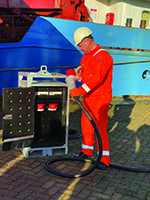
The vessels will then not need to run their diesel generators to generate power for use on board, resulting in reduced air pollution and noise. The trial will last around five months. Five different systems will be tested during this period. The size and setup of this trial make it unique in the world. “Shore-based power enables us to kill two birds with one stone: cleaner air and less CO2,” stated Arno Bonte, Alderman for air quality and sustainability. “I’m expecting this trial to give us insight into using shore power in more locations, particularly in urban areas.”

Allard Castelein, CEO Port of Rotterdam Authority: “We’re continuing to go that step further with shore-based power. This has been compulsory for inland shipping for some ten years. Stena Line in Hoek van Holland has it and we’re going to install this for Heerema at Rozenburg. In the coming decades many more vessels will need to use shore power. But the larger the vessel, the more complicated and expensive this is. So it takes time.”


What is special about the Parkkade trial is that it uses mobile concepts instead of permanent shore-based power connections. This means that these can be used wherever shore power is needed. The trial will also test different energy sources, such as hydrogen, battery, bio LNG, LNG and hybrid solutions. The latter solution combines various energy sources. For the above-mentioned fuels, an on-site generator is needed to convert these into electricity. The trial will mainly examine the technical and commercial feasibility, user-friendliness and environmental impact. Measurements will be taken during the trial to compare the systems’ sound and emissions with those resulting from the same vessel generating electricity using its own generators.


Many coasters from shipping lines such as Wilson, Vertom and Wijnne&Barends use the Parkkade. In principle, any sea-going vessel that berths there can use the mobile shore power, but many sea-going vessels are not equipped with a shore power connection.

The trial involves a sum of €500,000. The money largely comes from the national government via the Dutch National Collaboration Programme on Air Quality. The programme’s objective is to improve air quality, particularly in urban areas.Following the mobile shore power trial on Parkkade, a second trial will start in 2020. This will focus on innovative shore power concepts for larger sea-going vessels. €1,500,000 is available for this.


Calculations by DNV GL and the Port Authority indicate that the total energy demand of sea-going vessels in the port amounts to around 750-850 GWh. This is equivalent to some 200,000 households. This means that there are gains to be made in terms of air quality, liveability and the climate. Shore-based power is relatively easy to install and make profitable for inland shipping and ferries. The former use comparatively little energy and the second sail on fixed routes so that, apart from on the vessels themselves, facilities are only needed in a few ports. Shore-based power for sea-going shipping is more complex as electricity consumption is high and these vessels call at many different ports. This demands cooperation between ports, terminals and shipping companies. Another important factor is that large sea-going vessels consume a lot more electricity. For instance, with their thousands of passengers and crew, cruise ships’ electricity consumption is equivalent to that of a small city. 


Over the coming five months, shore power systems will be tested from the following five companies:

–       ENGIE Ventures & Integrated Solutions B.V.: Hybrid system with a Big Battery Box, integrated with a motor generator on biofuel (HVO);

–       PON Power & sister companies: Hybrid container with a battery combined with a generator on HVO fuel and a 20ft container with solar panels on the roof;

–       Aggreko Benelux: LNG-powered Gas engine in a 20ft container;

–       Mobiele Stroom BV: Bio LNG-powered turbine in a 20ft container;

–       JP-Energiesystemen B.V: Hydrogen fuel cell generator combined with a small battery.
Konecranes secures repeat order for portal harbour crane in Vladivostok

0

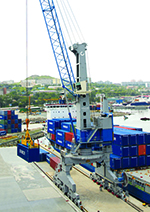
After handover in late autumn 2020, the crane will expand capacity for handling containers of automotive parts and common consumption goods. Vladivostok is the largest Russian port on the Pacific coast. It is the eastern end of the Trans-Siberian railway, providing a direct transport link to Moscow. For many years, it has played a key role in the automotive industry, and the car manufacturing company Sollers has a joint venture with a leading car manufacturing company and a factory (assembly and engine shops) in the city. Demand is increasing, so Pacific Logistic, who handle containers with vehicle parts for Sollers, decided to invest in a new portal harbour crane to boost their ability to handle a growing volume of imports. “We bought a Model 3 in 2014 and have been very satisfied with it,” says Ivan Turichenko, Technical Director of Pacific Logistic. “It was easy to customise for the special conditions of this harbour and it’s been an essential part of our operations for half a decade. Now we need to increase our capacity. Since we already know the capabilities of this crane, we think another is a good investment.” 


Their new crane will be the same as their previous purchase, a Konecranes Gottwald Model 3 Portal Harbour Crane in the G HSK 3432 variant. It will be tailored to meet their specific quay infrastructure with a quayside track gauge of 10.5 meters and a portal clearance height of 6 meters. Because the permissible rail loading is low, it will have 32 wheels, 8 at each corner of the crane. It is equipped with an external power supply to help lower operational costs while reducing noise and local exhaust emissions in the terminal. “The Model 3 portal harbour crane is growing in popularity,” says Hans-Juergen Schneider, Regional Sales Manager, Konecranes Port Solutions. “We just handed one over to Sweden. Now we have a repeat order from Russia. This confirms that our medium-sized portal harbour cranes have a clear market niche, with their flexibility of design fulfilling the needs of customers in a wide variety of locations.”


This order is part of Powered by Ecolifting, Konecranes’ vision to minimize the footprint and improve the handprint of equipment for container terminals. From eco-optimizing diesel drives, to hybridisation and fully-electrified fleets, we will continue to do more with less. 

SC Ports in strong position heading into 2020

0

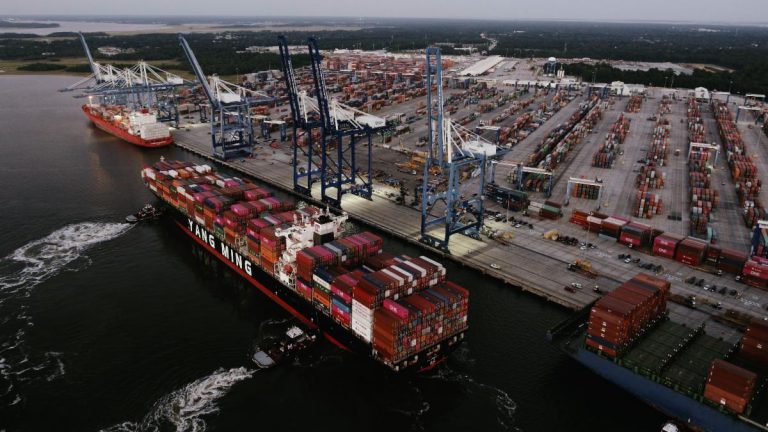
“We continue to attract cargo with our efficiently run terminals and reliable service,” SCPA President and CEO Jim Newsome said. “This is made possible by our excellent team and the broader maritime community, all of whom work tirelessly to keep cargo moving seamlessly through our supply chain.” SC Ports saw strong cargo volumes at container, breakbulk and inland terminals back in November. SCPA handled 184,928 TEUs at the Wando Welch and North Charleston container terminals during this period. This brings the total TEUs handled thus far in fiscal year 2020, from July through November, to 1.04 million – a 6% increase year-over-year. As measured by the total number of boxes handled, SCPA moved 104,324 pier containers in November. The Port has handled 588,873 pier containers in fiscal year 2020, which is up nearly 5% from the prior year. Beyond the oceanside terminals, SC Ports runs two very successful inland ports in the Upstate and Pee Dee regions of South Carolina. The inland ports use overnight rail to move cargo to and from the Port of Charleston, giving cargo owners in the Southeast and Midwest direct access to the port. Inland Port Greer reported 9,370 rail moves in November, while Inland Port Dillon saw 2,410 rail moves. Combined, the inland ports handled 11,780 rail moves in November for a total of 77,445 rail moves thus far in fiscal year 2020, up 27% year-over-year. “Looking ahead to 2020, we expect to continue weathering uncertainty in the world economy, but our strong position in the Southeast and proximity to a booming consumer market will drive growth,” Newsome said. “We expect to grow above the market as more cargo shifts from West Coast to East Coast ports.” During a recent board meeting, SCPA Board Chairman Bill Stern congratulated SC Ports on receiving international recognition for performance and overall productivity. The Journal of Commerce ranked both the Port of Charleston and Wando Welch Terminal No. 1 for productivity among North American midsized ports. “The equipment operators at S.C. Ports and all those working in the maritime community enable the notable productivity that cargo owners have come to rely on at S.C. Ports,” Stern said. Newsome also thanked the SCPA Board of Directors for their time and service to the Port. The board unanimously approved the re-election of board officers for the next two years: Stern as board chairman, Dave Posek as vice chairman, Kurt Grindstaff as treasurer and Willie Jeffries as secretary. “We appreciate the board’s continued support of our investments that enable us to service some of the biggest ships in the world,” Newsome said. “This next year is critical as we progress on our momentous infrastructure investments, including a new container terminal and a 52-foot deep harbour, both set for completion in 2021.”

Early container record at Ports of Stockholm

0

A milestone number of 60 001 TEUs was reached and surpassed at the Ports of Stockholm CTF container terminal back on 17 December, only a few months before the move to the new freight port, the Stockholm Norvik Port. “The record felt like an early Christmas present. The workforce have done a fantastic job and in recent years the container volumes have been at record levels. It is clear that the need for efficient transport to the Stockholm region is increasing steadily,” says Thomas Andersson, Ports of Stockholm Managing Director. With short approach lanes and good overland connections, the Stockholm Norvik Port is a logical and sustainable alternative for the transport of goods to and from the Stockholm region. “This record proves a point, and it is with the greatest confidence that we will soon open the new container terminal at the Stockholm Norvik Port, together with Hutchison Ports. With state-of-the-art equipment, and larger and more efficient surface area, we can deliver an even better product and increase volumes even further,” says Johan Wallén, Director of Sales and Marketing at Ports of Stockholm. When the Stockholm Norvik Port opens in 2020 it will replace the container terminal at Stockholm’s Frihamnen Port. The new container terminal will be run by Hutchison Ports, one of the world’s leading container terminal operators. The RoRo terminal at the Stockholm Norvik Port will also open in 2020. This will be run as part of Ports of Stockholm’s own business operations.