Monday, December 8, 2025
spot_img
Home Blog Page 360

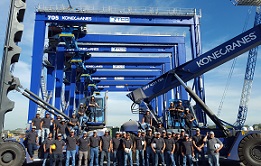
Konecranes hands over RTGs to TCQ Guatemala

0

“This was our first order to TCQ and Guatemala. The delivery went smoothly thanks to excellent cooperation with the terminal personnel. The cranes have been handed over and have successfully entered service,” said Kim Salvén, Sales Director, Europe, Konecranes, Port Cranes.

“These cranes will be instrumental to this new terminal’s growth and success. We look forward to continuing and deepening our relationship with TCQ,” concluded Mr Salvén.

Kalmar delivers 27 straddle carriers to Maher Terminals

0

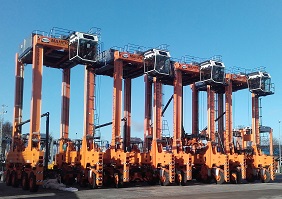
The order has been booked into Cargotec’s 2015 third quarter order intake and deliveries are expected to be completed during the spring 2016.

Maher Terminals is both renewing and expanding their straddle carrier fleet, now with environmentally responsible diesel-electric power utilizing U.S. EPA-mandated Tier 4 Final emission controls. The Kalmar ESC350 diesel-electric straddle carriers are rated for 50 metric tons (mt) with twin 20 feet containers or 40 mt with single containers. Included also in these straddle carriers are special features to improve productivity and performance in the challenging operating conditions of the customer. Furthermore, the straddle carriers will be pre-tested in Kalmar’s testing facilities and delivered fully erected, allowing shorter installation and commissioning time at the customer’s site.

“Maher Terminals LLC is a long-standing customer of ours and we value the relationship greatly. We are honored to be part of their development activities,” commented Richard Pope, Kalmar’s manager of port crane sales in North America. “When the industry is in transition driven by rapid technological, environmental and economic developments, we are committed to provide state-of-the-art solutions.”

Maher Terminals LLC is one of the largest multi user container terminaloperators in the world with highly efficient terminal operation. They have  launched a Sustainable Port Infrastructure Project to strengthen operations while helping to reduce environmental impact and use of natural resources.

APM Terminals Mumbai introduces solar power

0

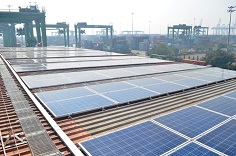
As part of the clean solar energy project, solar panels have been installed on the roofs of two terminal structures, and the conversion of energy from collected sunlight into stored electricity has commenced. The system became fully operational on January 1st, 2016, with a power generation potential of 361,000 kWh (kilowatt hour) units per year.

“APM Terminals and the APM Terminals Global Terminal Network are always looking for opportunities to improve services and enhance environmentally sustainable business operations; the Mumbai Solar Panel Project reaffirms our commitment to green power and caring for the Indian environment”, said APM Terminals Mumbai COO, Ravi Gaitonde.

A feasibility study was completed by the terminal in 2015 on the possibility of generating solar power to reduce conventional electrical power consumption at the facility, which handled approximately two million TEUs in 2015, representing over 40% of the record-breaking 4.48 million TEUs handled by the Mumbai port complex in 2015. The resulting Solar Panel Installation Project to capture and store energy from the sun for use as electrical power for terminal operations will be undertaken in three phases.

Phase I of the Solar Power Project, now underway, included the installation and implementation of solar panels on the roofs of the terminal’s workshop and Central Gate Complex. Phase II will see the installation of solar panels on the roof tops of the STS (ship-to-shore) crane machine houses, with the expected completion date of June 2016, following trial testing. These new panels will generate an additional 220,000 kWh (kilowatt hour) units per year.

Phase III of the project is currently in the conceptual stage, and will call for panels covering a wider surface area, resulting in solar generation of approximately 15% of the terminal’s total annual power requirement, approximately five million kWh (kilowatt hour) units per year.

India, with a population of 1.2 billion, is the world’s fourth-largest producer of electricity, following China, the USA, and Russia, and the fifth-largest consumer of electricity, after China, the USA, Russia and Japan. Approximately 70% of India’s electrical power is generated by burning fossil fuels. Accessibility to clean, carbon-free, renewable energy sources will become increasingly important for ongoing economic growth as India’s population expands by an estimated 200 million (the approximate size of the current population Brazil) over the next 15 years.

Twin Damen cutter suction dredgers for Canadian oil sands

0

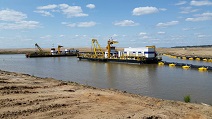
With both vessels built in Canada, the contract marks the close cooperation between Damen and Aecon, Canada’s largest publicly traded infrastructure development and construction company.

Two newly-built Damen CSDs have commenced operations in Northern Alberta, Canada. The two 40.64-metre long vessels perform dredging duties in oil sands tailings ponds. These tailings are a by-product of oil sands mining (oil sands being a surface substrate that is saturated with bitumen – a heavy and sticky form of crude oil). The effective management of these tailing ponds is therefore of vital importance.

The considerable size of the project required two of Damen’s largest cutter suction dredgers: the Damen ECSD650. This vessel is capable of production levels of 7,200 m3 per hour at 6.5 bar. This electrically-powered design receives its power supply from a 13.8 kV ship-to-shore cable.

Full component supply
Fabrication of both vessels took place in Canada,  involving close cooperation between Damen and Aecon. With their broad scope of business interests including a shipyard in Pictou, Nova Scotia, Aecon had all the necessary shipbuilding skills to handle construction. Their scope included construction of all the structural steel components and piping for the dredgers.

Damen’s involvement concerned the overall vessel design and provision of all the major components including motors, steel package and electric and hydraulic installations. Damen Dredging Equipment provided the dredging engineering and design in addition to parts such as pumps, winches and cutter heads.

The Damen team also provided technical assistance during the building, outfitting and commissioning phases as well as on-site training of operations team.

Transport solutions
Due to the location of the Aecon yard, approximately 5,000 km away from the oil production site, efficient transportation of the two vessels was vital. Damen’s solution was modular construction – facilitating transportation by truck as well as safe and fast assembly on arrival. The modularity of the design will also make any future relocations a more straightforward procedure.

The vessels – called Igor Mazursky and Fitzgerald – can dredge to a maximum depth of 10 metres. Their primary duty is to pump water back to the process plant and to maintain the capacity of the tailings ponds within their design specifications. Dredge production is flexible as the dredgers can be either controlled from the vessel itself or via remote control from the shore.

Construction partners
The dredging muscle comes from Damen’s BP6560MD dredge pump that features a variable-frequency drive with a 2200 kW electric motor. to The hydraulic installation is power by a 600 kW electric motor which feeds to the 250 kW cutter head and the winches.

With these two dredgers delivered in summer 2015, these two ECSD 650 vessels represent Damen’s growing presence in the North American market. “We are extremely proud to be active in Canada,” comments Damen Manager North America Jan van Hogerwou. “This important dredger contract not only represents a successful construction partnership with Aecon, but also a continuance of our long term strategy in this part of the world.”