
Monday, December 8, 2025
spot_img
Home Blog Page 376

POLB moves over 7 million TEUs in 2015

0

Cargo volume climbed 5.4 percent in 2015 compared to 2014, as the Southern California seaport and its industry partners transformed the challenges of congestion at the start of last year into a scene of free-flowing cargo and record setting months. “We’re gratified to see the business growth — we worked diligently over these past 12 months to recover from a very challenging start to the year, resulting in record volume and productivity gains and the strong and steady return of diverted cargo,” said Port of Long Beach CEO Jon Slangerup. “We credit terminal operators, labor, shipping lines, cargo owners and our local community with pulling together to turn things around.”

In December, the Port achieved 5.1 percent overall growth, compared to December 2014. Imports increased 7 percent to 296,002 TEUs, while exports fell 4.1 percent to 126,118 TEUs. In December, empties rose 9.5 percent to 174,328 TEUs.

For 2015, a total of 7,192,066 TEUs moved through the harbor. Imports rose 3.1 percent to 3,625,263 TEUs, while exports dropped 4.9 percent to 1,525,560. Empty containers rose 20.2 percent to 2,041,243 TEUs. The strong dollar continues to favor imports and discourage exports, resulting in more empties being sent back overseas to be refilled with goods.

During July and August, Long Beach achieved record cargo volumes resulting in the Port’s biggest quarter in its history — more than 2 million TEUs moved through the Port in the third quarter.
With an ongoing $4 billion program to modernize its facilities this decade, the Port of Long Beach is building the Port of the Future by investing in capital and service improvements that will bring long-term, environmentally sustainable growth.

CEO Jon Slangerup will present more information about the Port’s 2015 accomplishments and plans for 2016 during the annual State of the Port address on Thursday, Jan. 21. Please go to www.polb.com/StateOfThePort for more details.

For more details on the cargo numbers, please visit www.polb.com/stats.
ICTSI’s Matadi terminal to open for business in mid-2016

0

Matadi is the chief sea port of the Democratic Republic of the Congo and the capital of the Kongo-Central province. It is situated on the left bank of the Congo River 148 km (92 miles) from the mouth and 8 km (5 miles) below the last navigable point before rapids make the river impassable. The port serves an extensive hinterland including the capital city of Kinshasa, the largest city in Central Africa.

The ICTSI DR Congo Terminal will initially commence operations in August 2016, with one berth. Full delivery of Phase One, incorporating a second berth and total quay line of 350m will be by November 2016. Container handling capacity will be 175,000TEU/yr with a nine hectare terminal area incorporating a yard area of six hectares. Depth alongside the quay will be 12m at all times, offering the ability to serve Panamax, Handymax and Wafmax vessels.

As part of the overall development plan, ICTSI is also actively investigating the impact and opportunities for dredging the river in steps from 7.3m to 9.1m, 11m and eventually possibly even 12m. With the material to be dredged mainly sand there is considered to be real scope to achieve this and the delivery of wide economic benefits.

Handling operations along the 350m quay will be via heavy duty mobile cranes with reach stackers in the yard area for container handling. The Terminal Operating System will be Navis N4, incorporating value-added functions such as integrated billing, etc.

Construction activity to date at the terminal site, which is located south west of Pont Marechal (before the bridge) and the existing public port, has seen the completion of the access road, commencement of piling for the quay and the start of works on the yard area and terminal building and gates.

“We are very pleased to be progressing this USD 100m investment on schedule in Matadi, says Hans-Ole Madsen, ICTSI Senior Vice President for Europe, Middle East and Africa regions.

“The works are going well,” he underlined, “and we are very confident that we will be able to meet current and future cargo handling requirements for the Democratic Republic of the Congo in both the container and general cargo handling sectors.”

Based on demand, ICTSI also has the option to immediately implement a Phase Two development providing an additional 350m of quay line and supporting yard area. “We are ready to undertake this” emphasized Madsen, “as it is just a matter of timing in line with demand. We are very confident that we can build on the new efficiencies that Phase One will deliver including reduced vessel waiting time and reduced transit times for goods from point of origin to destination.”

The ICTSI DR Congo Terminal is a joint venture company between, ICTSI, The Ledya Group and SCTP SA. ICTSI operates 29 terminals in 20 countries and is recognized to be a leading developer, manager and operator of gateway container terminals of different sizes and serving extended hinterlands including cross border.

NYK selects Rotterdam for their break-bulk cargo

0

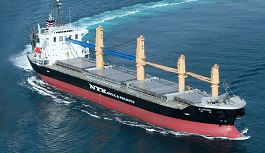
NYK has opted for a ‘one-stop-shop’ solution that efficiently concentrates its different freight flows in a single port. While Rotterdam already served as NYK’s port of call for its bulk cargo, until now the company still used Antwerp for its break-bulk.

“It’s a fine feather in the cap of our break-bulk proposition,” says Robert Jan Timmers of the Port of Rotterdam Authority. “Indeed, Rotterdam has the best proposition in this area. We are superior in terms of the quality and effectiveness of our hinterland connections and the optimum accessibility of our port. What’s more: the port of Rotterdam is frequently the most economical option thanks to fewer superfluous middlemen.”

“Besides already calling on Rotterdam for the unloading of our bulk cargo, we now plan to also unload our breakbulk in Rotterdam – for the simple reason that it raises the efficiency of our calls. In addition, we will be coordinating the export of both freight flows from Rotterdam. This way we can avoid having to call on a second port,” says NYK Bulk & Projects’ General Manager Seiji Ando, calling from Hamburg.

NYK Bulk & Projects Carriers is a division of NYK, the world’s largest shipping company. Operating a fleet of 160 vessels, the division concentrates on the worldwide transport of project cargo, heavy lift cargo, steel and bulk cargo. Every month, the 20,000-30,000 tonne vessels of the company’s Europe-Far East Service maintain a scheduled service between the  Japanese ports of Yokohama and Kobe and Rotterdam. Their return voyages follow a more flexible itinerary, and the ships can load and unload in ports along the Mediterranean, the Black Sea, the Red Sea, India and Southeast Asia.

First estimated figures show drop of 8.7% in container volumes for Singapore

0

This was largely caused by the overall slump in Asia-Europe volumes, compounded by developments such as the rebalancing of volumes across alliances agreements, and an increase in direct sailings due to lower bunker prices.

However, vessel arrival tonnage grew 5.6%, while Singapore remained the world’s top bunkering port with a 6.5% increase in volume of bunkers sold.

To help the container lines cope with the challenging economic environment, the Maritime and Port Authority of Singapore (MPA) and PSA Corporation Limited (PSA) have proactively worked on a suite of help measures.

From 15 January 2016, MPA will be granting an additional 10 per cent concession on port dues for container vessels calling at the Port of Singapore, if they are carrying out cargo works with a port stay of not more than five days. The additional concession will be in place for one year, and will be granted on top of existing port dues concessions such as the Green Port Programme incentives and the 20 per cent concession first introduced in 1996. In all, these concessions are expected to amount to more than S$17 million in annual savings for container lines.

PSA will also put in more resources to help their customers through this period. PSA is working with their customers to enhance vessel productivity at the port and optimise network planning activities such as service deployments and phasing in and out of vessels, with the aim of lowering their operational costs. PSA is also actively engaging container lines which wish to establish a long-term strategic presence in the Port of Singapore.

The measures were announced by Mr Khaw Boon Wan, Coordinating Minister for Infrastructure and Minister for Transport, at the Singapore Maritime Foundation New Year cocktail reception today. In his address, Mr Khaw added that “the measures are another reflection of the Singapore Government’s consistent commitment to stand with and help our partners through challenging times”.

Vessel Arrival Tonnage
Annual vessel arrival tonnage reached 2.50 billion gross tonnage (GT) in 2015, a 5.6% increase over the 2.37 billion GT achieved in 2014. Container ships, bulk carriers and tankers were the top contributors, each accounting for about 30 per cent of total vessel arrival tonnage.

Container and Cargo Throughput
Container throughput totalled 30.9 million twenty-foot equivalent units (TEU) in 2015, a drop of 8.7% the 33.9 million TEU registered in 2014. Total cargo tonnage handled last year also decreased by 1.1% over 2014 to reach 574.9 million tonnes.

Bunker sales
Singapore remained the world’s top bunkering port in 2015. The total volume of bunkers sold in the Port of Singapore grew 6.5% to register 45.2 million tonnes, compared to 42.4 million tonnes in 2014.

The Singapore Registry of Ships
The Singapore Registry of Ships maintained its growth momentum last year. Compared to 2014, the total tonnage of ships under MPA’s register grew by 4.9% or 4.1 million GT. In 2015, the total tonnage of ships under the Singapore flag climbed to 86.3 million GT, from 82.2 million GT in 2014, consolidating Singapore’s position as one of the top five ship registries in the world.