

Monday, December 8, 2025
spot_img
Home Blog Page 379

Expansion works due to start in the port of Nacala

0

Preparatory work is underway to launch tenders for the project and will costs around USD270 million. The work includes reconstruction and expansion of the pier, acquisition of general cargo handling equipment, construction of the railway container terminal and improvement of access roads.

Back in May 2015, the Ambassador of Japan in Mozambique, Akira Mizutani, signed an agreement with the government of Mozambique to grant a loan of USD280 million to finance the second phase.

The first phase of the project was also funded by the Japanese government at a total cost of USD84 million. The work included repairing the north pier, paving the container terminal, installation of equipment to modernise fuel operations and construction of a new railway terminal which was awarded to the Japanese company Penta–Ocean Construction Co Ltd.

With the latest agreement the Japanese government is investing more than USD360 million in Nacala. In addition to serving Mozambican commercial operators and farmers, the port of Nacala is the gateway for goods entering and exiting neighbouring Malawi.
Room to expand for Gdansk

0

“The throughput of the port of Gdansk this year will be 35 million tonnes, an increase of three million tonnes, so we are obliged to provide enough power to grow the Polish economy,” said Dorothy Raben, GPA president.

With several Chinese investors already expressing interest in the project, Raben assured that the External Port would not impede container flows from the container terminal, DCT Gdansk, which is currently undergoing an USD324 million expansion to raise capacity to three million TEU and enable it to dock 18,000 TEU ships.

Container throughput at DCT Gdansk fell 10% in 2015 year-on-year to 1.1 million TEU due to the embargo with Russia, but overall cargo throughput was up.

Gabon allocates funds to new bulk port

0

Around USD86 million has been allocated for the construction of a port in Owendo, close to the capital, which is a 50/50 joint venture with Olam International, the Singapore-listed agricultural products group.

The port is expected to be operational in the second
quarter of 2016 and will improve the competitiveness of the country.

Another USD126 million has been allocated to the construction of a major highway project connecting Libreville with towns in the rest of the country. Poor road infrastructure has traditionally been a major hindrance to regional trade and highways connect only two of the six capitals included in the zone. This project is expected to be completed at the end of 2016.

Multi-million pound investment sees opening of pioneering dry bulk storage at the Port of Hull

0

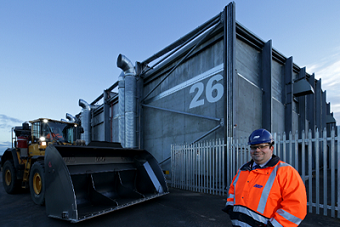
ABP Dry Bulks Manager, Craig Barbour said: “ABP really is leading the way in wood pellet storage in the UK following the £130 million investment in dedicated handling facilities in both Immingham and Hull. A warehouse like this was the obvious next step.

“We thought long and hard about what we wanted from the facility and what we’ve got is a building that can be used to store any dry bulk cargo safely whilst reducing risk to our staff. It’s a great example of best practise and leads the way in terms of industry standards.”

The 50m x 120m warehouse was built by Lincolnshire construction firm A Torn Construction Ltd, and is capable of holding up to 26,000 tonnes of cargo. The building can be easily adapted to store other dry bulk products as it has blanked-off fire doors within retaining walls and the design has eliminated internal ledges to make the cleaning process more efficient when the building is being used for storing biomass.

As well as specialist fire protection measures including an incipient aspirating fire detection system, the warehouse also features internal LED lighting, wireless carbon monoxide and heat monitoring, an expanding foam fire suppression system, smoke extraction capabilities and an internal and external mist air system to control dust.

Craig Barbour continued: “The shed will be used for dry bulk cargoes primarily, supporting ABP’s agreement with Drax and so far it’s performing exceptionally well. It’s a valuable asset and has the best controls available to make sure it’s able to remain operational.

“The LED lighting and improved access points means that productivity has increased without the need to compromise on health and safety.”