
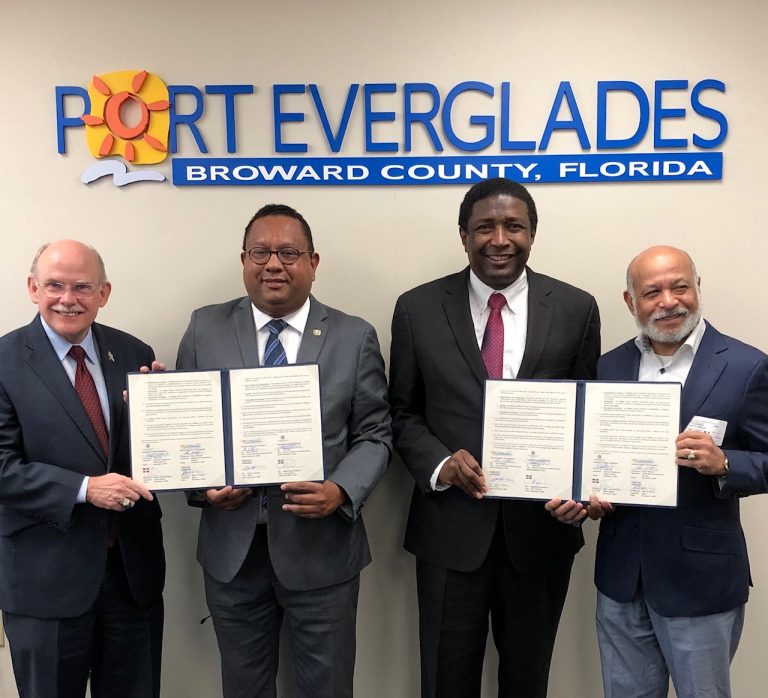
Trade between Port Everglades and the Dominican Republic increased by 6.11 percent in 2018, according to World City’s 2019 Port Everglades Trade Numbers publication. Five years ago, the Dominican Republic ranked as the 5th largest trading partner for Port Everglades, but it has since held the number one position for four straight years. “International trade promotion is a priority for our Port and Broward County for generating economic prosperity in our region,” said Broward County Mayor Dale V.C. Holness, who signed the MOU document along with the Acting Chief Executive and Port Director Glenn Wiltshire on behalf of Port Everglades. “Our port’s trade with the Dominican Republic alone in 2018 reached a record $2.69 billion.” The two parties want to establish an alliance of cooperation aimed at facilitating international trade and generating new business by promoting the sea trade routes between the two countries. The MOU outlines joint initiatives, including marketing activities and market studies, training, and sharing of information on technology, modernisation and improvements. “We value this MOU as transcendental and historic since this is the first time that this institution has signed an agreement with any U.S. port,” said Victor Gómez Casanova, Executive Director of the Dominican Republic Port Authority. “We will immediately take joint actions to continue strengthening relations with Port Everglades and Broward County and accordingly increase the commercial exchange between us.” The MOU was signed by Aníbal Piña, Deputy Director, on behalf of Gómez and witnessed by the Consul General of the Dominican Republic in Miami Miguel Angel Rodriguez. “The Dominican Republic is an important trade partner for Port Everglades and the nation,” said Wiltshire. “Port Everglades ranked as number two among all the nation’s seaports, airports, and border crossings for United States’ trade with the Dominican Republic.” The top Port Everglades import from the Dominican Republic that grew the most in 2018 at 73 percent was electrical supplies and apparatus, mostly automotive circuit breakers and electrical switches, to be the number one ranked commodity. The dominant Port Everglades export to the Dominican Republic was cotton yard for the apparel industry. Port Everglades also ranked number one nationally for cotton yarn exports, accounting for nearly 36 percent of the nation’s total. During Fiscal Year 2019 (October 1, 2018 through September 30, 2019), Port Everglades handled 52,027 TEUs (a standard maritime measurement of 20-foot equivalent units) in trade with the Dominican Republic. Top import commodities included clothing, electric machinery, medical instruments, plastics, fruits, cosmetics, cotton, iron and steel. Top export commodities included clothing, cotton, machinery, cars, plastics, medical instruments, and textiles. Under the agreement, the two parties may also embark on initiatives related to the cruise industry. Port Everglades is the third busiest cruise port in the world. And the Dominican Republic has recently added a new cruise port, for a total of five cruise ports in the country including the popular Amber Cove. The Dominican Republic is the second-largest Caribbean nation by area, and the third by population.
DP World Sokhna to facilitate trade and logistics for Egypt’s new administrative capital
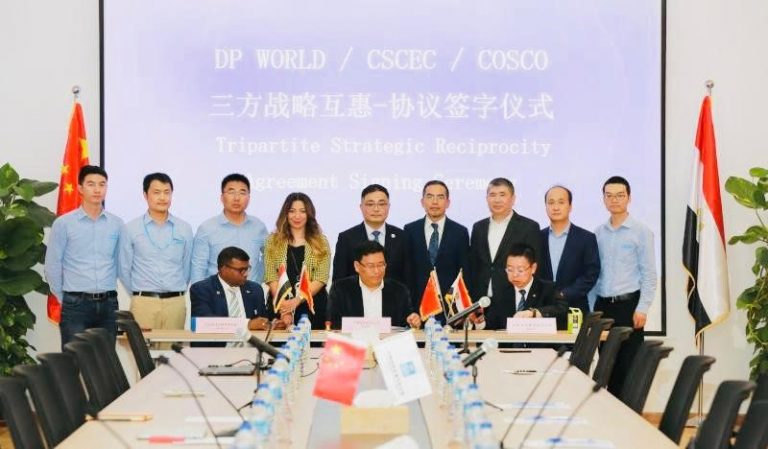
As part of the agreement, CSCEC, the largest construction conglomerate in China and the company in charge of developing the central business and financial district in the new capital, will benefit from Sokhna’s proximity to the new capital and its advanced road and rail links, in addition the Port’s strategic location just below the southern entrance to the Suez Canal, on the Red Sea, a key gateway for Asia, Europe and other international markets. DP World Sokhna already has a dedicated facility for catering existing and future business of CSCEC. Upcoming Basin 2 facility will support the business of CSCEC. Located approximately 50km east of the current capital Cairo, Egypt’s new administrative capital will cover an area of 700km2 and will be capable of accommodating 6.5 million people, when completed. Suhail Al Banna, CEO and Managing Director of DP World Middle East and Africa said: “Our strategic partnership with the China State Construction Engineering Corporation and China Ocean Shipping Company provides the opportunity for DP World Sokhna to expand its role in supporting Egypt’s economy by serving as the exclusive port for all of the central business district’s cargo, and ultimately, companies who will be setting up their operations in the new capital.” Al Banna added: “As a major gateway for Egypt’s trade, we look forward to utilising DP World robust capabilities to handle cargo transiting through the important East-West trade route.” As a driver for economic growth, job creation and urban transformation, the new capital is a $45 billion mega-project and one of the key development projects that are being rolled out by the Egyptian government. Moreover, the government plans to relocate ministries, parliament and civic institutions to the new capital. The signing ceremony was held at CSCEC premises in New Capital near Cairo, and attended by Ajay Singh, CEO of DP World Sokhna, Alia Gammal, Commercial Manager of DP World Sokhna, Chang Weicai, General Manager of CSEC Egypt, Tiang Dong, Vice President of COSCO Shipping Europe GMBH, Lin Ji, Chairman of the Management Board and Fan Jue, Managing Director of COSCO Egypt. DP World Sokhna recently marked its 10th year anniversary by announcing a major expansion through Basin 2, a move which brought DP World’s total investment in Egypt to $1.6 billion. When completed in the second quarter of 2020, Basin 2 will nearly double capacity at the port to 1.75 million TEUs per year.
The European ECCLIPSE project will help ports in the SUDOE region to minimise the effects of climate change on their infrastructures and operations
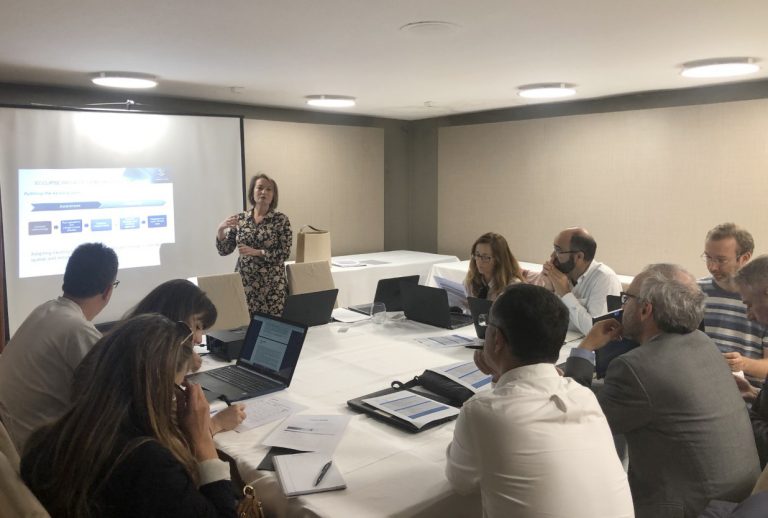
It will also contribute to raising awareness of the impact of climate change and will define transnational strategies for prevention, adaptation and action in the SUDOE region that can minimise their effects. Ports are key elements of the international transport system. Given their location, both their infrastructures and their operations are affected by the maritime climate and by the impact that climate change can have on them, such as new wave conditions, increased sea levels, floods, storms, heatwaves, etc. In this regard, ports in the SUDOE region (southwestern Europe) are faced with the important challenge of adapting to the effects of climate change in the region they are located. Ensuring port operations under these changing conditions requires a deeper understanding of climate change on a local scale to design suitable adaptation strategies, compared to the present models, which, given their global perspective and long-range forecast are not effective for decision-making. The ECCLIPSE project will define a common methodology for analysing the impacts of climate change and its effects on the maritime-port environment. To this end, the main climatic risks will be analysed and it will be identified which infrastructures and operational ones may be affected by these impacts. In addition, climate change scenarios and their local effects on the port environment will be identified. The final step will be to draw up a strategy for adapting to the effects of climate change, including a risk prevention plan and proposal of measures and protocols for action in the event of alerts. The project consortium is made up of the Fundación Valenciaport (coordinator), four technological partners: Spanish Ports Authority, Hidromod, Cerema and the Foundation for Climate Research, and three ports: Valencia, Aveiro and Bordeaux. In these ports, awareness days and pilots of the tools developed will be organised to analyse the main climatic variables affected and their impacts.
Canada Infrastructure Bank invests $300 million in Port of Montreal's expansion project in Contrecoeur
The Canada Infrastructure Bank’s (CIB) financing demonstrates significant support for the expansion of the largest port in Eastern Canada, which must expand its activities to fully participate in national economic growth. This project will enable the port to meet the needs of the market in the coming decades. “This financial commitment demonstrates how the CIB works with the public and private sectors to deliver projects that support economic growth. The Contrecoeur expansion will strengthen and diversify our trade with other countries. Given the Port’s central role in the Canadian economy, this wealth creation will have an impact on the entire country,” said Pierre Lavallée, President and CEO of the CIB. As part of a joint press conference with the Port of Montreal, Lavallée also highlighted the eco-responsibility of the Contrecoeur project. “The CIB is now participating in seven projects. They are in different sectors, different regions, and all have potential for green benefits. Without the Contrecoeur terminal, ships would have to travel to U.S. ports, which would increase GHG and air pollutant emissions,” he indicated.
Competitive advantage
CIB’s support will allow the Port of Montreal to increase its container handling capacity. “We will be more competitive, which will strengthen Montreal’s role as a hub for maritime trade in Eastern Canada. This will support national economic prosperity through job creation and supply chain development,” said Sylvie Vachon, President and CEO of the Port of Montreal. This announcement follows the signing of a memorandum of understanding between the CIB and the Port of Montreal last August. The two organisations collaborated to develop the Contrecoeur project, particularly in terms of financial structure. “Given CIB’s mandate is to attract private investment in projects of public interest, this support validates the national importance of our project and the strength of its structure,” added Ms. Vachon.
Key milestone
The CIB’s financial commitment is a major step forward in the development of the Contrecoeur project. It enables the Port of Montreal to continue working, in collaboration with the private sector, to complete the financial structuring of the project by promoting the fact that the project benefits from a solid financial commitment of 300 million dollars from the CIB. CIB’s financial commitment is a provision of long-term capital to bridge the gap between periods of construction, revenue growth and achieving profitability of the container terminal. The financing of the CIB is a recognition of the transformative nature of the Contrecoeur terminal project. This commitment also illustrates the interest of market players in the project and its potential to attract private investors.
Endorsements
CIB’s financial commitment announcement is supported by Infrastructure and Communities Minister, Catherine McKenna. “Canada must use every tool we have to finance transformative infrastructure that supports sustainable economic growth. The Canada Infrastructure Bank has the expertise and financial heft to help unite the country behind projects that benefit Canadians by strengthening our national economy,” she said. For his part, Transport Minister Marc Garneau pointed out that “Contrecœur’s project is central to the development of the Canadian supply chain and the Greater Montreal’s positioning as a gateway to the North American market. Investing in our key trade infrastructure is essential to grow our economy and provide good jobs for Canadians.”