Monday, December 8, 2025
spot_img
Home Blog Page 425

One year on: Alexandra Dock construction works lay foundation for UK's low-carbon future

0

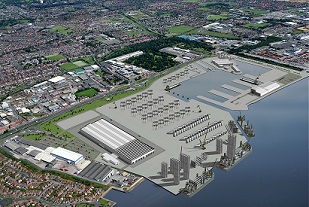
Dry land has breached the water’s surface in the dock for the first time since it was completed 130 years ago, after dredger Eke Möbius pumped one million cubic metres of material from the Estuary into
the dock to infill one third of the water area.

ABP’s project team and engineers working for main contractor the GRAHAM Lagan Construction Group Joint Venture (JV) have also stored sand for use during the seven-hectare reclaim for the new quay. The reclaimed area will be used to store wind turbine components prior to loading onto installation vessels and as well as providing material for the infill activity, the dredged area will improve navigation for the wider Estuary.

In Spring 2016 the dredging of the new berth pockets will begin, which will allow deeper drafted wind installation vessels to come alongside the newly built quay walls.

ABP Head of Projects Humber, Simon Brett said: “This transformative project is already delivering real, tangible benefits to the city and the wider region. We’ve already created jobs and many more will follow, and we are already seeing a renewed pride and confidence in our city and our region.

“I’m very proud to say that this development is currently on time – the deadlines we have all set ourselves are extremely tight and it is import we continue to make positive progress to deliver the scheme to Siemens’ timetable.”

The dredging activity is happening alongside marine piling for the new quay wall, which will feature berths for three installation vessels, as well as the construction of the 60m east lead-in jetty and enabling works on the 25,000-square metre site of Siemens’ offshore service building, which is located in the south eastern section of the dock.

Feature article: Stable year for Japan's Container Ports

0

Last year, the ports of Tokyo and Nagoya experienced slight increases while Osaka and Yokohama reported marginal drops. The port of Kobe continues to rebuild and recover from the devastation caused by the 1995 Great Hanshin Earthquake and happily reports that despite flat traffic at the start of 2015 there are pleasing rises in cargo traffic in April and May with the port recording 7.7% and 2% rises respectively.

Tokyo

  • throughput in 2014: 4,389,854 TEU – up 0.7%
  • port welcomes new service calls
  • new equipment to boost performance

According to the 2014 provisional figures, the Port of Tokyo handled 4,894,511 TEU up 0.7% from 4,860,784 TEU handled in 2013. The port of Tokyo is Japan’s top container port, handling over 20% of the country’s total overseas container traffic. The Port of Tokyo opened on May 20, 1941, as an international trade port. Today, as the international port handling the country’s largest number of foreign trade container units, and as the hub port for domestic maritime shipping, Tokyo has grown to serve as an indispensable lifeline supporting the National Capital Region’s industry and lives of the 40 million residents. The Port of Tokyo Seaside Road forms an important roadway network that helps to revitalise the economy of entire Tokyo, stimulating the development of the Waterfront Urban Subcenter and other waterfront areas and facilitating port distribution. Phase II Tokyo Port Seaside Road opened in February 2012, as a seaside road to form a roadway network that stimulates the development of the waterfront area and facilities port distribution between the terminals and the hinterland of the Port of Tokyo. Decentralisation of traffic has been recognised by subsequent investigation. New container terminals will be constructed in the Outer Central Breakwater Reclamation Area and the New Waste Disposal Area to serve key navigation routes and coastal routes from Asia. In the Outer Central Breakwater Reclamation Area Container Terminal, 2 berths are scheduled to be completed this coming year with a depth alongside of 11m and 16m. The port authority has ordered 3 container gantry cranes (16 rows) and 3 container gantry cranes (22 rows) – both for delivery in 2017 for the new container terminals. Last year, Tokyo welcomed some new services; 2 Asian container service routes, 2 Korean container service routes, 5 Chinese routes and 1 North American route. Other container handling equipment on order are 2 container gantry cranes (20 rows) for the Oi Container Terminal and 1 container gantry crane (13 rows) for the Shinagawa Container Terminal both with delivery scheduled for March, 2016. In April 2015, 3 new container gantry cranes (21 rows) went in service at the Oi Container Terminal.

Yokohama

  • throughput in 2014: 2,880,029 TEU – down 0.3%
  • drop in container traffic expected for 2015
  • modernised Honmoku D4 container terminal started operations


Predictions for container volumes for the port of Yokohama seem to be quite difficult. Over the years, we have seen both huge drops and increases on container throughput. After a surge in container volumes in 2012, the port saw container throughput dwindle to 2.9 million TEU in 2013 – down 5.4% compared to the year before when it handled just over 3 million TEU. For 2014, container throughput dropped slightly by 0.3% as the port tries to maintain its container throughput. The stronger yen also affected Japanese exports as it made Japanese products more expensive in foreign markets. As a result some of the companies moved their production facilities overseas, while distribution centres moved out of the region due to high costs compared to other Japanese ports. Hopes were that container throughput figures for Yokohama in 2014 might be higher but a general slowdown in China – Yokohama’s biggest trading partner – has obviously compromised this. Despite the fact that the country’s ports remain dogged by inefficiencies and high labour costs the port of Yokohama is working hard to defy this image and has modernised Honmoku D4 container terminal which started operations, and will soon be followed by Minami Honmuku MC-3 and MC-4 container terminals. Expectations are that container throughput for 2015 might be considerably lower as a result of the financial crisis in China. In July 2015, the port announced that cargo volumes dropped for the month of June by 5% to 9.67 million tonnes while container throughput dropped 5.3% to 210,069 TEU to the same month in 2014. The port also said that both exports (-4.2%) and imports -6.6%) were down compared to June 2014

Nagoya

  • throughput in 2014: 2,738,244 TEU – up 1.1%
  • investments planned
  • access to East Channel widened and deepened

In 2014, container throughput at the Japanese Port of Nagoya was 2.7 million TEU, growing by 1.1% over the previous year when it handled 2.7 million TEU. With outgoings of 1,376,402 TEU and incomings of 1,361,842 TEU, container trade at the Port of Nagoya shows a good balance. Containerised cargo trade reached 49.35 million tonnes (up 1% compared to the year before). To strengthen international competitiveness and support regional economic activities, a number of investments are planned for the next few years. To improve the accessibility of the port, the width of the East Channel was increased to 580m and dredged to a depth of 16m, the West Channel to a width of 400-540m and depth of 14m, and the Central Channel to a width of 350m and depth of 12-16m. There are 4 container terminals at the Tobishima Pier. The Tobishima Pier South Side Container Terminal opened its first berth in 2005 and its second berth in 2008. These two berths are operated with 6 Super-Post-Panamax quay cranes capable of reaching 22 rows of containers on deck, 24 remote-controlled automated RTGs and 33 AGVs (Automated Guided Vehicles). A third berth is planned adjacent to these 2 berths and total length will be 1,050m with a depth of 16m alongside when it is completed. For geographical reasons, these container berths are equipped with quake-resistant structures. The Port’s hinterland is home to Japan’s automobile industry. Nagoya is the No. 1 automobile exporting port in Japan, shipping approximately 1.5 million completed automobiles. The port also plays a major role as a point of entry to Japan, through its connections with approximately 160 countries around the world.

Kobe

  • Throughput in 2014: 2,596,500 TEU
  • Traffic surge of 10% In December 2014
  • April 2015 recorded 7.7% rise in traffic


Last year, Kobe handled an estimated total of 2.596 million TEU – up slightly at 1.7% compared to 2013 when it handled 2.55 million TEU. The slight decrease in container throughput might be caused by the efforts the port of Busan in North Korea is making in attracting more and more shipping lines that normally would call at Kobe. Both import and export containerised cargo volumes for the port were stable in 2014. In December 2014, the port saw cargo traffic surge 10% from the previous year to 8.357 million tonnes. Of the 8.357 million tonnes, 4.342 million tonnes came from foreign trade – up 2.9% from a year earlier, and the remaining 4.015 million tonnes came from domestic trade, up a huge 19%. Kobe was once Japan’s busiest port, but it is still recovering from the earthquake (and tsunami) that hit Japan in 2011 followed by the radiation leak of the Fukushima nuclear power plant as shipping lines opted to re-route their calls to other Japanese ports. Therefore the government is planning more investments in port infrastructure and equipment over the next couple of years. It has started dredging the channels to a
n overall depth of 16m in order for the port to handle larger container vessels in the future. It has also invested heavily in a container terminal – Rokko Island RC-6/7 and is planning to include STS cranes on berth PC15-PC17 capable of handling 22 rows of containers in the second phase of developing the terminal. In January 2015, container throughput at Kobe increased 0.6% to 201,822 TEU compared to the same month in 2014.

Osaka

  • throughput in 2014: 2,437,550 TEU – down 1.9%
  • domestic container traffic down 9.4%
  • Work on port infrastructure continues


The port of Osaka is Japan’s fifth-largest container port after Tokyo, Yokohama, Nagoya and Kobe.

In 2014, the port saw container throughput slip 1.9% by handling 2.44 million TEU compared to 2.485 million TEU the year before. In the first six months of 2014, container traffic saw an increase of 4.5% to 1.08 million TEU compared to the same period in 2013. The combined volume of international and domestic containers reached 1,216,329 TEU – up 3%. The slight decrease in container flows was contributed to a consumption tax increase in Japan, which might have slow-downed consumer spending, as well as the depreciation of the yen, which has impacted on the purchasing power of Japanese consumers. Osaka exported and imported 2,173,763 TEU – down 0.9% compared to the year before. An additional 263,786 TEU of domestic containers were moved to and from other ports in Japan – down 9.4%. In 2014, the port handled a total of 2.438 million TEU – down 1.9% compared to the year before when it handled 2.4385 million TEU. Osaka Port Corporation – the port operator – was privatised by the policy of Ministry of Land, Infrastructure and Transport in 2011. And, Osaka Port Corporation was integrated with Kobe Port Terminal Corporation in October 2014. This privatisation and integration have resulted in a more flexible management for new business, efficient operations and a better service, making Osaka more competitive on a global scale. Work on port infrastructure continues and the port started the construction work on extending wharf C12 from 400m to a total length of 650m in 2013.

Feature article: Lifting is big business

0

Across the board, the major fork lift manufacturers have now introduced Stage IV / Tier 4 engines in their container handling lift trucks, which can deliver up to 25% fuel saving compared with previous models. And many of the manufacturers assured us that lower fuel usage doesn’t mean a loss of performance. In fact, some have combined a new gearbox to their engines offering a fifth gear – ‘the overdrive gear’ – that reduces engine RPM by around 25-30% whilst keeping the same drive speed. In June 2015, Kalmar, part of Cargotec, unveiled its new K-Motion solution, which is a new drive train system, embedded into the programming of the Kalmar Gloria reach stacker, increasing efficiency and productivity by elevating uptime, ergonomics and safety, while reducing fuel consumption and running costs. The Kalmar K-Motion solution increases precision in both low and high drive speed modes, with the smart control system splitting the power to increase overall drive and lift efficiency. The fine-tuned joystick also delivers more precise driving. As a result, daily operations are made safer, so operators can focus on the tasks ahead and react quickly, avoiding accidents, damaged cargo and driver fatigue. As the less efficient torque converter has been replaced by hydrostatic technology, the throttle works as an actual speed throttle. The combination of hydrostatic and mechanical technologies delivers a more efficient transmission and allows for a down-sized engine. This reduces fuel consumption and exhaust emissions, giving reductions of up to 40% without compromising drive and lift power. So, expect the K-Motion solution soon to be applied to other lift trucks in their range.

Hyster

Hyster continues to play a key role in many port centric operations by offering their full range of materials handling equipment including lower capacity forklift trucks. To reduce operating costs for one of their clients, the container packing station, Packing Center Hamburg (PCH), Hyster carefully adapted their material handling equipment to its specific use. PCH currently uses Hyster H2.5 FT Advance series diesel forklift trucks, Hyster J2.5 XN Advance+ electric lift trucks and a R1.6 reach truck. To save money and energy, the trucks have been equipped with the Duramatch transmission (featured on the Fortens H2.5FT Advance+ trucks), which prevents wheel-spin when accelerating and loading or unloading. This significantly reduces friction, which saves a set of tyres at a cost of around EUR 1,500. Also a device has been installed which automatically switches off the engine if the machines are not used for a two minute period. Like all Hyster products, excellent serviceability is delivered thanks to easily accessible and intelligently designed components say the company. There is a display showing diagnostic service codes, helping to minimise downtime during routine maintenance. Reliable operation of the truck is enabled by the CANbus Communications system, which is used to manage
the electronic systems. Together with depot operator Hamburg Container Service GmbH (HCS), the Hyster Special Engineering Department (SPED) in Nijmegen, the Netherlands, also developed the ‘Checker Device’ for empty container handlers. This innovative solution supports companies by
significantly simplifying the inspection of containers and therefore helping to reduce costs. With the Hyster Checker Device, containers can be firmly locked in place at a height of 1.9m. This allows the checker to inspect the containers thoroughly for damage from all sides. The advantage of this is that the container no longer needs to be set down for inspection, cutting out a stage from the procedure and saving time, which significantly increases operation efficiency. Hyster has also introduced the 5-8 high empty container handler, which promises excellent flexibility and performance for terminal operators faced with an increasing number of empty containers. “As container slot capacity grows worldwide, an increasing number of empty containers are usually expected to fit into the same yard space, quickly,” said Chris van de Werdt, Sales Manager – Hyster Big Trucks. “The result is higher stacks, a significant increase in double handling and an extra shift a day in some cases. The new 5-8 high Hyster empty container handlers are designed and built for the operational needs at terminals looking beyond 2020,” explained van de Werdt. “They are fast and accurate delivering exceptional reliability where equipment availability is operation critical.”

Hyster offers nine different engagement system options on their new H18-23XM-12EC, designed for handling single containers or for the increasing trend of double handling. The machine will stack up to 8 containers (two on six) high and helps to reduce cycle times when loading lorries bringing
two containers down onto a truck, then lifting the top container ready for the next. It is also quick to reduce stack size when high wind speeds are expected.
“We have spreader options that can lift 20′, 40′ or 45′ on 40′ pick-up points easily and quickly, all of them designed to reduce the chance of miss-picks,” van de Werdt said. “We also deliver spreaders capable of lifting 45′ boxes at 45′ pick-up points.” Even at 8 containers high, experienced drivers have extreme confidence in the Hyster empty container handler and are always quick to recommend the machine “because they can perform better, more easily,” van de Werdt added. “They enjoy the speed of response, low noise levels in the comfortable cabin, great visibility, low centre of gravity and great manoeuvrability.”

Konecranes

In April 2015, Sweden-based Konecranes delivered two lift truck to Sri Lanka’s biggest Inland Container Depot – Ace Container terminal. Ace Container terminal is a part of Aitken Spence Logistics, which is a subsidiary of Aitken Spence, one of the largest blue-chip conglomerates in Sri Lanka. With a 15 acre site, the Sri Lankan Inland container terminal shifts and realigns containers with over 500 moves daily. To cope with the ever increasing business and the importance to cater to various trade needs, Aitken Spence Logistics awarded a contract to Konecranes for two new lift trucks – a Reach Stacker and an Empty Container Handler, at the end of last year. The machines are equipped with the latest technology like Truconnect Remote Monitoring Software. Truconnect enables Aitken Spence Logistics to track the real usage of the lift trucksthrough a remote connection. It works through a condition monitoring unit which collects operating and usage data that is then compiled into a report- accessible 24/7. “It enables them not only to track the efficiency of their fleet, but can also save time and maintenance costs in the long run,” said
Andreas Falk, Sales Director Ports and Lift trucks Middle East. “The reports contain information that will prove invaluable in efforts to improve fleet
efficiency, productivity and safety by providing information such as: total fuel consumption; average fuel consumption when the truck is running laden, empty or idling; average fuel consumption per load; top and average speed; load spectrum; travelling distance; and other parameters.” In May 2015, Konecranes delivered its 5,000th lift truck to Cargo Terminal Lehmann, owned and managed by the Hans Lehmann group, a German shipping and ports operations company. This unit was a SMV 4538 CCX4, a reachstacker especially designed for intermodal operations and with capacity to lift wagons, trailers and swap bodies up to 45 tonnes capacity at 1st rail. The machine is one of the latest C generation lift trucks and comes with an all-new Optima cabin, and complies with EU stage 4 engine regulations.

Kalmar

In August, Kalmar announced it secured important contracts to supply mobile equipment to Kazakhstan’s premier in-land dry port, KTZE – Khorgos Gateway. The first contract included two Kalmar DCT80-45E7 empty container handlers and six Kalmar DRT 450 reachstackers while another contract was for seven Kalmar TT 612d terminal tractors t
ogether with ten terminal chassis. All units are expected to be delivered by the last quarter of 2015. KTZE – Khorgos Gateway is a green-field dry port project located on the border of Kazakhstan and China. The dry port, which by its completion in 2018 will reach 580 hectares, is expected to become a significant point of economic growth throughout Kazakhstan, becoming a hub linking cargo between the East and West. In South America, Kalmar has been doing well with orders for forklift trucks. In August, the company received an order from Puerto Central S.A (PCE) in San Antonio, Chile for 24 Kalmar Ottawa T2 terminal tractors and three Kalmar
DCG160-12 forklift trucks. As part of the plan to become one of the largest container terminals in Chile, PCE is building a new multipurpose terminal with a 15m draught, allowing the port to handle Post-Panamax ships. Phase 1 of the project, which will transform Puerto Central into a multi-purpose terminal with a capacity of 1.3 million TEU, has already benefitted from the delivery of seven Kalmar E-One2 rubber-tyred gantry cranes (RTGs) in July 2015. In addition, the terminal operates with eight Kalmar Ottawa terminal tractors. In the same month, Kalmar was awarded a major port equipment order from long-standing customer Sociedad Portuaria Regional de Buenaventura S.A. (SPRBun) as they gear up for growth at their operations in Terminal Especializado de Contenedores de Buenaventura S.A. (TECSA) in Buenaventura, Colombia. The order was for the delivery of 14 Kalmar E-One2 rubber-tyred gantry cranes (RTGs) and six Kalmar forklift trucks. The new equipment is set to compliment an existing fleet of 26 Kalmar Ottawa terminal tractors. In September, Kalmar will deliver its 1,000th DCG90-180 forklift to Norwegian NorSea A/S. The Kalmar DCG90-180 is a mid-range forklift with a lifting capacity of 9 to 18 tonnes. The DCG90-180 carries on a bestselling tradition in what historically is Kalmar’s most successful segment,with over 10,000 forklifts sold, including its predecessors.


Feature article – Finance secured for Offshore Megaport

0

With the completion of the widened and deepened Panama Canal moving closer to the official opening in April 2016, many ports on the U.S. East Coast and in the Caribbean have been working hard to accommodate the anticipated increased number of larger vessels that will sail through the Canal. We have seen major infrastructure investments in ports in the Gulf of Mexico but nobody expected that the Louisiana International Deep Water Gulf Transfer Terminal project (LIGTT) – constructed at the mouth of the Mississippi River – would take off. However, backers of the LIGTT announced at the end of August that they have amassed enough private financing to begin the first phase of the project. Last year, at the PIANC Congress in San Francisco the project was highlighted by a representative of the Bechtel Corporation. Bechtel will play a major role in the project and has already begun pre-construction work for the 250-acre deep-water port.

The company will also provide preliminary services for overseeing the design and permitting of the facility including early procurement and terminal operator integration. But the offshore megaport project – with a size of around 250 acres and located three miles off the coast of Plaquemines Parish, 20 miles south of Venice – between the Port of Houston and Port of New Orleans – was branded as a failure within Bechtel due to the fact it took so long to secure the finance for the project.

Over the last couple of years, Bechtel has promoted the idea of offshore islands for the use of handling cargo – the thought process was merely based on the finance of such a project – it would be cheaper to build the island rather to go through a port expansion project onshore. As a result they have successfully constructed one offshore island off the coast of Africa and the concept has now been brought to the US.

Here the thought process is simple – when the multi-billion dollar Panama Canal project is finished next April it would only be able to accommodate
ships with draughts as deep as 50 feet – 5 feet deeper than what is now available on the lower Mississippi. The offshore terminal will have a water depth of more than 80 feet to accommodate “larger vessels” that are unable to use the new Panama Canal. The mega terminal will become a trans-shipment hub for the region whereby larger vessels are being unloaded and cargo put on shallow draught coastal and river vessels that could navigate to ports upriver or sail to other ports within the Gulf of Mexico.

Finance completed

The full development of LIGTT could take around five years to build at a cost of USD10 billion. The terminal will include facilities to handle containers, dry cargo and liquid bulk including liquefied natural gas (LNG). It has been estimated that if LIGTT reach its proposed
capacity the new hub will create “tens of thousands of jobs.” And although some services at the megaport would be automated, there would be a
need for operations staff that would live offshore at the facility. As a result, it will shuttle works to and from the offshore island with crew boats – like they already do for the offshore oil and gas industry. With the finance in place for the first phase, approval from the U.S. Army Corps of
Engineers and Coast Guard is necessary to begin construction of the offshore island. If approval is granted within an anticipated 9 to 12 month time frame, the first phase could be operational by late 2016. This first phase (out of five) will see the construction of a USD25 million dry bulk transfer terminal with a completion date of the summer 2016. This dry bulk terminal will handle grains, beans, fertilizer and other items. The next step would be to develop a container trans-shipment hub that would compete with neighbouring ports but also with other trans-shipment hubs like the port of Kingston in Jamaica and Freeport Bahamas. Containerised cargo was the original focus of the LIGTT project but input from private sector investors led to changes that involved a broader variety of cargo. Handling of containers remain a very significant part
of the LIGTT vision, hence the hub will be able to accommodate eight 18,000+ TEU container vessel simultaneously in about 36 hours. Currently, no other port in the Caribbean can offer that at the moment and this quick turnaround will be a major attraction for shippers. Wal-Mart, the global retailer that’s most likely to take advantage of the new “Panamax” class cargo ships, has already committed to the project and have been influential in shaping LIGTT. They have already indicated they would be interested in shipping containers through the terminal even if it added time to their delivery, which shows that cargo shippers are willing to add time if it means they can save money with volume.

Concerns

In response to the announcement that the LIGTT is a go, Gary LaGrange, President and CEO of the Port of New Orleans, issued a statement wishing
the project well. LaGrange did point out in the statement that “there are aspects to the overall scope” of its development that could “represent
duplicity” with his port.

“We don’t see the feasibility in duplicating what is already in existence with plans to expand,” said LaGrange. “Louisiana’s present and future container operations are at the Port of New Orleans. Funding of more than USD300 million has been invested in the Napoleon Avenue Container
Terminal, which is served by six class one railroads with a new USD25.1 million intermodal transfer terminal currently under construction. Future plans call for the terminal to be expanded to a capacity of 1.5 million TEU.”

Another port that has expressed concerns for the project, is the Port of South Louisiana – upriver near LaPlace. The port handles the same dry bulk cargo the first phase of LIGTT intends to transfer. Paul Aucoin, president of the port, said he supports “any idea that sends more ships that can fit under the Huey P. Long Bridge” to his facility. Aucoin was more uncertain as to whether there would be an interest among cargo carriers to
send larger ships to the mouth of the Mississippi. “Most cargo is time-sensitive,” said Aucoin. “I can’t see why they would go through a transfer to get to the five ports on the lower Mississippi that they’re already servicing.” Although finance has been put in place for the first phase – without the approval (yet) from the U.S. Corps of Engineers – and an overwhelming response from the industry, financial backers of the project are confident
that the five phases will be built within the set timeframe. But there is a fly in the ointment. The U.S. Corps of Engineers that have to approve the plans has been studying the feasibility of a potential USD300 million dredging project to deepen the lower Mississippi River by as much as 5 feet compared to the USD10 billion to build the offshore island.