Thursday, December 11, 2025
spot_img
Home Blog Page 429

Will cracks in locks delay opening of Panama Canal?

0

The consortium behind the expansion of the Panama Canal believes that cracks found in the third set of locks will not delay the inauguration of the extended waterway planned for April 2016.

“The GUPC has given verbal indications that the finalisation date is still April 2016, as planned,” the ACP said in a statement, adding that it expected to receive formal notification of what caused the fissures.

The multi-billion-dollar canal expansion was originally due to be completed by 2014 but delays and disputes between the GUPC and the ACP over cost overruns from the original USD5.25 billion price tag have pushed back the date.

Autonomous truck platooning technology to boost port productivity

0

Autonomous truck platooning technology, which comprises one human-driven truck with one or more driverless trucks following behind, will help alleviate the shortage of manpower in the trucking industry and raise productivity with more cargo transported per driver. By shifting more haulage activities to off-peak hours, this can also help improve traffic flow during peak periods. This will help the trucking industry meet the increased demand for container haulage between the different port terminals and ultimately, other truck movements island-wide.

With the signing of the MoU, MOT and PSA will be issuing a request for proposals (RFP) by December 2015 to design and carry out autonomous truck platooning trials over a three-year period. Two proposers will be shortlisted to demonstrate their technology during the first stage, before one of the two is selected to trial its technology at the designated route in Singapore.

The trials will initially involve inter-terminal haulage between Brani Terminal and Pasir Panjang Terminals. A 10km long test route along West Coast Highway has been identified for this purpose. The technology may eventually be scaled up for haulage within the port area, as well as between Pasir Panjang Terminals and Tuas Port.

Permanent Secretary for Transport Pang Kin Keong, who is Chairman of the Committee for Autonomous Road Transport in Singapore (CARTS), said, “As Singapore’s maritime sector continues to grow and container volumes increase, the need for efficient inter-terminal and inter-port haulage has never been greater. Autonomous truck platooning technology can enable us to make a quantum leap in productivity in the port sector, while addressing the shortage of drivers in the trucking industry and adding value to their jobs.”

Ong Kim Pong, Regional CEO Southeast Asia of PSAInternational said, “PSA is pleased to partner the Ministry of Transport on a  project that underlines our commitment to doing things better through innovative technologies. As we continue the development of our terminals at Pasir Panjang and plan for future terminals at Tuas, autonomous truck platooning will enable PSA to serve our customers better through increased port and inter-terminal productivity.”

Nigerian Ports Authority advocates for improved port infrastructure to facilitate export

0

He however pointed out that other factors which might be extraneous to the Authority are also critical towards achieving enhanced export activities in the nation’s seaports.

Stressing that the provision of appropriate port infrastructure was necessary to enhance trade in the economy, Malam Habib assures that the Authority would encourage any effort designed to change the trade orientation of the nation from import dependent to export.

The Managing Director was speaking through the General Manager Capital Project, Engr. Rufai Mohammed in a paper titled “Providing Enabling Port
Infrastructure to Enhance Trade” at the just concluded two day International Seatrade and Investment Convention (ISIC) 2015, under the theme “Exploring New Trade Frontiers.”

He reiterated that as globally accepted seaports accounts for over 80 per cent by volume of International trade and commerce, emphasising that for a seaport to be competitive, it must have a robust infrastructural base amongst other requirements.

He argued that with the major infrastructural improvements embarked upon by the Authority in its ports and harbour in all its four pilotage districts, coupled with the impending 25 year port master plan which has reached an advanced stage, the Organisation is being positioned to properly meet the demand of all categories of port users for both imports and exports. Malam Habib explained that mindful of the Federal Government determination of delivering an efficient port system for the overall good of the nation’s economy, the Authority was consolidating and entrenching the gains of the port reform by facilitating and synergizing the activities of the Private Terminal Operators, Shipping Lines, Freight Forwarders and other stakeholders, as well as improving the existing port infrastructure.

The Managing Director who enumerated a number of completed and on-going capital projects embarked upon by the Authority explained that the projects were meant to add efficiency to the nation’s seaports as well as to make the system competitive, effective and user friendly.

“Sustained efforts at providing the enabling port infrastructure has impacted on the overall port operational efficiency”, he added.

In his goodwill message at the opening ceremony of the convention, the Managing Director had commended the conveyors of the event, being the first of its kind in nation’s maritime industry for their fore-sight and said the event would not have come at a better than now “as the nation strives to promote export trade, in that way changing the orientation of our nations sea trade which is import dependent”.


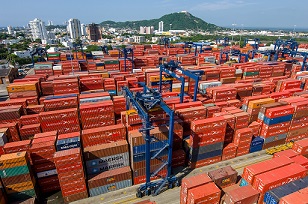
Cargotec's Kalmar receives significant port equipment order of 23 RTG cranes and 79 terminal tractors from Colombia

0

Both terminals are owned and managed by Port of Cartagena
Group. The order includes a total of 23 rubber-tyred gantry cranes (RTGs) and 79 Kalmar Ottawa T2 terminal tractors. Kalmar will deliver five RTGs and 9 terminal tractors to SPRC and 18 RTGs and 70 terminal tractors to Contecar. The total value of the order is approximately EUR 45 million, and the order has been booked into Cargotec’s 2015 third quarter order intake. The deliveries will take place between July and December 2016.

SPRC and Contecar have a long partnership with Kalmar, with an existing fleet of two ship-to-shore cranes, 49 Kalmar E-One2 RTGs, 92 terminal tractors, 22 reachstackers and two lift trucks in operation at their terminals. The latest order is part of SPRC and Contecar’s master expansion plan, in keeping with their growing throughput and further enhancing their position as the leading terminals in the Caribbean region. From their current volumes of 1,400,000 and 3,200,000 TEUs annually, the terminals are anticipating a rapid growth of 5 to 7% at SPRC and 8 to 11% at Contecar
over the next five years.

Eduardo Bustamante, Operations Manager at SPRC and Contecar commented; “Our relationship with Kalmar dates back to 1997. With a proven record of true partnership and an order of this scale, there was no one else we would rely on. Our main challenge over the next few years is how to manage the rapid growth while remaining focused on serving our customers during the transitions resulting from growth. Kalmar has support us as a reliable partner consistently delivering value through quality products and support. We expect to continue to achieve improved levels of productivity at lower operating costs with Kalmar equipment. We are also considering partially automating our RTG operations, so Kalmar, being the leader in this field, was a natural choice for us.”

Kalmar is providing SPRC and Contecar a specially designed battery powered electrical air conditioning system for terminal tractors to improve the
operator environment and reduce the impact on the environment with lower emissions and reduced noise. The expected saving in fuel costs is 30%. The terminals will also implement Kalmar SmartPath tracking system on the new terminal tractors after delivery. Kalmar SmartPath improves efficiency by using location-based job assignments. Equipment is automatically assigned to the closest job, which reduces driving distances and fuel consumption, and speeds up the operations.

Dan House, Managing Director, Latin America, said: “SPRC operates with one of the largest Kalmar RTG fleets globally and this
agreement further demonstrates the importance of long-term partnerships where continuous support remains paramount in maintaining efficient terminal operations. The RTG cranes will come prepared for future remote control and semi-automation features, which will be added in the near future. We are also delighted that SPRC and Contecar chose the new generation Kalmar Ottawa T2 terminal tractor, which was introduced to the market last year. This is the largest single order for T2 in South America.”